Clear Sky Science · en
Effect of devulcanized reclaimed rubber content on structure, mechanical properties, and thermo-oxidative aging behavior of ethylene-propylene-dien-monomer (EPDM) rubber
Why old rubber still matters
Every year, vast amounts of rubber from seals, hoses, roofing, and tires end up as waste because the very process that makes rubber tough and elastic also makes it hard to recycle. This study looks at a promising way to give one common rubber, EPDM, a second life. By carefully breaking and reforming some of the tiny links that hold the material together, the researchers explore how much recycled EPDM can be mixed into new products without sacrificing safety, durability, or performance. Their findings point toward more sustainable rubber parts in cars, buildings, and industry, with less material sent to landfills or burned as fuel.
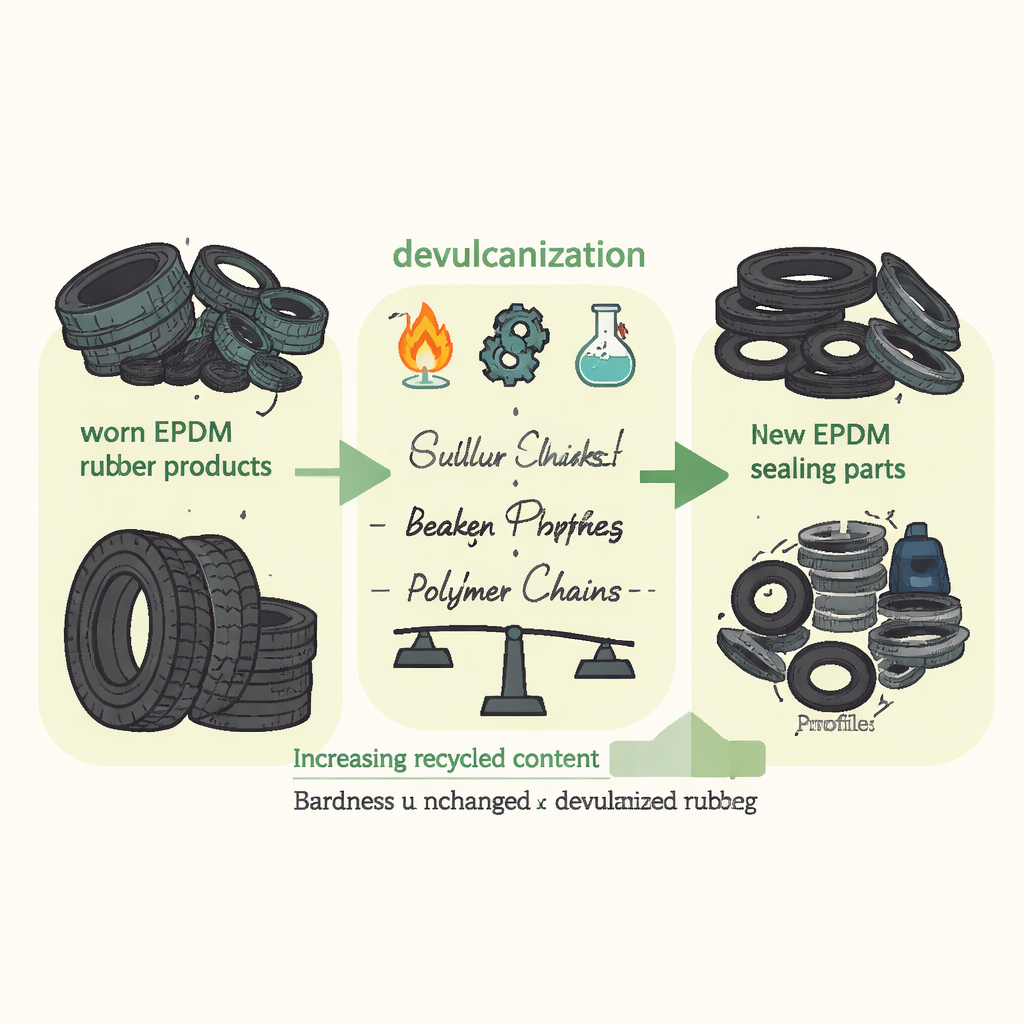
Turning worn rubber back into a useful ingredient
EPDM rubber is widely used because it resists heat, ozone, and weathering better than many other elastomers. Once it is “vulcanized” – chemically crosslinked to form a three-dimensional network – it becomes strong and elastic but very hard to melt down and remake. The team worked with “devulcanized” EPDM, where many of the sulfur-based links between chains have been selectively cracked while leaving the main polymer backbone mostly intact. This reclaimed material still contains polymer, carbon black, oils, and mineral fillers. The researchers mixed it into a standard EPDM sealing compound at four levels: none (a virgin reference), 20%, 40%, and 60% devulcanized rubber. For the highest level, they also tried a modified recipe that cut back on carbon black and softener to compensate for what the recycled material already brings in.
How adding recycled rubber changes structure
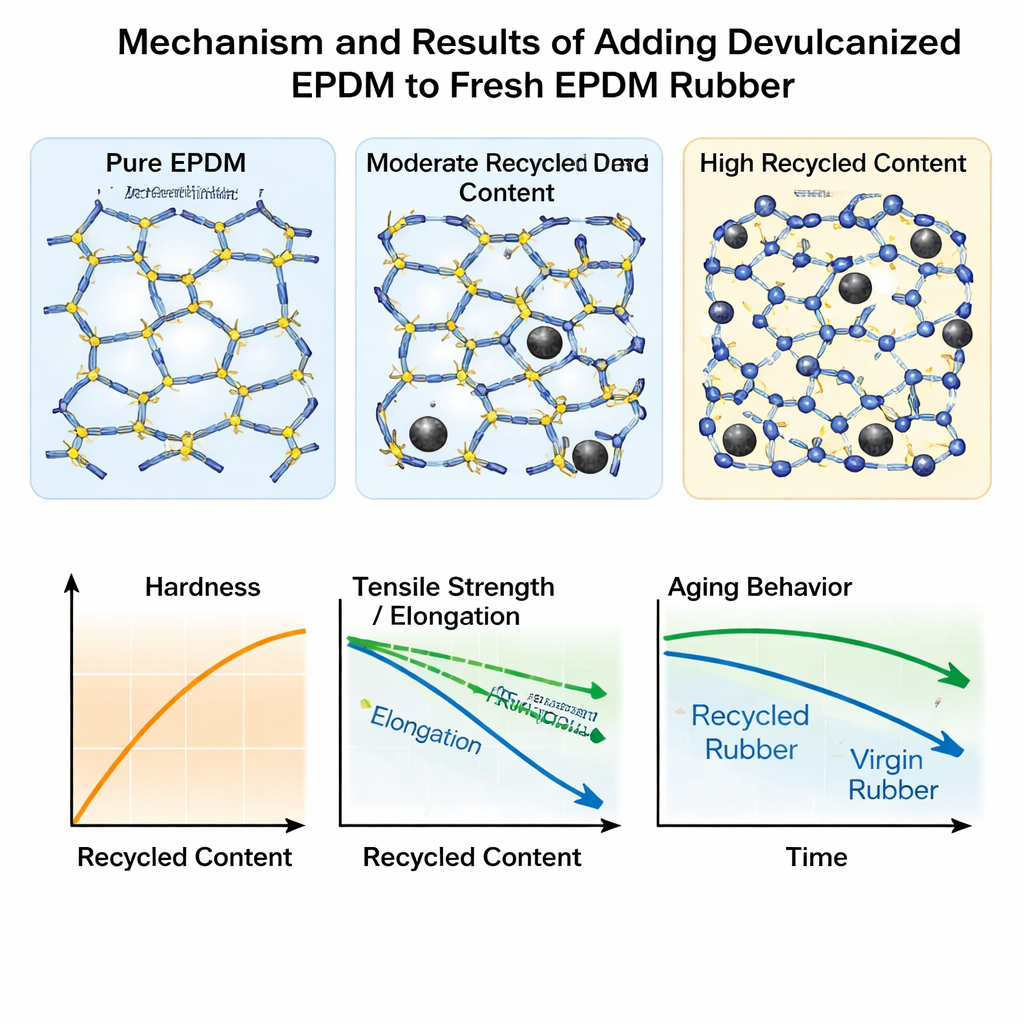
To understand what happens inside the rubber, the authors used a suite of techniques that track how the network forms and ages. Curing tests, swelling experiments, temperature‑dependent stress relaxation, low‑field NMR, and a freezing‑point method for trapped solvent all probe how tightly the chains are tied together. Most of these methods agreed that adding devulcanized EPDM raises the overall density of links in the network, mainly because the recycled material still carries reactive sulfur and partially broken bonds that can form new bridges during re‑curing. However, one technique – based on how the presence of the rubber shifts the freezing point of a solvent – suggested that at high recycled content the average spacing between links actually grows. The authors propose that this discrepancy may reflect a more complex mix of long, flexible sulfur bridges and shorter, stiffer ones in the recycled-rich compounds, and that not all methods “see” this structure in the same way.
From lab tests to real‑world performance
Mechanical tests revealed a clear trade‑off as more devulcanized EPDM was added. Shore A hardness, a simple measure of how firm the rubber feels, climbed steadily with recycled content, reflecting a stiffer, more tightly bound network with abundant filler. At the same time, tensile strength, tear resistance, and elongation at break dropped, especially at the 40% and 60% levels. Microscopic irregularities in how the new and old rubber regions connect, uneven crosslinking, and partially damaged chains create “weak spots” where cracks can start and grow. The modified 60% recipe, with reduced carbon black and oil, softened the material slightly and improved its ability to stretch compared with the unadjusted 60% blend, while keeping most properties in a similar range. This shows that smart formulation can partly offset the drawbacks of heavy recycling.
What happens as the rubber ages
Durability is just as important as initial strength for seals and gaskets that may sit in hot, oxygen‑rich environments for years. To mimic long‑term service, the researchers aged all compounds for up to six weeks at 70 °C and 100 °C, and for equivalent shorter times at 125 °C. They tracked changes in chemistry, stiffness, strength, stretchability, and elasticity. As expected, aging led to more crosslinks and some chain breakage in every material. Yet the devulcanized‑containing compounds did not age faster than the virgin reference; in many cases, their loss of strength and flexibility was comparable or even slightly less severe. Infrared spectra and crosslink measurements showed that the network gradually shifts from longer, more mobile sulfur bridges toward shorter, more rigid ones, but this shift did not cause dramatic extra embrittlement in the recycled blends. The adjusted 60% recipe sometimes behaved unusually well, hinting that recipe tuning can improve both initial performance and aging resistance.
What it all means for greener rubber
For non‑specialists, the main message is that EPDM rubber made with a substantial fraction of carefully devulcanized material can still perform respectably, especially if the recipe is adjusted to account for the extra fillers and reactive sulfur it carries. More recycled content makes the rubber firmer but less stretchy, and very high levels still bring a noticeable hit in strength. However, the recycled blends do not fall apart faster when exposed to heat and oxygen; they age at roughly the same pace as conventional EPDM. This suggests that, for many sealing and cushioning uses where extreme mechanical performance is not critical, manufacturers can safely replace a sizable share of virgin rubber with reclaimed EPDM, cutting waste and resource use while maintaining long service life.
Citation: Leng, Y., Spanheimer, V., Katrakova-Krüger, D. et al. Effect of devulcanized reclaimed rubber content on structure, mechanical properties, and thermo-oxidative aging behavior of ethylene-propylene-dien-monomer (EPDM) rubber. Sci Rep 16, 6350 (2026). https://doi.org/10.1038/s41598-026-36961-w
Keywords: EPDM rubber, devulcanization, rubber recycling, material aging, sustainable polymers