Clear Sky Science · en
Optimization based load forecasting and demand management in smart building microgrids with Greylag Goose and Bi level graph models
Why Smarter Buildings Need Smarter Energy Brains
As homes, offices, and campuses add solar panels, batteries, and electric vehicles, managing energy becomes surprisingly tricky. Buildings must constantly decide when to draw power from the grid, when to charge or discharge batteries, and how to avoid waste and blackouts. This paper presents a new “energy brain” for smart building microgrids that predicts electricity use with high accuracy and plans battery use so carefully that it can more than double battery life.
Keeping the Lights On in a Complex Mini-Grid
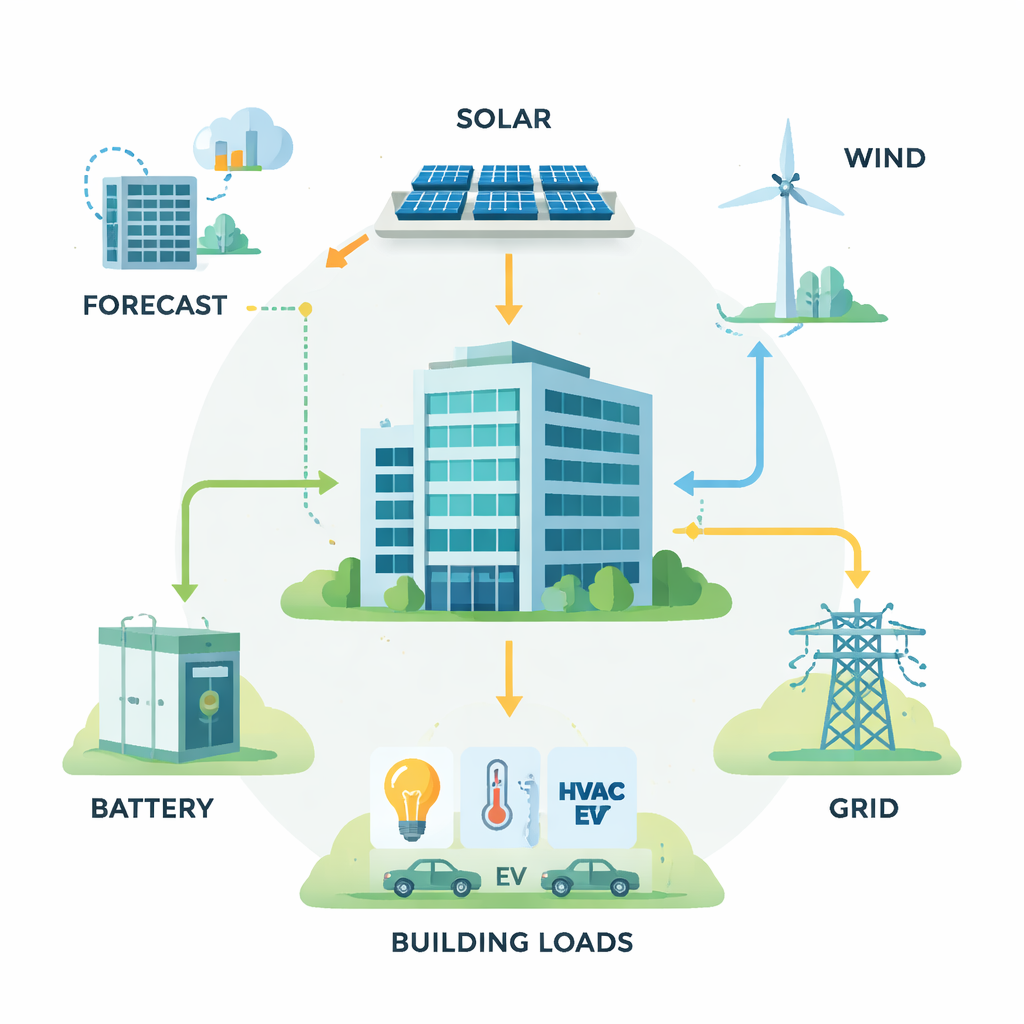
A smart building microgrid is like a tiny power system wrapped around a single site. It may include rooftop solar, small wind turbines, batteries, electric vehicles, and a connection to the main grid. The building’s energy manager must match supply and demand every few minutes, even as sunlight changes, people come and go, and batteries age. If forecasts are off, the building may buy expensive peak power, waste renewable energy, or wear out batteries faster than expected. The authors focus on two key goals: predicting short-term energy demand in such buildings and using that knowledge to operate batteries in a way that cuts both costs and wear.
Cleaning the Data Before Making Predictions
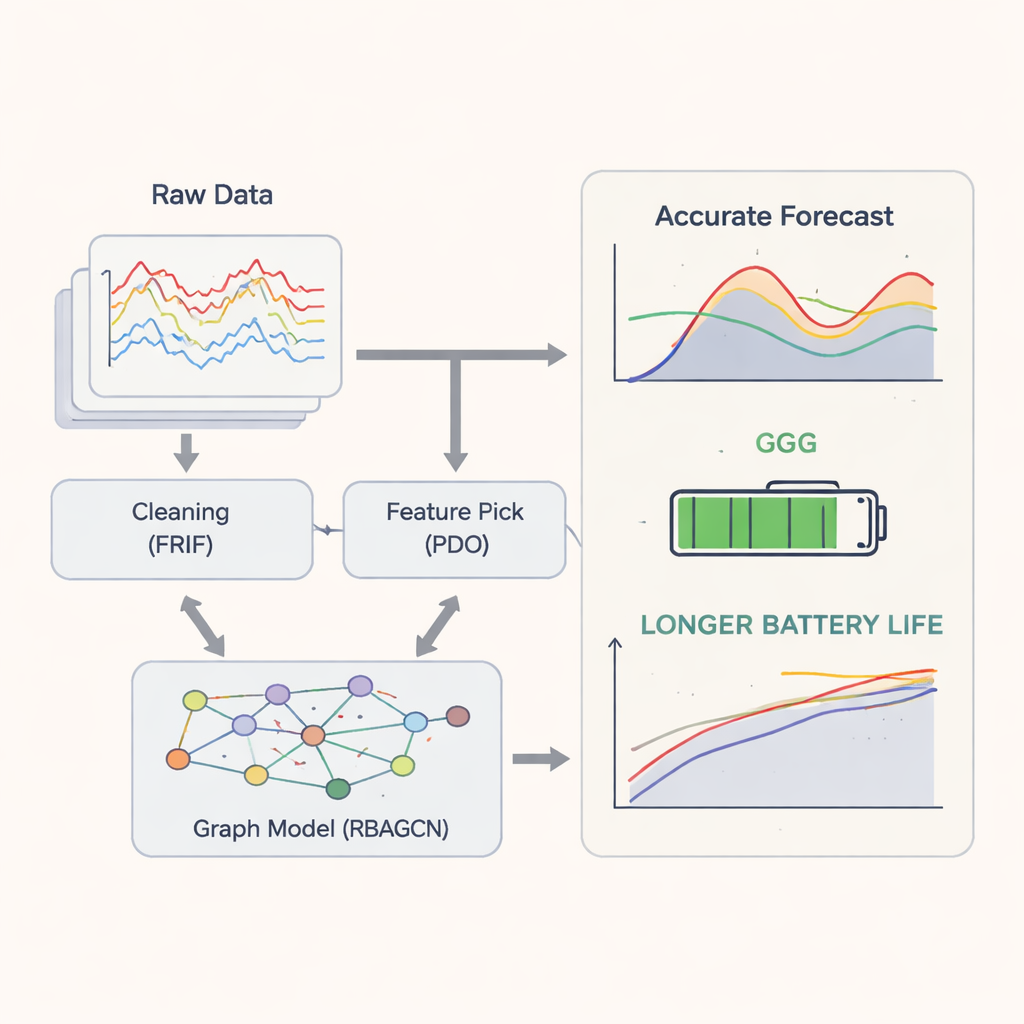
The system starts with a year of detailed measurements from a real smart building microgrid in India. Every five minutes, sensors recorded grid currents and voltages, solar output, battery behavior, and weather conditions such as temperature, humidity, and wind speed. Real-world data are messy: sensors fail, readings jump, and different quantities use different scales. To fix this, the authors apply a specialized cleaning step called Fast Resampled Iterative Filtering, which smooths out noise while keeping real swings in demand. Then they use a nature-inspired search method, Prairie Dog Optimization, to decide which sensor readings actually matter most for prediction. It settles on five core inputs—such as solar voltage, battery discharge power, and time of day—removing redundant signals that add complexity but little new information.
Teaching a Network to Read the Energy Web
Instead of treating each measurement as an isolated time series, the authors model their interactions as a network. In their Relational Bi-Level Aggregation Graph Convolutional Network, each node in the graph represents one of the key features (for example, temperature or battery discharge power), and the links represent how strongly they influence one another over time. The model first learns local patterns, like how solar voltage and battery power move together over a short window, and then builds up global patterns that capture daily cycles and broader relationships. By combining these layers, the system sees not just when demand changes, but how that change is tied to sun, temperature, and battery use, improving its ability to predict upcoming loads.
Borrowing a Flight Pattern from Geese
To tune this graph model, the authors use another bio-inspired method, Greylag Goose Optimization. In nature, geese in V-formation constantly adjust their positions to save energy and stay on course. In this algorithm, each “goose” represents a possible set of model settings, such as learning rate and internal weights. During training, these virtual geese explore and refine their positions, seeking combinations that yield the lowest forecasting error without getting stuck in poor local solutions. This adaptive tuning helps the model remain stable even when building loads are highly irregular, such as sudden spikes from electric vehicle charging or drops during unoccupied hours.
Sharper Forecasts and Longer-Lasting Batteries
Tested against several popular deep learning and hybrid methods, the new framework reaches about 98.3% average forecasting accuracy, versus roughly 80–92% for the best alternatives. Its error measures are less than half those of competing models, and its predictions are more consistent from run to run. When the resulting forecasts are used for battery-aware scheduling, the building can keep demand within an efficient range and avoid deep, stressful charge–discharge cycles. The simulations suggest that this more careful control can more than double the time a battery stays above 80% of its original capacity, turning better prediction into real hardware savings.
What This Means for Everyday Energy Users
For laypeople, the key message is that better “digital planning” inside a building can translate directly into lower bills, fewer grid disturbances, and longer-lasting batteries and equipment. By cleaning sensor data, focusing on the most informative signals, modeling how they interact, and tuning the model intelligently, the proposed approach gives building microgrids a much clearer view of the near future. That clarity, in turn, allows smarter choices about when to store, use, or sell electricity, moving us closer to reliable, low-carbon buildings that quietly manage their own energy behind the scenes.
Citation: Ahamed, B.S., Dhanya, D., Sivaramkrishnan, M. et al. Optimization based load forecasting and demand management in smart building microgrids with Greylag Goose and Bi level graph models. Sci Rep 16, 6386 (2026). https://doi.org/10.1038/s41598-026-36960-x
Keywords: smart building microgrids, load forecasting, battery degradation, energy management, graph neural networks