Clear Sky Science · en
Biological welding enables rapid and efficient bladder cystotomy closure and reveals the underlying repair mechanism
Sealing a Leaky Bladder with “Biological Welding”
When the bladder tears—after trauma, surgery, or disease—repairing it is delicate, time‑consuming work. Surgeons must carefully stitch the organ closed while trying to prevent bleeding, infection, and urine leakage. This study explores a new tool called biological welding, which uses controlled bursts of electrical energy to seal tissue. The researchers asked a simple question with big implications: can this approach make bladder repair faster, safer, and gentler than traditional stitches?
A New Way to Close Internal Wounds
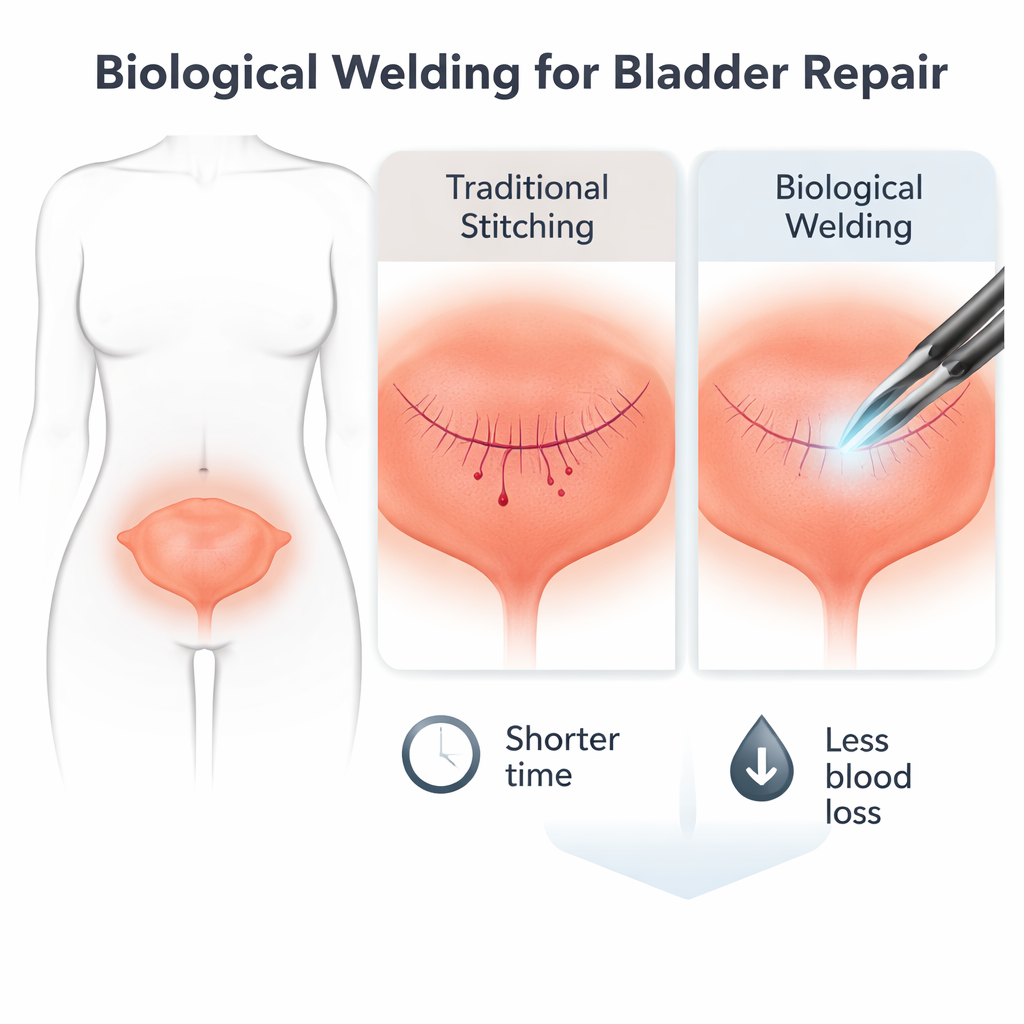
Biological welding combines cutting, stopping bleeding, and fusing tissue into a single device. Instead of passing a needle and thread through the bladder wall, the surgeon presses special forceps across the cut and delivers short pulses of high‑frequency current. The energy briefly heats and compresses the tissue, causing nearby cells and structural proteins to bond together and form a sealed seam. Earlier work suggested this technique could shorten operations and reduce blood loss in other types of soft‑tissue surgery. However, it had not been systematically tested for bladder repair, where any leak of urine into the abdomen can be dangerous.
Testing the Method in a Realistic Animal Model
To put the technique to the test, the team created controlled bladder tears in 32 adult Beagle dogs—an established large‑animal model that resembles human bladder surgery in size and tissue behavior. Half of the animals had their bladders repaired with standard absorbable stitches, while the other half received biological welding with a preset electrical energy range. The surgeons measured how long each operation took, how much blood was lost, and whether the repaired bladder could withstand pressure without leaking. They also followed the animals for weeks, checking blood and urine tests, examining the bladder’s inner and outer surfaces, and studying tiny tissue samples under the microscope.
Faster Surgery, Less Blood, Fewer Early Problems
The welded bladders held up just as well as the stitched ones: in both groups, the repaired sites withstood pressures roughly twice as high as normal bladder pressure without leaking. Where the techniques differed was in efficiency and side effects. Operations using biological welding were about three times faster than traditional suturing, and blood loss during the repair was reduced by almost 80 percent. Within the first hour after surgery, urine from the welded group was pale yellow, while the stitched group often showed blood‑tinged urine. Over the first week, animals that received welding had far fewer red blood cells in their urine and showed lower levels of white blood cells and neutrophils in their blood—signs that the body’s inflammatory response was milder.
How the Bladder Heals Under the Surface
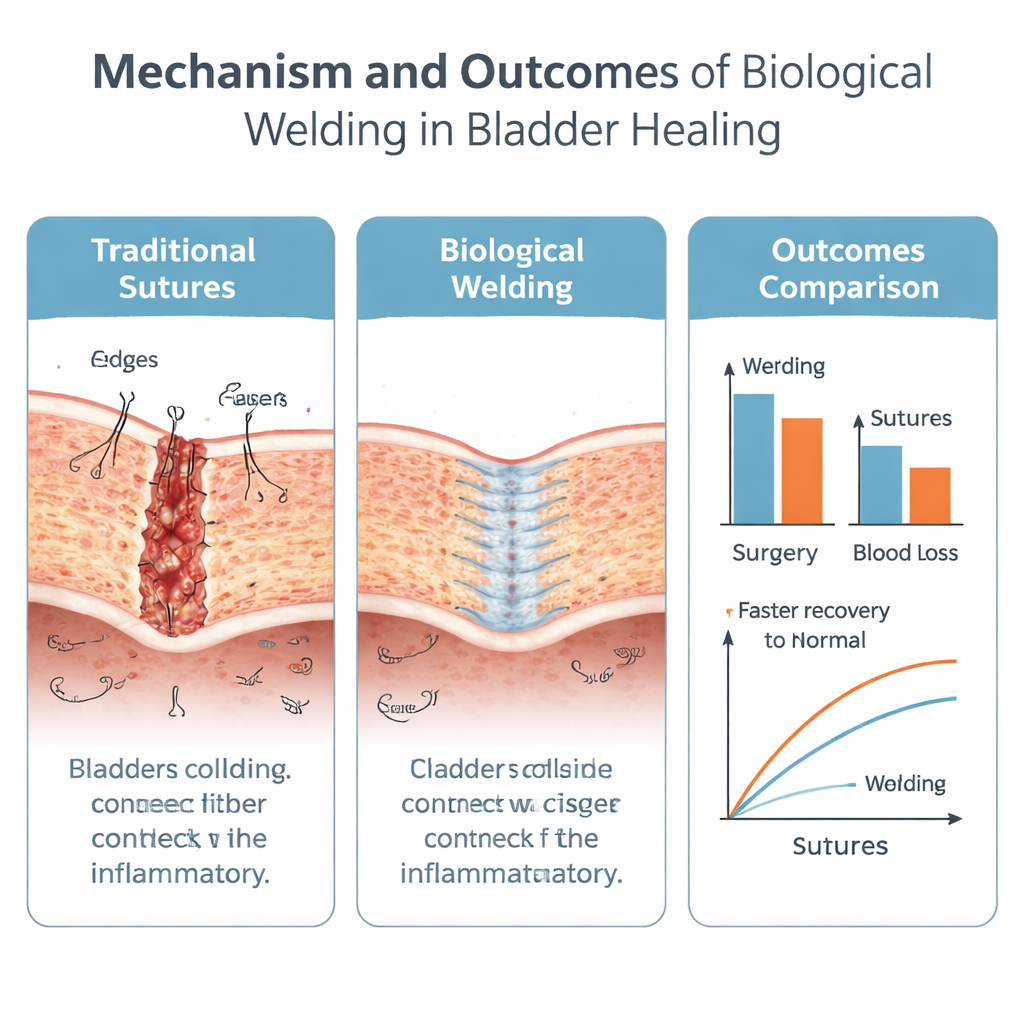
Microscopic examinations revealed how these benefits arise. Immediately after welding, the bladder’s inner lining on either side of the cut was pressed tightly together, forming a continuous layer, though there was mild heat‑related injury in the outer membrane. Over the next weeks, welded sites showed rapid growth of new supporting cells and blood vessels, and the repair region gradually became hard to distinguish from surrounding tissue. Sutured sites, by contrast, contained residual stitch material for weeks, more scattered inflammatory cells, and looser, less orderly regrowth of the muscle layer. Advanced Raman spectroscopy—a light‑based technique that detects molecular fingerprints—showed earlier increases and better organization of collagen and related proteins in welded tissue, consistent with a stronger, more orderly scar.
Zooming In on the Body’s Repair Programs
The researchers also examined which genes were switched on or off during healing. Both techniques activated immune‑related genes and signaling pathways soon after surgery, as the body launched a repair response. However, biological welding triggered a smaller and shorter‑lived wave of gene changes. By 12 weeks, welded bladders had fewer genes still behaving abnormally than stitched bladders, suggesting that the tissue had returned to a more normal state sooner. Some gene networks linked to immune activity and tissue remodeling were uniquely or more modestly engaged by welding, hinting that the technique nudges the body toward brisk but self‑limiting repair instead of prolonged inflammation.
What This Could Mean for Future Patients
For non‑specialists, the take‑home message is straightforward: in this animal study, biological welding closed bladder tears just as securely as stitches, while dramatically shortening surgery time, cutting blood loss, and softening the body’s inflammatory reaction. The welded bladders healed smoothly, with fewer adhesions and earlier normalization of tissue structure and gene activity. Although more research is needed in more complex injury models and eventually in human patients, this work suggests that a carefully controlled “electric seal” may one day help surgeons repair the bladder—and possibly other organs—more quickly and gently than with needle and thread.
Citation: Zeng, F., Chen, Y., Guo, M. et al. Biological welding enables rapid and efficient bladder cystotomy closure and reveals the underlying repair mechanism. Sci Rep 16, 7590 (2026). https://doi.org/10.1038/s41598-026-36959-4
Keywords: bladder repair, biological welding, surgical innovation, tissue healing, urology