Clear Sky Science · en
Testing the causal relationship between interpersonal closeness and inter-brain synchrony
Why our brains may sync up when we talk
Imagine chatting with a friend and feeling like you are "on the same wavelength." Neuroscientists have taken that phrase literally, discovering that people’s brain activity can become synchronized during conversation. But is this brain-to-brain synchrony a special sign of emotional closeness, or does it simply reflect the fact that two people are interacting at all? This study set out to tease those possibilities apart by asking whether deliberately making strangers feel closer would actually change how much their brains sync up.
Turning strangers into almost-friends
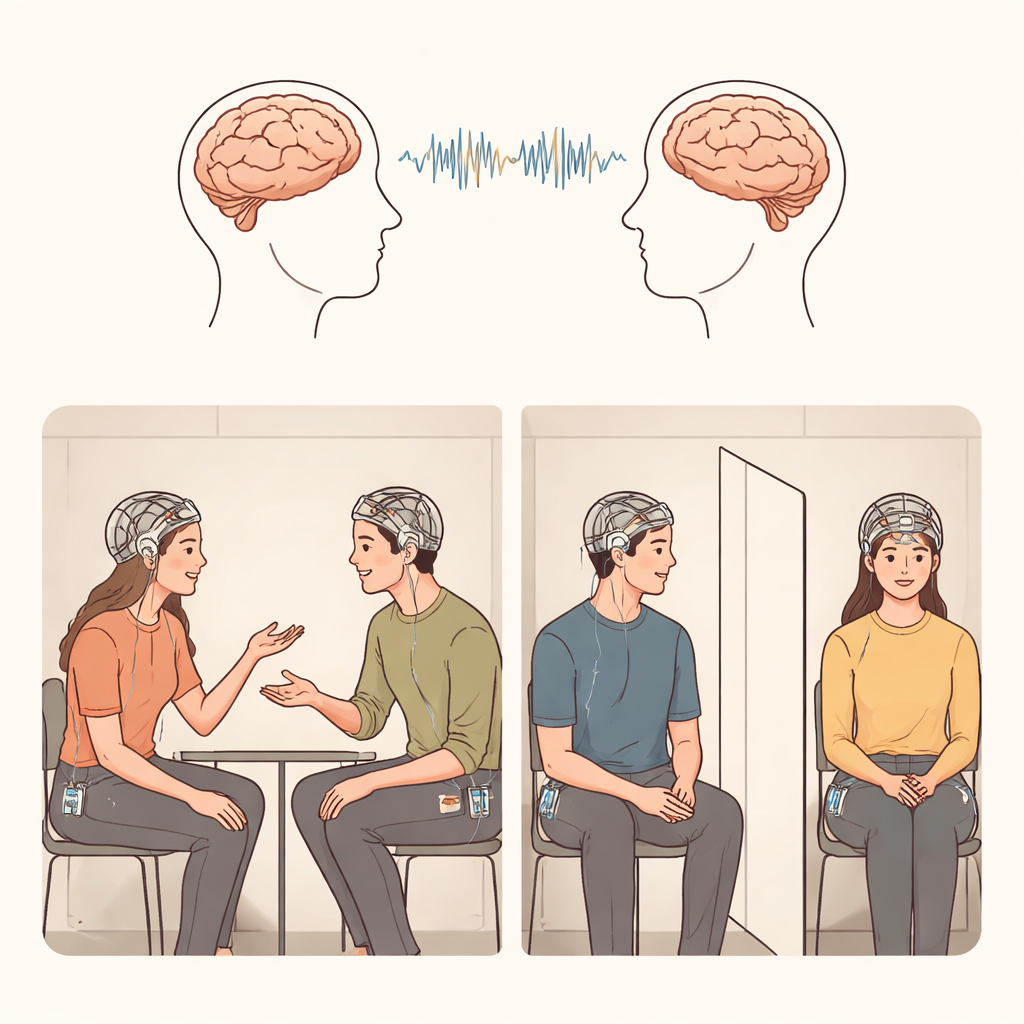
To test this, the researchers recruited 123 pairs of young adults who did not know each other beforehand. Each pair was randomly assigned to one of three situations. In one, they sat quietly and thought about answers to bland questions without speaking or seeing each other. In another, they engaged in light small talk using the same superficial questions. In the third, they went through a well-known "Fast Friends" exercise: a guided, 24‑minute conversation built from increasingly personal questions designed to make strangers feel emotionally closer. Before and after, participants rated how close, similar, and warm they felt toward their partner.
Listening in on paired brains and bodies
While pairs took part in these situations, each person wore a mobile EEG cap, which measures tiny electrical signals from the brain. The team focused on how much the rhythms in one partner’s brain lined up in time with those of the other—a measure called inter-brain synchrony. They looked at several frequency bands, including very slow delta waves (1–4 cycles per second) and somewhat faster alpha and beta waves. At the same time, video cameras recorded body movement. Using motion-analysis software, the researchers quantified how closely each pair’s gestures and posture changes rose and fell together over time—what they called motor synchrony.
Closeness changes feelings, not shared brain waves
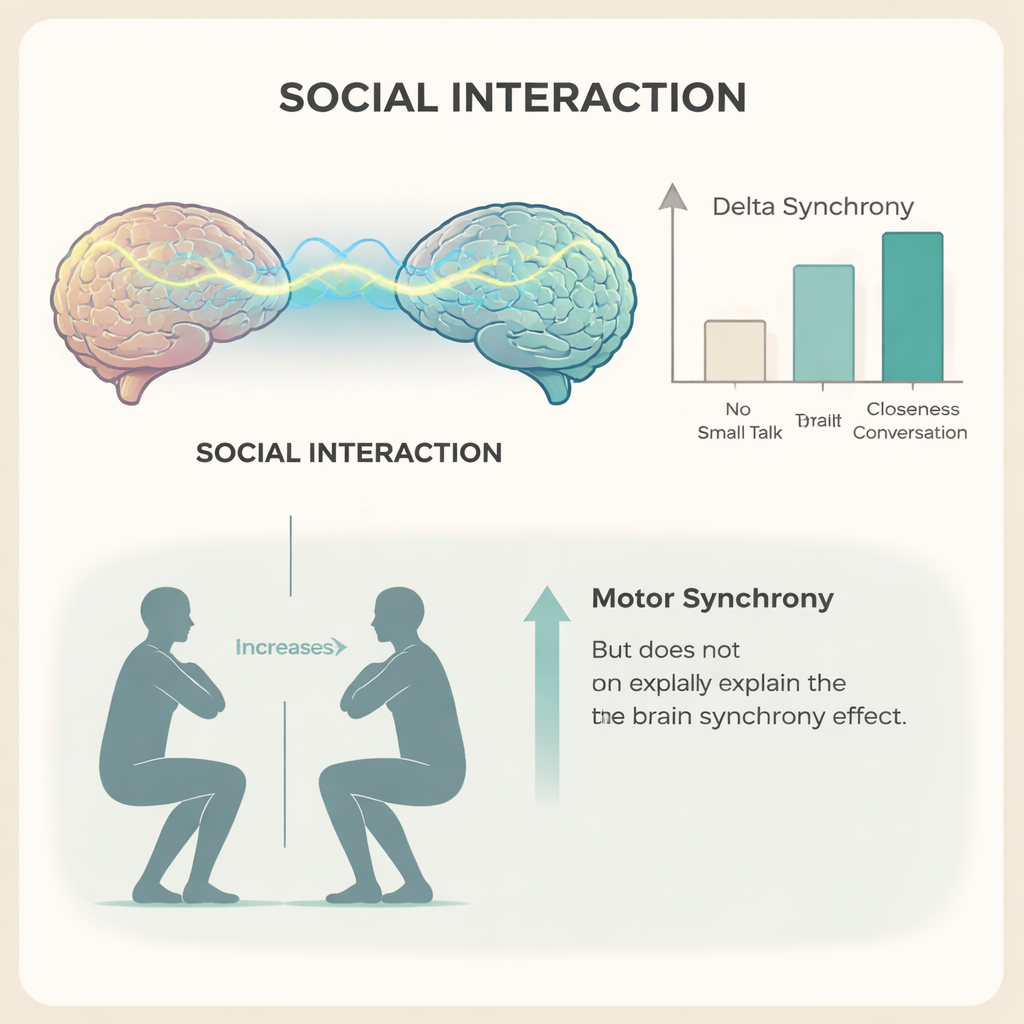
The Fast Friends exercise worked as intended on the social level. Compared with small talk, it reliably boosted self-reported closeness and perceived similarity, and both interactive conditions made people feel much more connected than simply sitting in silence. Yet, despite these stronger feelings, the pairs in the intimate-conversation condition did not show higher brain synchrony than those making small talk. Across all tested brain rhythms, inter-brain synchrony looked essentially the same for the two types of conversation. In other words, feeling closer did not, by itself, produce extra “locking together” of brain activity that the EEG system could detect.
Interaction itself drives shared brain rhythms
Where the brain signals did change was between interaction and no interaction. In the very slow delta band, pairs who talked—whether about everyday topics or personal ones—showed clearly higher brain-to-brain synchrony than pairs who never spoke or made eye contact. Their bodies also moved in a more coordinated way: interacting partners displayed stronger motor synchrony than those separated by a divider. However, these two kinds of synchrony did not neatly explain each other. Pairs with more aligned movements did not necessarily show more aligned brain rhythms, and the brain effect remained even after statistically accounting for motor synchrony. This suggests that other features of conversation—such as jointly tracking the rhythm of speech or sharing emotional engagement—may be key drivers of the observed neural coupling.
What this means for everyday connection
For a layperson, the takeaway is that simply engaging with another person—talking, listening, and responding in real time—appears sufficient to bring your brain activity into step with theirs at slow time scales. Making the interaction more intimate clearly changes how close people feel, but in this study it did not add a detectable extra layer of brain synchrony beyond that. The findings hint that brain-to-brain synchrony may be better understood as a marker of being actively involved in a shared interaction, rather than a precise barometer of how emotionally close two people are. Our brains, it seems, start to “tune in” to each other as soon as we truly interact, whether we are trading small talk or sharing our deepest stories.
Citation: Fornari, L., Janssen, T., Davidesco, I. et al. Testing the causal relationship between interpersonal closeness and inter-brain synchrony. Sci Rep 16, 6464 (2026). https://doi.org/10.1038/s41598-026-36958-5
Keywords: social interaction, brain synchrony, EEG hyperscanning, interpersonal closeness, motor synchrony