Clear Sky Science · en
Energy efficient clustering protocol in wireless sensor networks using an adaptive hybrid optimization algorithm
Why tiny wireless devices need smarter teamwork
The world is filling up with small, battery-powered sensors that watch over crops, bridges, factories, and even hospital patients. These wireless devices form the backbone of the Internet of Things, quietly sending data to the cloud. But most are dropped into places where changing or recharging batteries is difficult or impossible. This paper explores a new way to organize such sensor networks so they waste less energy, last much longer, and still deliver reliable data — a key step toward more sustainable smart cities, farms, and industries.
How today’s sensor networks waste their batteries
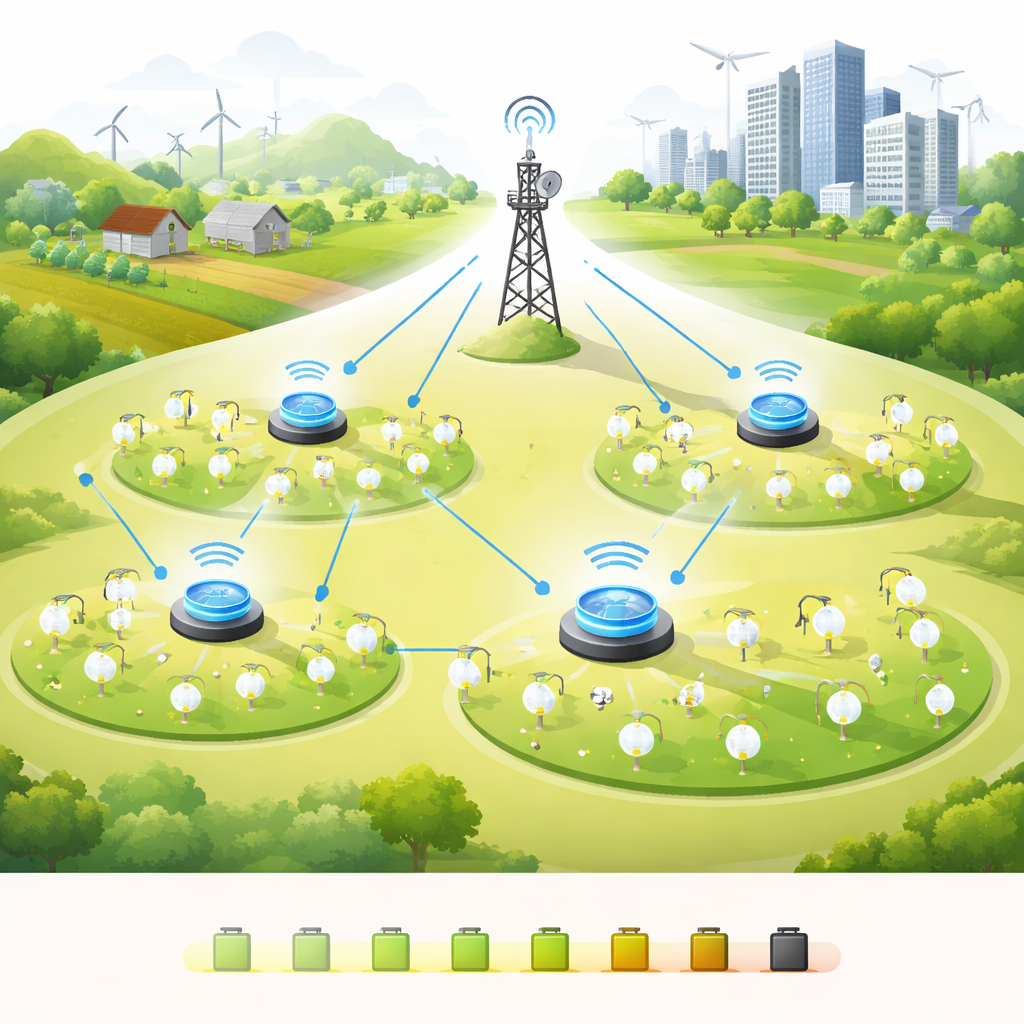
In a typical wireless sensor network, dozens or hundreds of small nodes collect measurements and send them to a central base station. To avoid chaos on the airwaves, many systems use “clustering”: nearby sensors send their data to a more powerful neighbor called a cluster head, which bundles and forwards the information onward. This reduces the total number of long wireless transmissions, which are very energy hungry. However, in most existing protocols the choice of cluster heads is partly random or based on limited rules. Low-energy nodes can still be picked as leaders, clusters can become lopsided and large, and sensors close to the base station are often overworked as relays. The result is that some nodes die very early, coverage becomes patchy, and the overall network lifetime is cut short.
A hybrid “swarm intelligence” brain for the network
The authors tackle this problem using a sophisticated optimization method inspired by collective behavior in nature. Their WIFN algorithm blends ideas from several “swarm intelligence” and evolutionary strategies, originally modeled on animals like whales and naked mole rats, as well as abstract physics-inspired search rules. Instead of hard-coding where cluster heads should be, the algorithm treats each possible arrangement of sensor roles as a candidate solution and scores it according to several goals: low energy use, tight and well-separated clusters, high remaining battery levels, and low delay in data delivery. Over many simulated generations, WIFN refines these arrangements, favoring better ones and discarding worse ones, while special mechanisms keep it from getting stuck in local dead ends. The final result is an automatically discovered pattern of which nodes should lead and how they should be grouped.
Designing clusters that respect energy and distance
In the proposed WIFN-based clustering protocol, only nodes whose remaining energy is above the network average are even allowed to become cluster heads. This simple rule avoids overburdening weak nodes. The algorithm also considers how far each sensor is from its potential leader and how far leaders are from the base station. Clusters are formed so that no head is too far from its members, and heads closer to the base station tend to serve smaller groups, reducing their workload. For long distances between a cluster head and the base station, the protocol automatically switches to a two-hop path, so a faraway leader can pass its data through a better-positioned neighbor instead of shouting directly across the field. Together, these decisions spread the energy cost much more evenly across the whole network.
What the simulations reveal about network lifetime
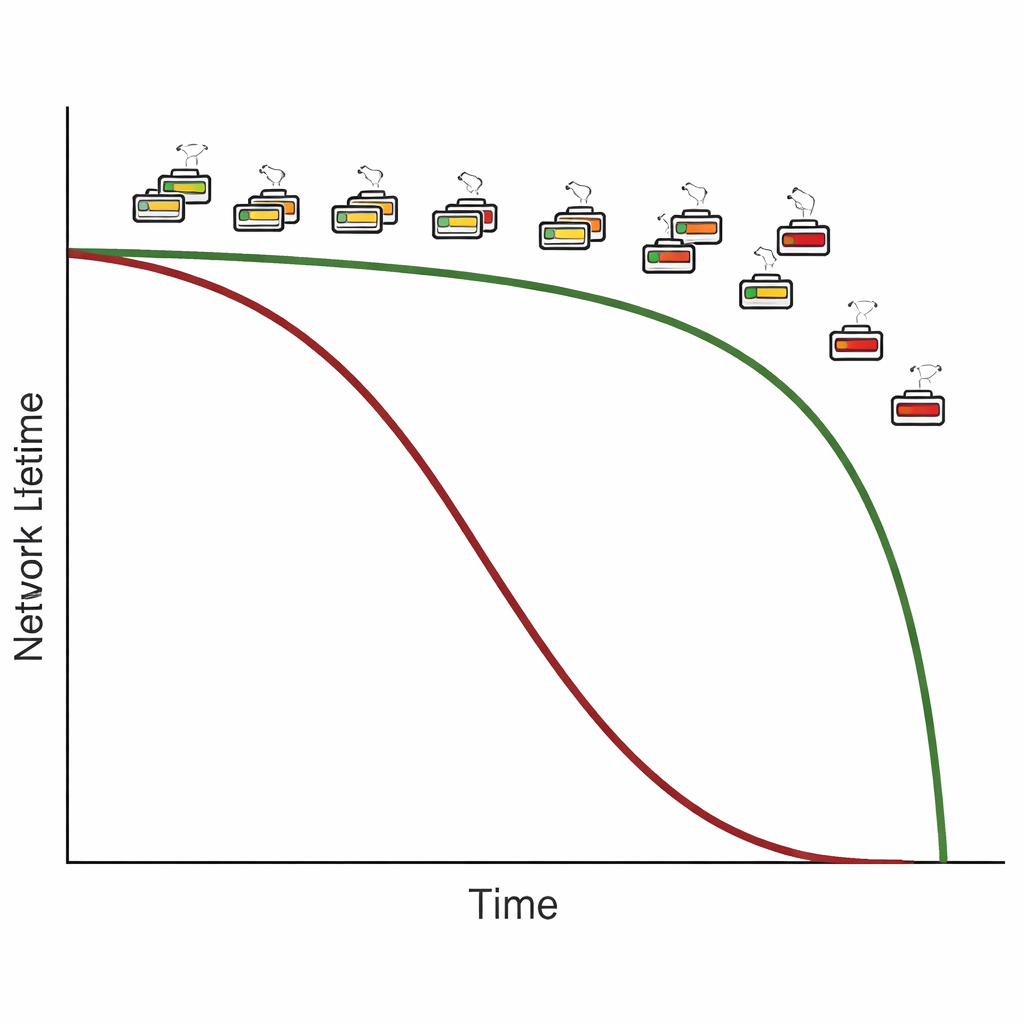
To test their approach, the researchers simulated a network of 100 sensors in a 100-by-100 meter area, comparing their protocol with several widely used clustering methods. They measured how many rounds of data collection the network could complete before the first node died (the “stability period”), when half the nodes died, and when nearly all were exhausted. They also tracked how much energy each node had over time and how fairly that energy was consumed. Across both uniform networks and more realistic mixed setups with higher-energy “advanced” nodes, the WIFN-based protocol kept nodes alive longer and maintained a more even spread of remaining energy. In many cases, the first node death was delayed by hundreds or even thousands of rounds compared with classic protocols, and the average energy per node declined more slowly.
Why this matters for real-world smart systems
For a non-specialist, the key message is that the way we organize wireless sensors can matter as much as the hardware itself. By letting an intelligent, adaptive algorithm choose which devices take on heavier communication duties and when to relay data in one or two hops, the network wastes less battery power and avoids “hot spots” where some nodes die much earlier than others. The proposed method slightly increases computing effort at the base station, but the payoff is a much longer-lived and more stable sensing system — a clear advantage for long-term applications such as environmental monitoring, precision farming, industrial automation, and disaster response, where changing a dead sensor may be costly, risky, or simply not possible.
Citation: Goel, S., Sharma, K.P., Mittal, N. et al. Energy efficient clustering protocol in wireless sensor networks using an adaptive hybrid optimization algorithm. Sci Rep 16, 6300 (2026). https://doi.org/10.1038/s41598-026-36957-6
Keywords: wireless sensor networks, internet of things, energy-efficient routing, clustering algorithms, metaheuristic optimization