Clear Sky Science · en
MCI-LB brain networks reorganization in relation to specific cognitive domains deficits
Why early brain changes in Lewy body disease matter
Dementia with Lewy bodies is now the second most common degenerative dementia, yet it is notoriously hard to spot early. Before full dementia appears, many people go through a stage called mild cognitive impairment with Lewy bodies (MCI-LB), marked by subtle problems with attention, memory, and visual perception, sometimes alongside sleep issues, mood changes, or Parkinson-like movements. This study asks a key question: long before dementia is obvious, how are the brain’s main communication networks already rewiring themselves, and are these changes actually helping the brain cope—or quietly setting the stage for decline?
Looking at resting brain networks
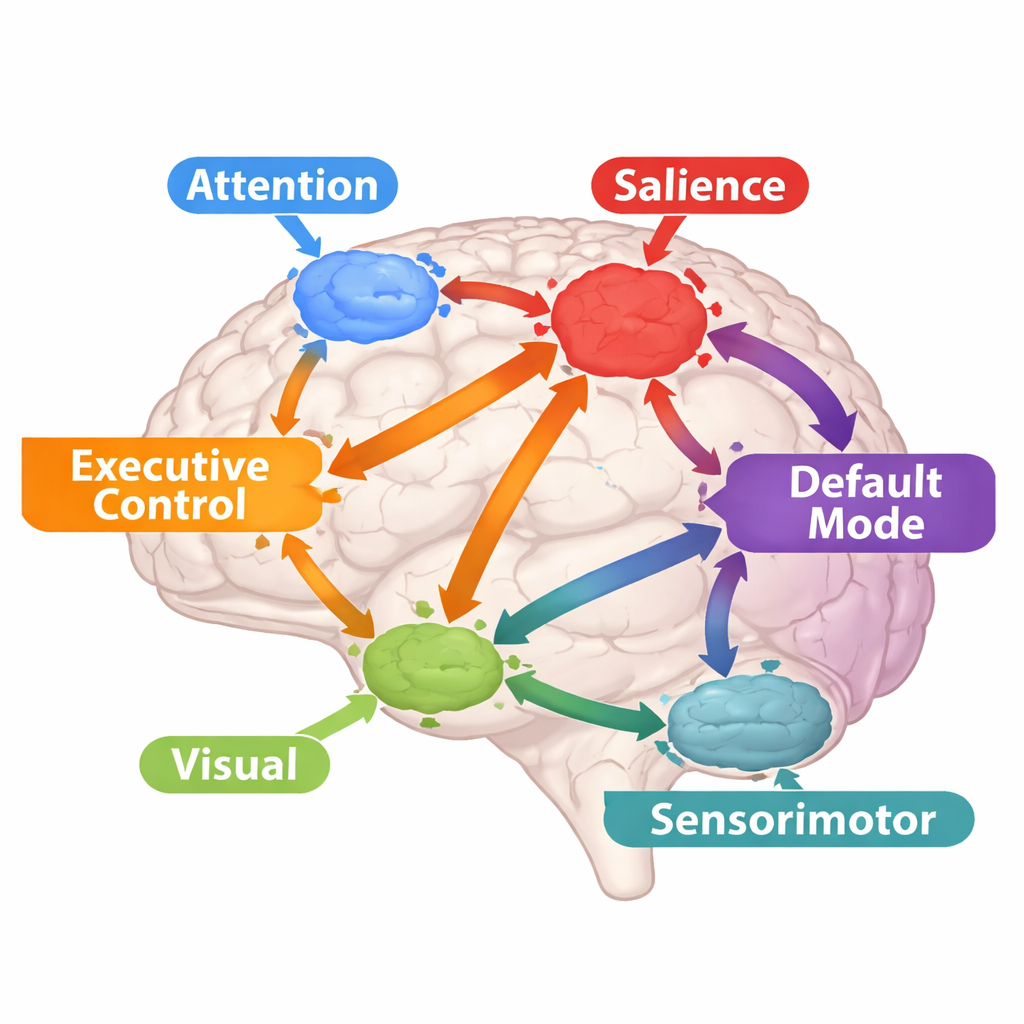
The researchers studied 38 people with MCI-LB and 24 healthy adults of similar age. Everyone completed a detailed battery of thinking tests covering attention, executive skills (planning and problem-solving), verbal and visual memory, and visuospatial abilities such as judging angles and locations. The volunteers also underwent advanced MRI scans while simply resting with their eyes open. From these scans, the team measured how strongly different brain regions’ activity rose and fell together over time—known as “functional connectivity.” They focused on eight large-scale networks: attention systems, executive control circuits, a salience network that flags important events, the default mode network active during inward thought, and networks handling movement, vision, and language.
Broken links and overactive detours
When the team compared the two groups, people with MCI-LB showed a mixed picture of weakened and strengthened connections between networks. Links were weaker between a key top-down attention system (the dorsal attention network) and the fronto-parietal network, which normally helps control and direct attention, and between the fronto-parietal and language networks. At the same time, some connections were stronger: the fronto-parietal network was more tightly coupled with the salience network and the default mode network, and the dorsal attention network showed increased coupling with the sensorimotor system. In other words, as the normal “control pathway” between attention and executive areas falters, the brain seems to reroute traffic through other networks that were not originally built to do that job.
How network shifts relate to thinking skills
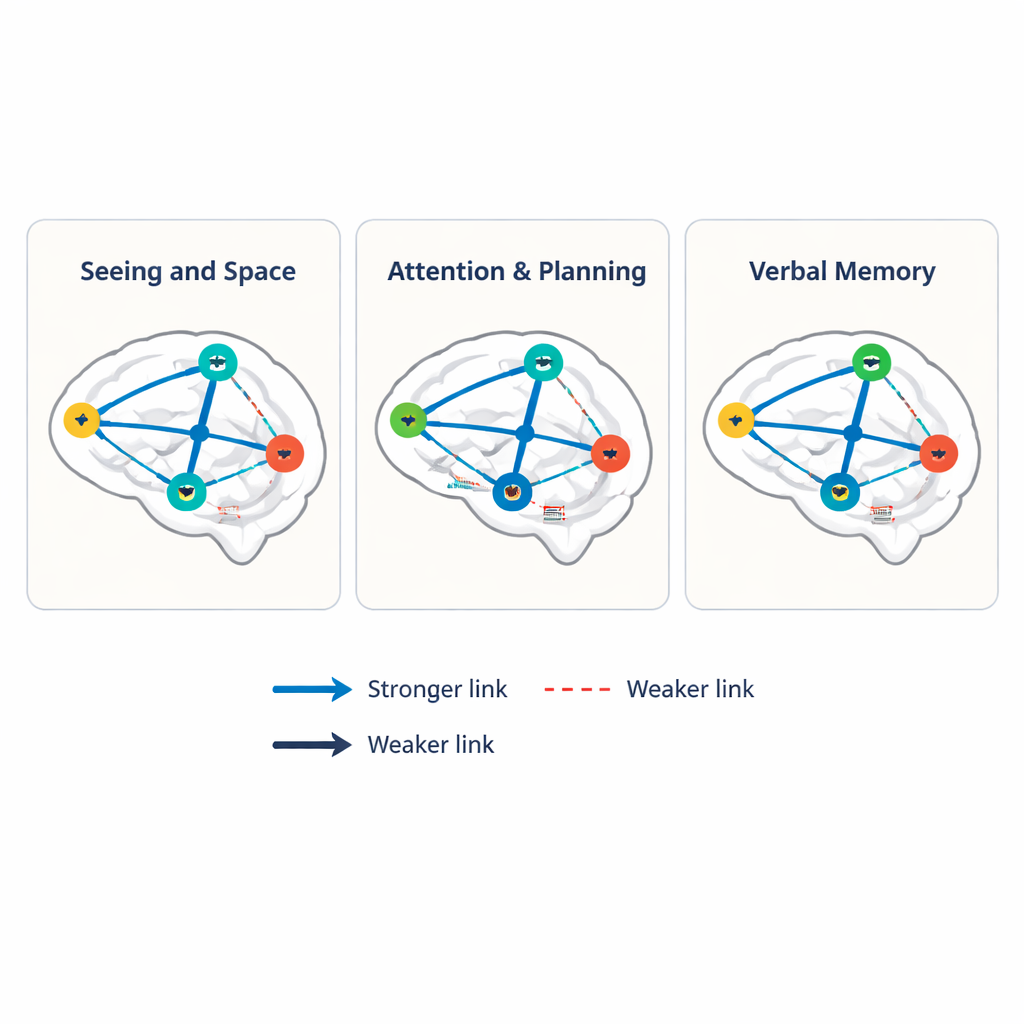
The researchers then asked how these wiring changes map onto everyday thinking abilities. Using statistical methods to group test scores into three main factors—visuospatial memory and spatial skills, attention and executive function, and verbal memory—they correlated each factor with specific connections between brain regions. Better spatial memory tended to go hand in hand with stronger links between attention and visual or sensorimotor networks, but with weaker links between some fronto-parietal regions and sensorimotor areas. Strong attention and executive performance were associated mainly with stronger “bridge” connections between fronto-parietal, attention, visual, and language regions, suggesting that people who cope better may recruit a broader coalition of networks to maintain focus and control.
Mixed support for verbal memory
Verbal memory—remembering spoken words and stories—showed an especially complex pattern. In some cases, better verbal memory was linked to stronger connections between attention networks, the salience system, the fronto-parietal control network, and language regions. Yet in other cases, stronger connectivity within language areas or between language and salience networks actually predicted poorer verbal recall. The authors suggest that in MCI-LB, language and salience systems may over-engage, flooding the brain with detailed processing of incoming words and meanings. This extra effort might paradoxically interfere with the clean encoding and maintenance of verbal information in memory.
Compensation that cannot fully keep up
Taken together, the findings paint a picture of a brain that is actively trying to compensate for early damage in Lewy body disease by tightening links between multiple networks. The salience and fronto-parietal systems, in particular, appear to act as hubs that work harder to balance internal thought (the default mode network) with outward attention and action. But this “all hands on deck” strategy has limits. Despite these network-level adjustments, people with MCI-LB still perform worse than healthy peers on many cognitive tests. The study concludes that the brain’s compensatory reorganization is real but only partially effective, and that the very networks being recruited for help may become overloaded—offering both a window into early disease mechanisms and a potential target for future interventions.
Citation: Onofrj, V., Franciotti, R., Mitterova, K. et al. MCI-LB brain networks reorganization in relation to specific cognitive domains deficits. Sci Rep 16, 5923 (2026). https://doi.org/10.1038/s41598-026-36953-w
Keywords: Lewy body dementia, brain networks, functional connectivity, mild cognitive impairment, attention and memory