Clear Sky Science · en
Efficient optimization of noise-reducing orifice plates in nature gas pressure regulators based on adaptive multi-scale sampling-kriging model
Why Taming Gas Pipeline Noise Matters
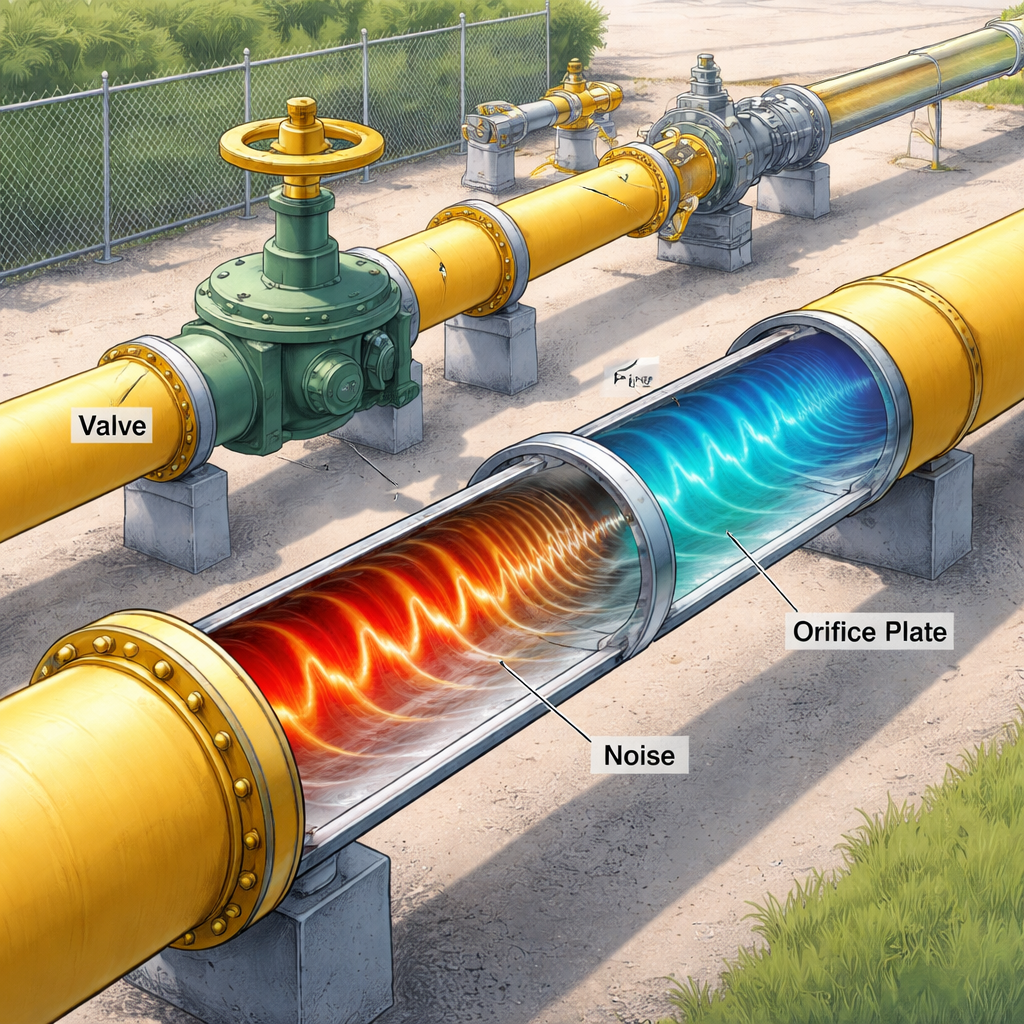
Natural gas stations often hide a surprising problem: they can be as loud as a rock concert. Inside the yellow pipes that feed cities and industries, special valves drop gas pressure from very high to safe levels. That sudden change creates roaring, low-pitched noise that can shake equipment, loosen bolts, and damage workers’ hearing. This study tackles that problem by redesigning a simple metal plate filled with holes and by inventing a smarter way for computers to search for the quietest design, cutting both noise and computing time.
Where the Rumble Comes From
In a gas station’s pressure-regulating branch, gas can enter at nearly 4 megapascals and leave at about one-fifth of that pressure. As gas squeezes through the narrow gap inside the valve, it speeds up dramatically, then spills into a wider pipe. That sudden acceleration and expansion creates swirling vortices, turbulent jets, and even tiny shock waves. These chaotic motions slam into the pipe walls and send out powerful sound waves, especially in the low and mid-frequency range between roughly 100 and 1,500 hertz. Field tests show that noise downstream of the valve can reach about 120 decibels, with the downstream side often 15–20 decibels louder than the upstream side.
The Simple Plate That Makes a Big Difference
Many stations now fight this noise by installing a perforated metal plate just downstream of the valve. The plate looks like a thick disk drilled with many small holes. As gas jets through these holes, its energy is broken up and spread out, and turbulent eddies lose strength over a short distance. Computer simulations in the study show that adding such a plate can shrink the high-noise region in the pipe. While the very highest local sound level may rise slightly near the holes, the overall noisy area becomes smaller, especially upstream of the plate, and the total sound level at the valve outlet drops. In real-world tests, a carefully designed plate cut measured noise from about 125 decibels to about 114 decibels, an 8–9% reduction in sound pressure level at the measurement point.
Why Trial-and-Error Design Falls Short
Designing these plates is not as easy as drilling a few holes. The diameter of each hole, the thickness of the plate, and the spacing between holes all interact in complex ways with the swirling gas. To judge whether a design is good, engineers run detailed computer simulations of the gas flow and the sound it produces. Each run can take hundreds of hours, and exploring dozens or hundreds of combinations quickly becomes impractical. Many current design approaches either rely on rules of thumb—which may miss the best design—or on traditional mathematical shortcuts that still require too many expensive simulations, because they add new test designs in rigid, fixed batches regardless of how close the search is to a good solution.

A Smarter Way to Let the Computer Explore
The authors introduce an adaptive multi-scale sampling method built on a statistical model known as Kriging. Instead of simulating every possible plate, they first run a modest number of full simulations and train a surrogate model that predicts noise for untested designs and also estimates its own uncertainty. The new method watches how this surrogate improves over time. Early in the process, when predictions are rough, it automatically adds more new designs per step to explore the full design space broadly. Later, as the model becomes more confident, it adds fewer designs and concentrates them around promising regions. Tested on standard mathematical problems, this adaptive strategy achieved higher accuracy with far fewer samples than three common alternatives. Applied to the gas valve plate, it found an optimized hole size, spacing, and thickness that brought the predicted noise down to about 116 decibels while using less than half the simulation effort of traditional approaches.
Quieter Pipelines, Cheaper Computing
For a non-specialist, the central message is that the study combines a simple mechanical fix—a drilled plate inside the pipe—with an intelligent search strategy that tells the computer where to "look" next. By letting the sampling pattern grow and shrink as needed, the method improves design accuracy by around 2.7% while cutting computational cost by about 54% compared with established techniques. That means engineers can reach a quieter, safer valve design in days instead of months, with fewer supercomputer hours. The same adaptive idea can be reused in many other fields where each simulation is expensive, offering a practical path to better designs with less noise, less cost, and less trial and error.
Citation: Xie, H., Wang, T., Meng, D. et al. Efficient optimization of noise-reducing orifice plates in nature gas pressure regulators based on adaptive multi-scale sampling-kriging model. Sci Rep 16, 5872 (2026). https://doi.org/10.1038/s41598-026-36943-y
Keywords: natural gas pipeline noise, pressure regulating valves, perforated orifice plates, surrogate model optimization, adaptive sampling