Clear Sky Science · en
Surgical resection versus non-surgical treatments for hepatocellular carcinoma with macrovascular invasion
Why this matters for people with liver cancer
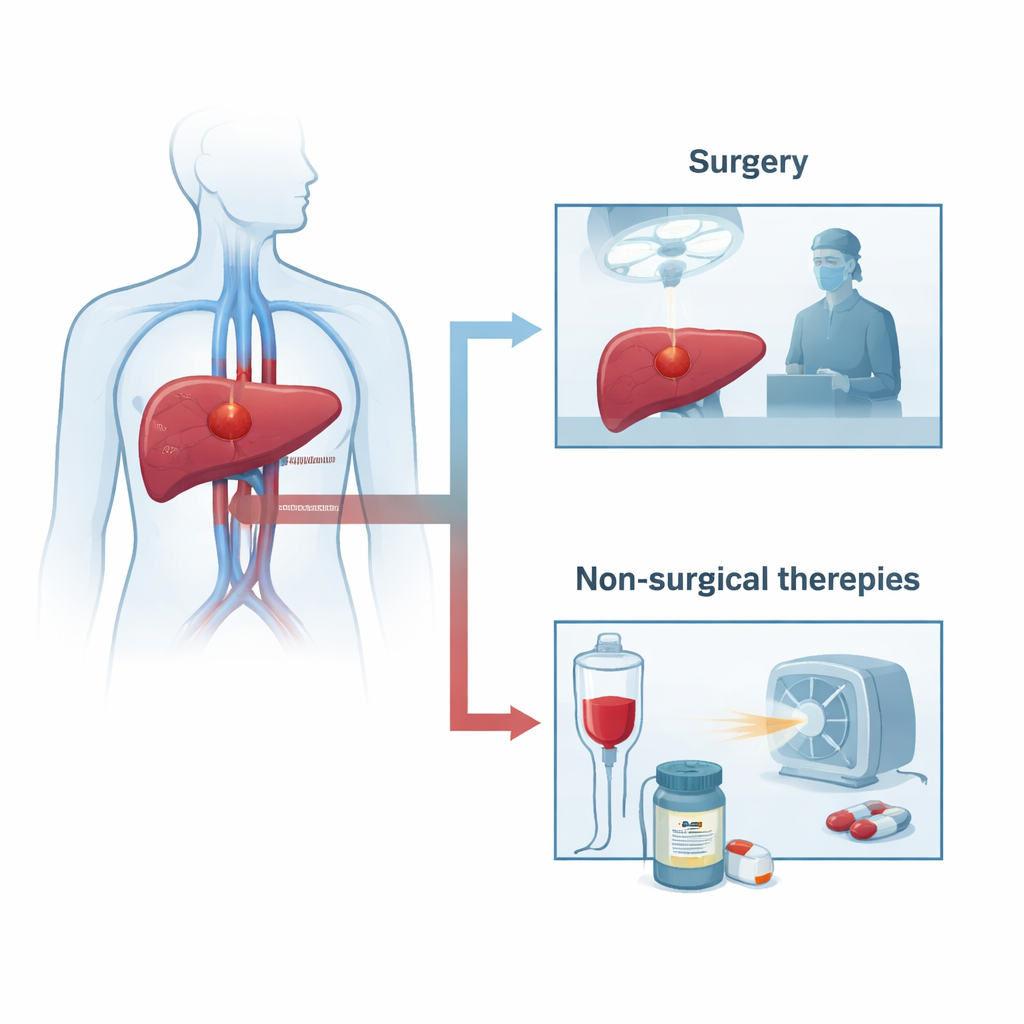
When liver cancer grows into the large blood vessels of the liver, it is usually considered very advanced and often judged "inoperable." Many patients are told that drugs or radiation are the only realistic options. This study asks a pressing question with real-life consequences: for these high‑risk patients, can carefully selected surgery actually help people live longer than modern non-surgical treatments?
A dangerous form of liver cancer
Hepatocellular carcinoma, the most common type of primary liver cancer, is often discovered late. In many patients, the tumor has already invaded major veins that drain blood from the liver, a situation called macrovascular invasion. Cancer growing inside these veins can send clots and tumor fragments toward the lungs and heart, leading to serious problems such as heart failure or blocked lung arteries. Because of this, international guidelines have long placed these patients in an advanced stage, recommending medicines or other non-surgical treatments aimed mainly at slowing the disease, rather than removing it.
What the researchers set out to test
Doctors around the world disagree on whether major surgery is worth attempting in this situation. Some Eastern guidelines allow liver surgery for selected patients with tumor-filled veins, while many Western guidelines still see this as a reason to avoid the operating room. To bring clarity, the authors systematically searched four large medical databases for studies published from 1990 to mid‑2023. They focused on patients whose liver cancer had invaded the portal vein, hepatic veins, the large vein returning blood to the heart, or even the right upper heart chamber. Only studies that directly compared surgical removal of the tumor with non-surgical approaches—such as chemoembolization, radiotherapy, targeted drugs like sorafenib, or best supportive care—were included.
How the study was done
The team gathered data from 33 studies including 10,551 patients, nearly half of whom underwent liver surgery. Using standard methods for meta-analysis, they combined results to compare the chance of being alive 1, 3, and 5 years after starting treatment. They also looked more closely at where and how far the tumor had grown inside the veins. For example, in some patients the tumor was limited to smaller branches of the portal vein, while in others it extended into the main trunk or beyond. Additional analyses compared surgery with specific non-surgical options, such as interventional procedures, radiation, or sorafenib‑based drug therapy.
Who seems to benefit most from surgery
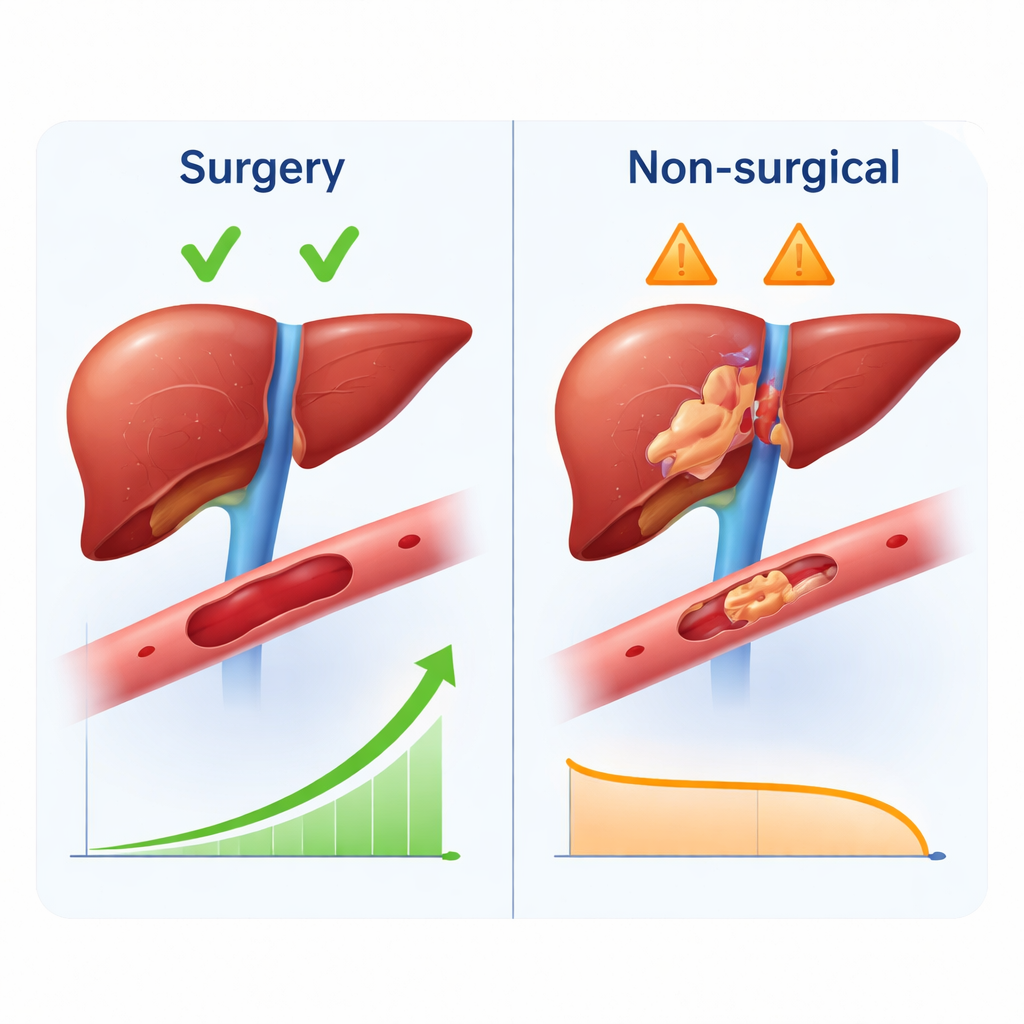
Across all patients with major vessel invasion, surgery was linked to clearly better survival: more people were alive at 1, 3, and 5 years compared with those who received only non-surgical treatments. The advantage was strongest when the tumor clot was confined to smaller or main branches of the portal vein (called type I and II disease) or involved the hepatic veins, which drain blood from the liver into the big central vein. In these groups, surgery consistently raised survival at all time points. By contrast, when the cancer extended into the main portal vein trunk or even beyond, the benefit of surgery largely disappeared, and results were similar to non-surgical care. In patients with tumor growth into the large central vein that leads to the heart, the evidence was too limited and mixed to draw firm conclusions.
How surgery compares with other modern treatments
When surgery was directly compared with commonly used non-surgical options, it often came out ahead. Patients who had their tumors removed tended to live longer than those treated with interventional procedures alone or with sorafenib. However, surgery did not clearly outperform modern radiation-based approaches in the available studies. The authors also point out a key gap: most non-surgical patients in the included studies did not receive today’s leading drug combination, atezolizumab plus bevacizumab, which has improved outcomes for advanced liver cancer. As a result, we still do not know whether surgery is better, worse, or complementary to these newer immune‑based treatments.
What this means for patients and families
For people with liver cancer that has just begun to invade nearby large veins—especially when the spread is limited and liver function is still reasonably good—this study suggests that surgery should not be dismissed out of hand. In carefully chosen patients with certain patterns of vessel involvement, removing the tumor and the clot may offer a better chance of long-term survival than older non-surgical approaches alone. At the same time, decisions remain complex and must weigh surgical risk, the exact pattern of vein involvement, and access to modern drug and radiation therapies. The study’s message to patients and clinicians is that, for some advanced liver cancers, a well-planned operation may still be a life-extending option rather than an automatic last resort.
Citation: Fang, Y., Zhou, E., Hu, J. et al. Surgical resection versus non-surgical treatments for hepatocellular carcinoma with macrovascular invasion. Sci Rep 16, 5832 (2026). https://doi.org/10.1038/s41598-026-36937-w
Keywords: liver cancer, hepatocellular carcinoma, surgical resection, portal vein tumor thrombosis, macrovascular invasion