Clear Sky Science · en
Distinguishing microplastics from microplastic-like particles in the marine fish from Qatar
Hidden Plastics in Everyday Fish
For people in Qatar and around the world, fish are a staple on the dinner table. But along with protein and healthy fats, fish can also carry tiny plastic bits from polluted seas. This study asks a simple but important question: how much plastic actually ends up inside popular food fish in Qatar’s waters — and how much of what we think is plastic really is plastic at all?
Why Tiny Plastics Matter
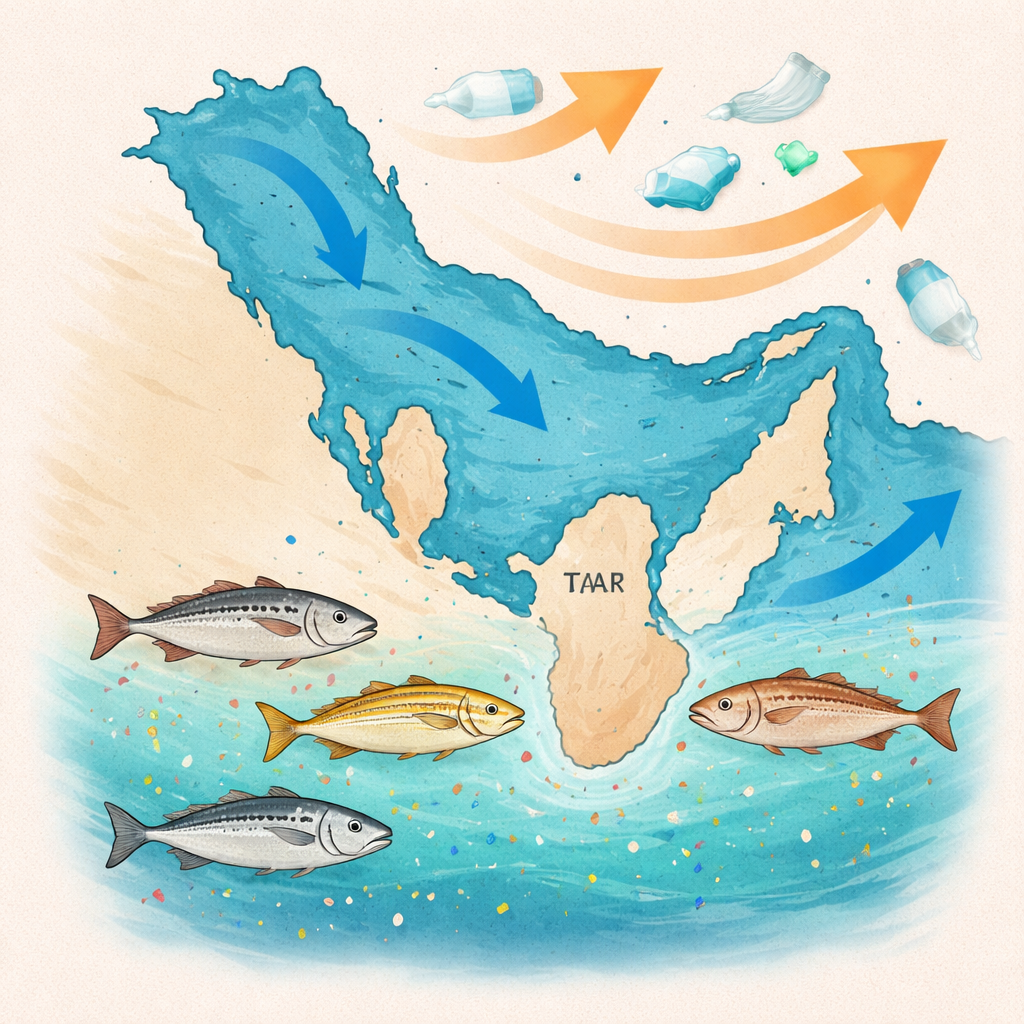
Modern life depends on plastic, and global production now reaches hundreds of millions of tons a year. Sunlight, waves, and weather break larger items — bags, bottles, fishing gear, synthetic clothing fibers — into microplastics, pieces smaller than five millimeters. Because these fragments float or sink slowly, they can be carried far from where they were thrown away, eventually reaching coasts like Qatar’s. Their small size means they can be swallowed by many sea creatures, from plankton and shrimp to the very fish humans eat. Once inside, they may damage organs or carry toxic chemicals.
Taking a Close Look Inside Market Fish
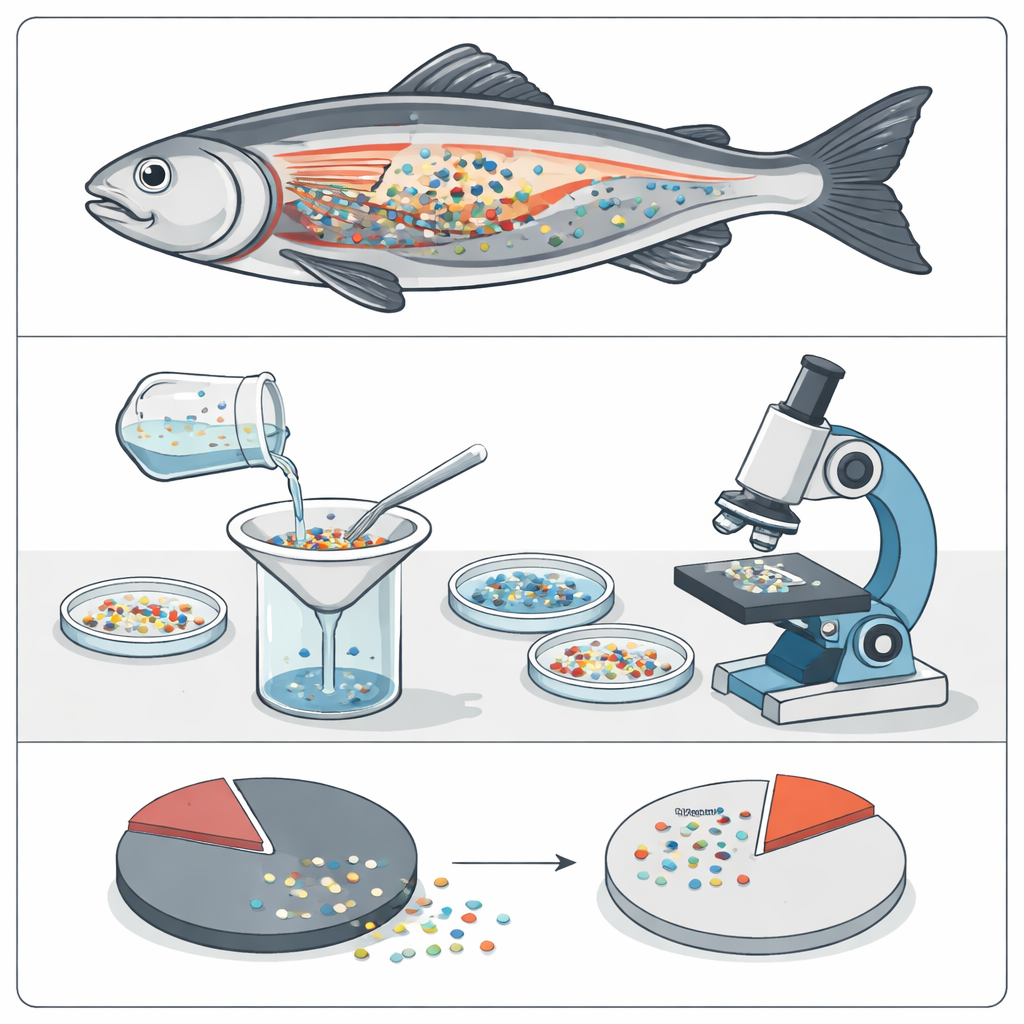
To understand what ends up in local seafood, the researchers examined 170 fish bought from markets and landing centers in northern Qatar. They focused on four well-known species that live near the sea floor and are often eaten: Hamour (a grouper), Sheri (spangled emperor), Sheam (yellowfin seabream), and Safi (a herbivorous rabbitfish). The team removed the digestive tracts — stomach and intestines — then used strong but carefully controlled chemicals to dissolve natural tissue while leaving solid particles behind. These leftovers were filtered and first checked under a powerful stereomicroscope to find and count anything that looked like microplastics.
Look‑Alikes Versus Real Plastics
Under the microscope, the fish guts contained more than a thousand tiny particles, and 85% of the fish had at least some of them. Most appeared as thin fibers, especially blue ones, likely resembling small worms or bits of algae to feeding fish. At first glance, these particles might all be counted as microplastics. But not every fiber or fragment is truly plastic; some can be natural materials such as cotton, plant debris, or other non‑plastic matter. To avoid overestimating pollution, the team used micro‑Raman spectroscopy, a technique that shines laser light on particles and reads their chemical “fingerprint,” allowing them to tell genuine plastics from look‑alikes. This extra step sharply reduced the count: only 162 of the 1,043 suspects were confirmed as plastics, and applying a strict quality standard cut that number down to just 7 particles across all 170 fish.
What the Study Found in Qatar’s Waters
When the dust settled, only 4.1% of the examined fish actually contained confirmed microplastics, at an average of 0.070 particles per gram of gut — low compared with many reports from other parts of the Arabian Gulf and the world. The team identified several common plastics, including polyethylene and polypropylene, widely used in packaging and single‑use items, and some more complex plastic blends. Interestingly, Safi, the plant‑eating species, tended to have more particles than the three meat‑eating species, perhaps because bits of plastic cling to algae and seaweed or settle into sediments where herbivores graze. Even so, differences between species and fish sizes were not strong enough to be statistically clear.
What This Means for Seafood and People
For everyday shoppers, the main takeaway is that while microplastics are present in Qatar’s marine fish, the levels found in this study were relatively low, and only a tiny share of suspected particles turned out to be true plastics when checked with advanced tools. The authors caution that they examined only a few species and only the gut, which people usually do not eat, and they used very strict rules to identify plastics. Still, the results suggest that careful measurement matters: relying on appearance alone can greatly exaggerate how much plastic fish actually swallow. The study underscores the need to reduce plastic waste entering the sea, continue monitoring local fish, and better understand how these tiny fragments move through food webs and what they might mean for long‑term human and ecosystem health.
Citation: Dib, S., Mohamed, A., Al-Khayat, F.A. et al. Distinguishing microplastics from microplastic-like particles in the marine fish from Qatar. Sci Rep 16, 5981 (2026). https://doi.org/10.1038/s41598-026-36935-y
Keywords: microplastics, marine fish, Qatar, food safety, plastic pollution