Clear Sky Science · en
Research on mesoscopic damage evolution mechanism of gas-bearing coal based on CT scanning with real time loading
Why Cracks Inside Coal Matter
Deep underground, coal seams do more than fuel power plants—they also store large amounts of gas, which can suddenly escape and trigger dangerous outbursts in mines. This study looks inside gas-bearing coal in real time as it is squeezed, using medical-style X-ray CT scanning and advanced computer modeling. By watching how tiny internal cracks and hard mineral grains share and concentrate stress, the researchers reveal why some coal fails suddenly and how gas makes that failure more likely. Their findings can help improve mine safety and support cleaner energy production from coalbed methane.
Looking Inside Coal in Three Dimensions
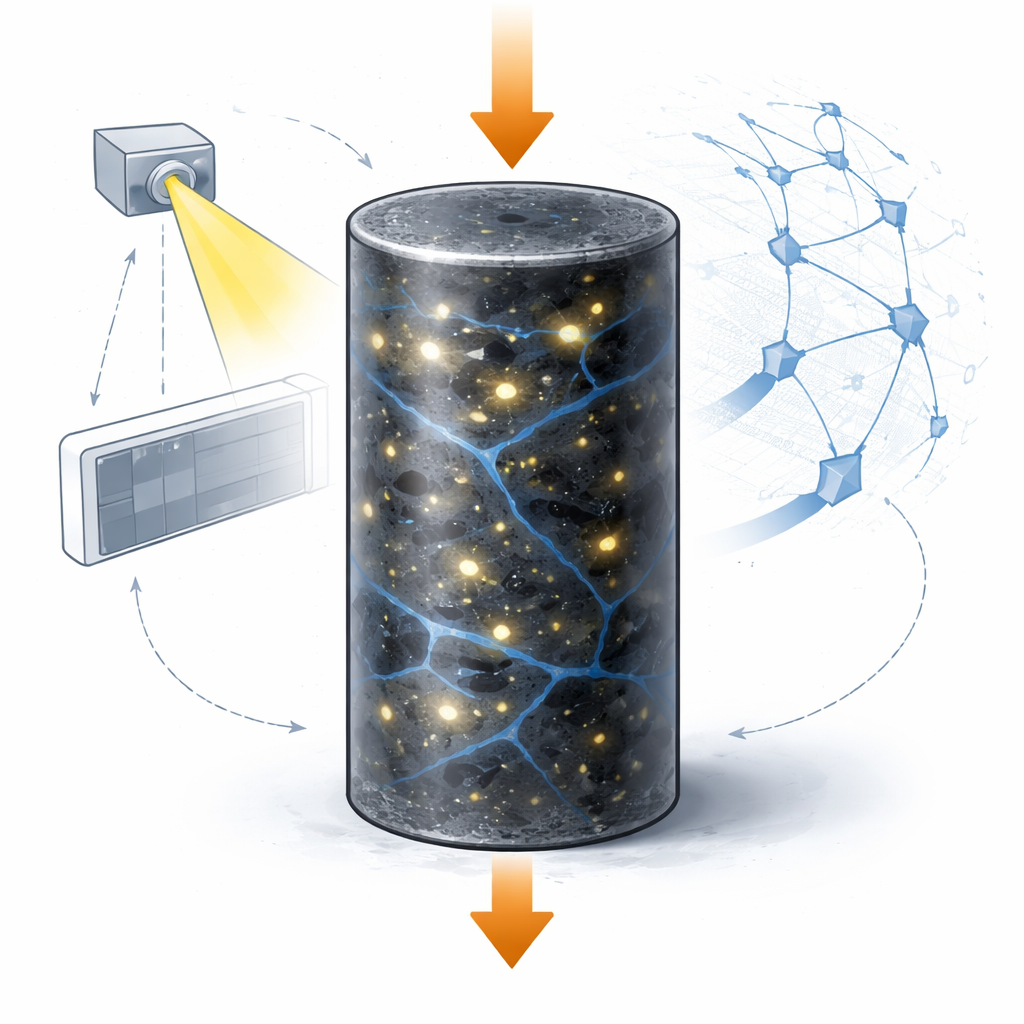
The team collected cylindrical coal samples from a Chinese mine known to have outburst risks. Each sample was placed into a special sleeve and loaded in a triaxial testing device while being scanned by a high-resolution CT system, much like a hospital CT scanner but tuned for rock. As the external stress increased step by step, the scanner captured thousands of X-ray images around the full 360° of the sample. These images were reconstructed into detailed 3D models, where bright spots and bands represent dense minerals, darker zones represent softer coal, and voids mark pores and fractures. Software tools were then used to clean up artifacts, separate minerals, coal, and pores by their gray levels, and build digital cores that faithfully reflect the internal structure of the real samples.
Simulating Stress Without a Rigid Grid
To follow how damage develops in such a complex material, the researchers used a “meshless” numerical method instead of traditional grid-based simulations. In this approach, the 3D CT model is treated as a cloud of points with different properties rather than a fixed mesh of blocks. Mechanical parameters such as stiffness and Poisson’s ratio were assigned to each phase: air-filled pores and fractures, softer coal, and stiffer minerals. The bottom of the virtual sample was fixed, while the top was pushed downward to mimic compression in the lab. This allowed the team to calculate how stresses and displacements evolved inside the coal volume as loading increased, giving a three-dimensional view of where cracks were likely to initiate and grow.
How Minerals and Cracks Shape Failure
The simulations showed that the relationship between overall load and internal maximum stress is strongly nonlinear. As the external load rose, high-stress pockets formed first around mineral-rich zones and near existing fractures. Because minerals are much stiffer than the surrounding coal, they act like a hidden skeleton that helps carry the load—but they also attract and concentrate stress. Narrow or banded mineral regions developed especially strong stress peaks, and new microcracks tended to appear beside these zones or parallel to mineral bands. Maps of stress direction revealed that both coal and minerals guide how forces flow through the sample, but minerals have a stronger steering effect. Meanwhile, displacement patterns were highly uneven: motion decreased from top to bottom overall, yet sharp differences developed between minerals, coal, and fractures, setting the stage for shear failure along their boundaries.
Gas Makes Weak Coal Weaker
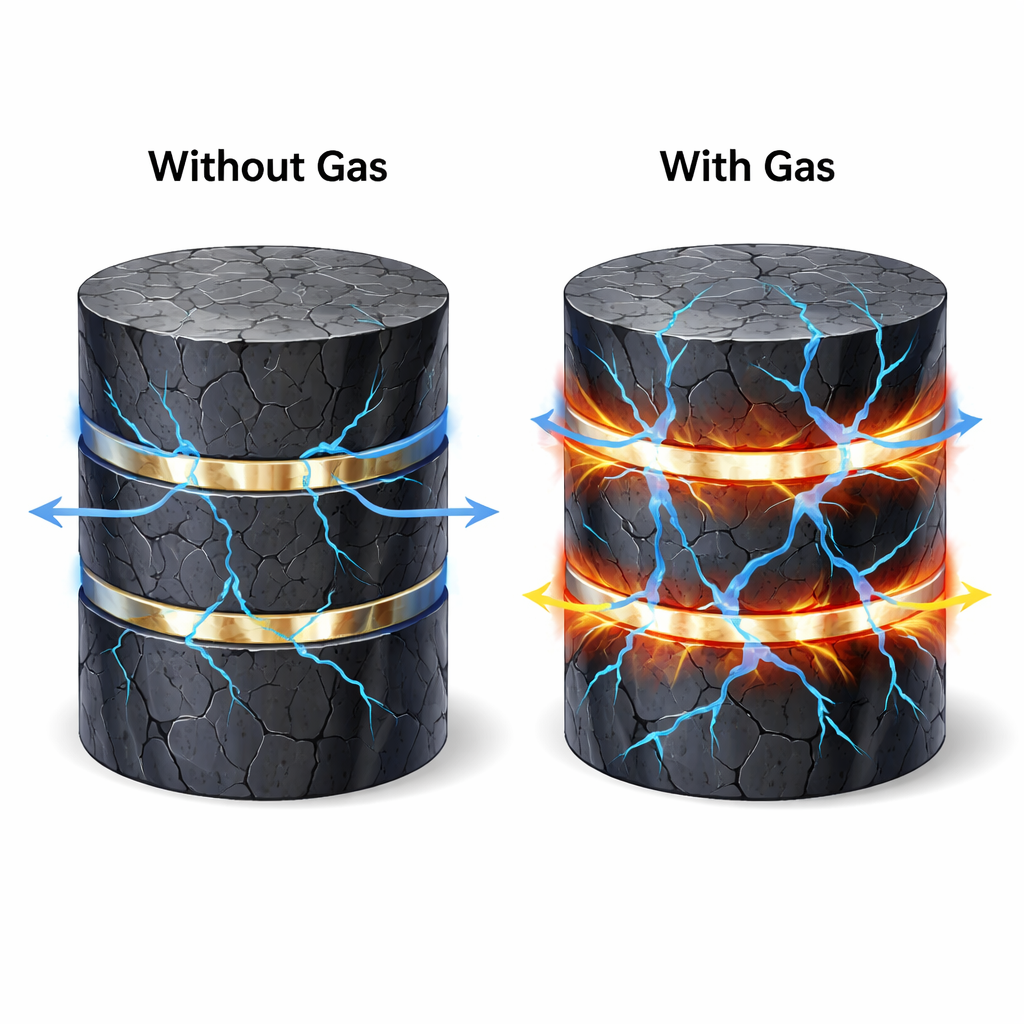
Coal in the ground is often saturated with gas. The study incorporated this by comparing cases with and without gas pressure, using a standard effective stress concept that reduces how much of the external load is actually carried by the solid skeleton. When gas is present, the effective strength and stiffness of coal drop, so the same external load pushes the material closer to its failure limit. The difference maps between gas-free and gas-bearing simulations showed that gas-loaded coal takes less of the stress, while minerals pick up more, increasing the contrast between hard and soft zones. This amplifies shear effects, enhances stress concentration around minerals, and makes internal cracks more likely to grow and link up, ultimately leading to instability and possible outbursts.
What This Means for Safer Mining
In plain terms, the research shows that gas-bearing coal fails not because of a single weakness, but because of the combined action of hard minerals, pre-existing cracks, and pressurized gas. Minerals both prop up the coal and concentrate damaging stresses; uneven displacements along mineral–coal and crack interfaces trigger shear damage; and gas shifts the internal stress state so that failure happens more easily. Real-time CT scanning, paired with meshless simulation, offers a powerful way to see this damage evolve in 3D, helping engineers better predict hazardous zones in coal seams and design safer extraction strategies.
Citation: Li, Q., Li, Z., Feng, G. et al. Research on mesoscopic damage evolution mechanism of gas-bearing coal based on CT scanning with real time loading. Sci Rep 16, 6213 (2026). https://doi.org/10.1038/s41598-026-36931-2
Keywords: gas-bearing coal, CT scanning, coal mine safety, fracture evolution, numerical simulation