Clear Sky Science · en
Highly sensitive positron imaging reveals short-term food distribution patterns in ant groups
How Ants Share Food in Real Time
When we watch ants crowd around a sugary spill on the sidewalk, it is easy to forget that what happens next—how that food is shared—is a complex social process. This study peeks inside that hidden world using tools more familiar from hospital cancer scanners than from backyards. By following tiny traces of radioactivity inside living ants, the researchers reveal, minute by minute, how a mouthful of sugar taken by one worker is spread, or sometimes not spread, through the group.
A New Way to Watch Hidden Flows
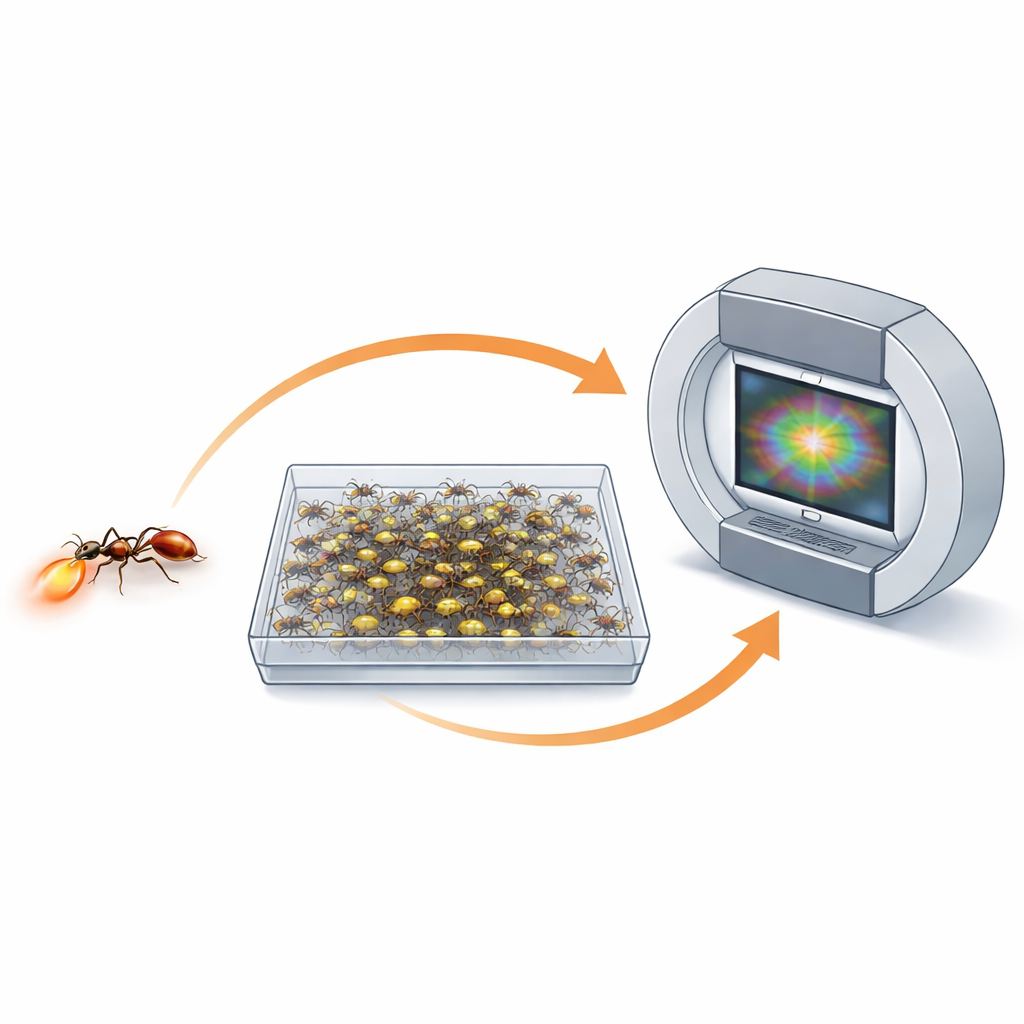
Understanding how food moves through an ant group can shed light on how social animals share resources, coordinate work, and adapt to changing conditions. Earlier studies used dyed or glowing liquids to track food, or older radioactive methods that produced only occasional snapshots. In this work, the team adapted a medical imaging technique called positron imaging to follow food flow almost continuously and with high sensitivity. They mixed a long-lived, positron-emitting form of sodium into sugar water, fed this labeled food to a single worker of the invasive yellow crazy ant, and then let that ant rejoin a group. As the ants engaged in mouth-to-mouth feeding, the imaging system recorded where the radioactive sugar went over time, without harming the insects.
Watching a Hundred Ants Share a Meal
The researchers first looked at large groups of about 100 workers. One ant was allowed to drink the labeled sugar and then was placed in a container with its nestmates, which sat between two opposing detectors. Over three hours, the system captured a movie showing bright spots where food-concentrated ants were located. To turn this movie into numbers, the team created an "index of dispersion"—a measure of how unevenly food was spread across the group. A high value meant only a few ants held most of the food; a low value meant many ants had similar amounts. In two of the three trials, the index dropped quickly within about 20 minutes and then stabilized, indicating that food had been broadly shared among many workers.
When Sharing Stalls Instead of Spreads
The third large-group experiment told a different story. At first, food began to spread, but after about 15 minutes it became concentrated again in only a few ants, and this pattern of spreading and reconcentrating repeated. Follow-up measurements of radioactivity in each individual confirmed that, in this trial, only about half the ants ended up receiving any labeled food at all. The authors suggest that this may reflect differences in which kinds of workers were present. Yellow crazy ant groups include foragers that tend to donate food and nurses that tend to receive. Because the third trial reused the same source colony soon after a previous sampling, it may have contained mainly non-foraging workers, changing how nutrients were passed around.
Zooming In on Individual Ant Exchanges
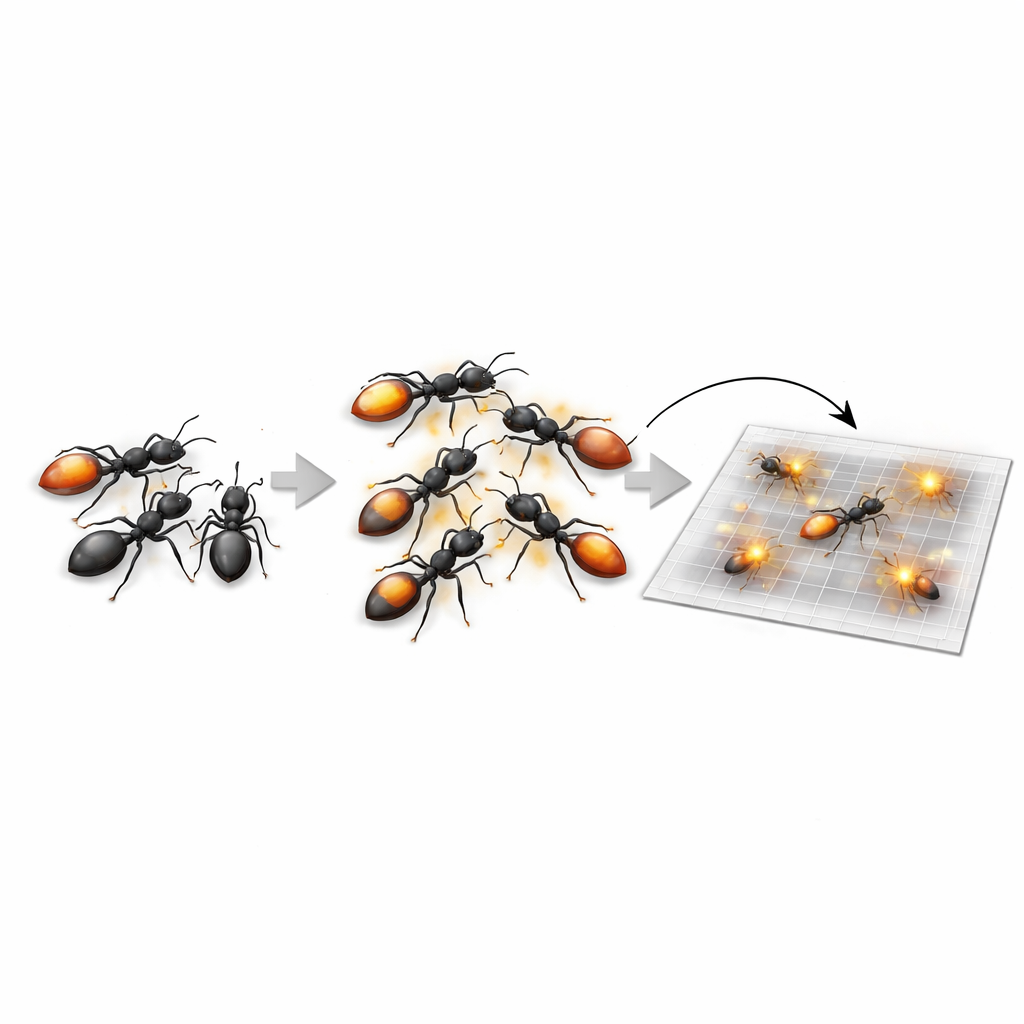
To see food sharing at the level of individual interactions, the team ran a second type of experiment using only 12 workers. Again, one ant drank labeled sugar before joining the group, but this time every ant was marked with a colored pattern and filmed from above with a standard camera while the positron imaging system recorded the radioactive signal. Using tracking software, the researchers converted the video into continuous position data for each insect and then combined this with the imaging data. This allowed them to estimate, second by second, how much labeled sugar each ant carried and how that amount changed as workers met and exchanged food. The results clearly showed ants clustering soon after the start and the labeled food moving out from the initially fed ant into its neighbors.
What This Means for Studying Social Life
By marrying medical-style imaging with careful tracking, this study delivers a new way to watch social insects share food in both large and small groups. The method is sensitive enough to detect very small amounts of food and flexible enough to work in species where colored dyes are hard to see. The findings show that food does not always diffuse smoothly through a group: sometimes it quickly becomes widely shared, and other times it circulates mainly among a few individuals, likely depending on which workers are present and what roles they play. For non-specialists, the key message is that an ant group behaves a bit like a living body, with specialized "organs" and "circulatory routes" for food—and now, for the first time, we can watch that internal circulation unfold in real time.
Citation: Suzui, N., Yamaguchi, M., Higashino, S. et al. Highly sensitive positron imaging reveals short-term food distribution patterns in ant groups. Sci Rep 16, 6833 (2026). https://doi.org/10.1038/s41598-026-36930-3
Keywords: ant social behavior, food sharing, radioisotope imaging, trophallaxis, collective foraging