Clear Sky Science · en
Physical model test on the effect of geosynthetic reinforcement on embankment constructed with modified lateritic soil under wetting-vibration
Why safer embankments matter
Highways and railways in rainy, tropical regions often run along man‑made earth mounds called embankments. These structures must stay stable while soaked by heavy rains and shaken by traffic and earthquakes. This study explores whether adding thin synthetic meshes inside these soil embankments can help them better withstand both water and vibration, offering safer, longer‑lasting roads and rails in places where the natural soil is naturally weak and wet.
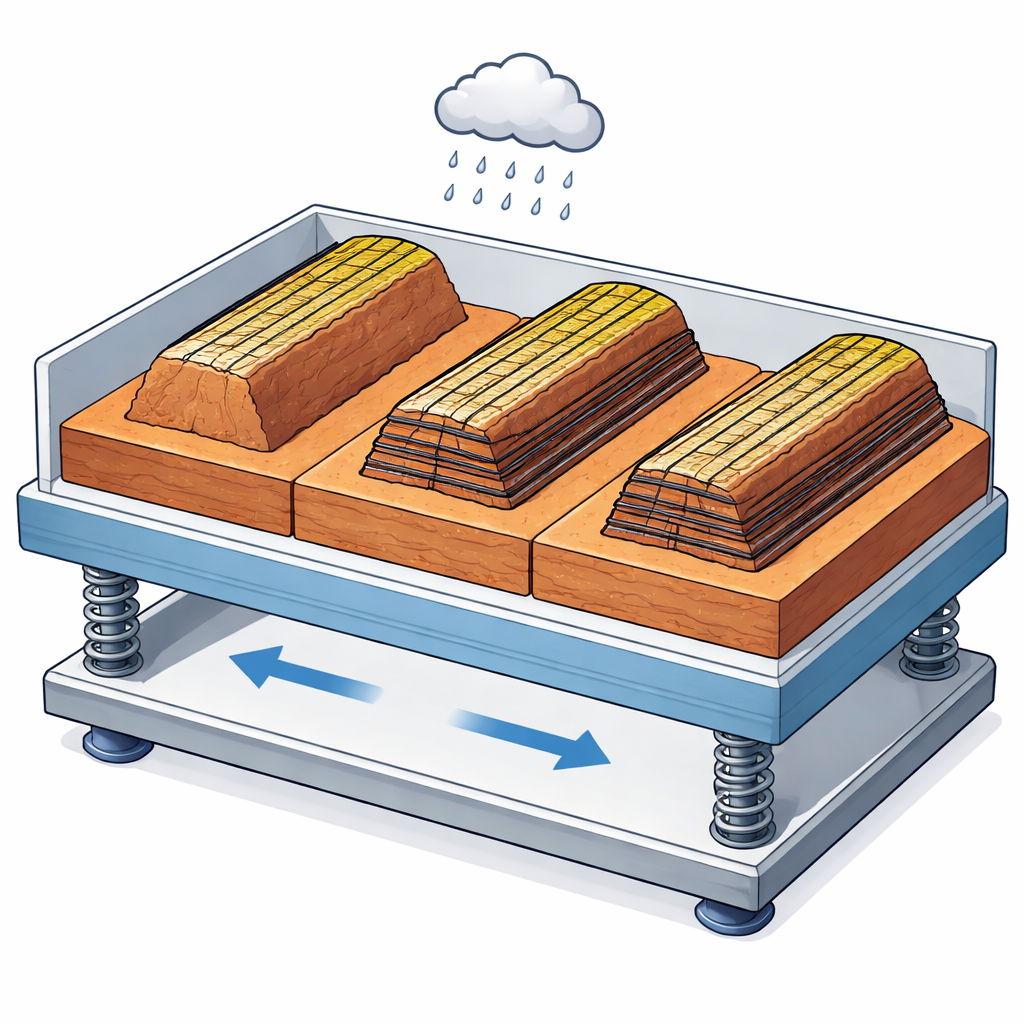
Building small embankments in the lab
The researchers focused on a common reddish tropical soil known as lateritic soil, which can be too soft and water‑sensitive for direct use in construction. Engineers often mix this soil with lime to stiffen it, much like adding cement to sand. In this work, the team created a lime‑treated version of the soil and used it to build three scaled‑down embankments in a large steel box mounted on a shaking table. One embankment was left unreinforced, one had a few layers of synthetic mesh buried inside, and one had many mesh layers throughout. By shrinking the structure but carefully matching its behavior to full‑size embankments, they could safely reproduce real‑world conditions in the laboratory.
Simulating rain and earthquakes
To imitate years of service in a rainy, quake‑prone region, the team first “rained” on the model embankments using a controlled sprinkler system, gradually wetting them from dry to half saturated. At several stages (0% to 50% wetted volume), the embankments were gently shaken with a random vibration signal known as white noise. This allowed the researchers to measure each model’s natural frequency (how fast it tends to vibrate) and damping (how quickly vibrations die out). They then subjected the embankments to three real earthquake records from California and Trinidad, scaled to different strengths. Tiny sensors buried in the soil measured shaking levels, water pressure in the pores between soil grains, and the pressure of the soil against the box walls.
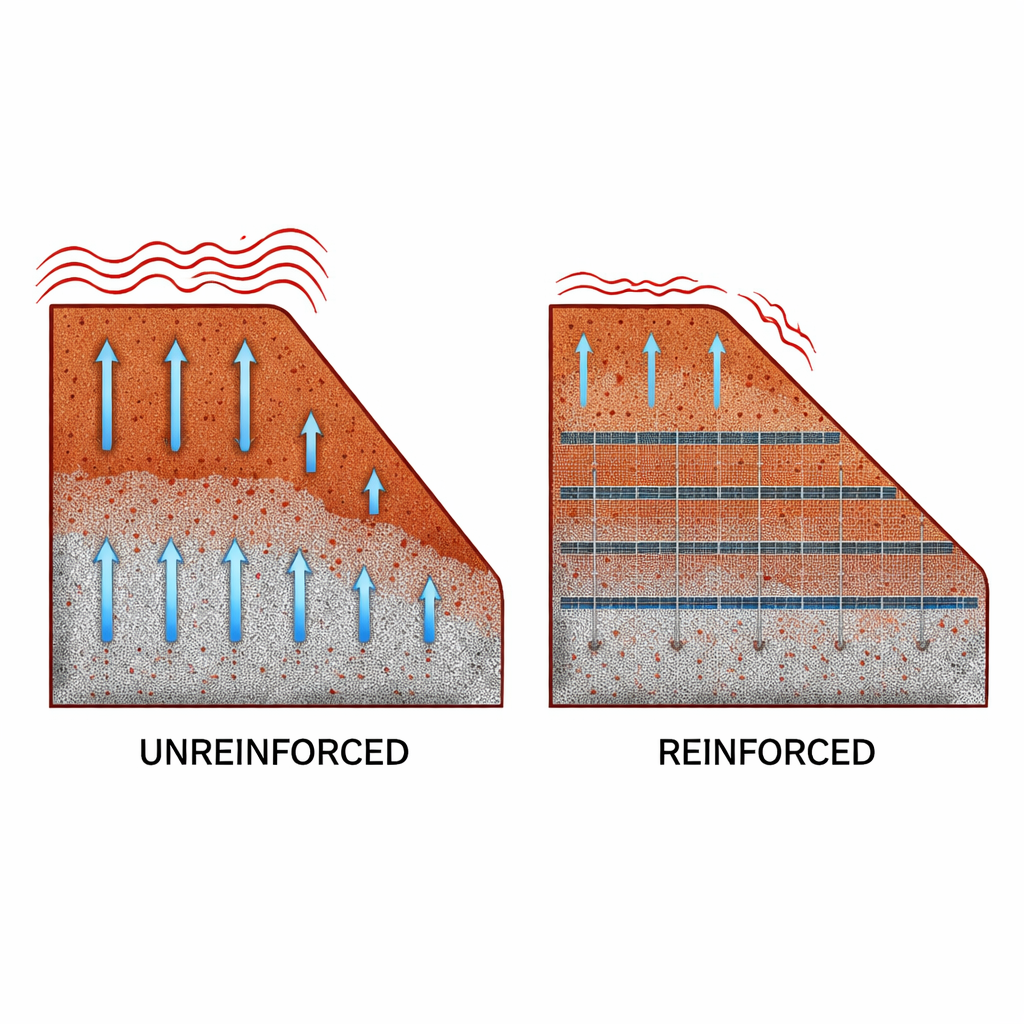
How reinforcement changes the way the soil shakes
Across all wetness levels, mesh‑reinforced embankments vibrated in a healthier way than the plain soil. The fully reinforced model had the highest natural frequency, followed by the partially reinforced one, while the unreinforced version vibrated more slowly. In simple terms, the meshes turned the soil mass into a stiffer, more integrated block. At the same time, the reinforced embankments lost less energy to internal friction, meaning their damping ratios were lower. Although that might sound negative, the crucial finding is that reinforcement reduced how much earthquake shaking grew as it traveled through the embankment. Measured as the peak ground acceleration amplification factor, this growth in shaking was consistently largest in the unreinforced model and smallest in the fully reinforced one, with reductions of up to about one‑third when many mesh layers were present.
Keeping water pressures and soil forces under control
Rain and strong shaking can build up pore water pressure inside soil, making it behave more like a liquid and increasing the chance of failure. The tests showed that as shaking intensity rose, pore water pressure climbed much more sharply in the wettest embankments, especially beyond moderate earthquake strengths. Yet in every case, reinforcement held these pressures down: partially reinforced models showed roughly one‑quarter to one‑third lower peak water pressures than unreinforced soil, while fully reinforced models typically cut them by around 40% to 50%. The pressure of the soil against its boundaries followed a similar pattern. With increasing shaking strength, these earth pressures grew, but remained consistently lowest in the fully reinforced embankments. Overall, the meshes acted like an internal skeleton, tying the soil together and helping it resist both water buildup and sideways thrust during shaking.
What this means for real roads and rails
The study demonstrates that embedding geosynthetic meshes in lime‑treated lateritic embankments can make them stiffer, reduce how much earthquake shaking is amplified, and significantly limit harmful buildup of water and soil pressures under wet conditions. For non‑specialists, the message is straightforward: adding thin, durable sheets inside earthen road and rail embankments can markedly improve their safety and resilience in rainy, seismically active regions. While local soil types still need to be checked before applying these exact numbers, the work provides a strong experimental basis for updating design rules and building more reliable infrastructure on challenging tropical soils.
Citation: Han, X., Gong, J., He, H. et al. Physical model test on the effect of geosynthetic reinforcement on embankment constructed with modified lateritic soil under wetting-vibration. Sci Rep 16, 6954 (2026). https://doi.org/10.1038/s41598-026-36929-w
Keywords: embankment reinforcement, lateritic soil, geosynthetics, earthquake loading, wetting vibration