Clear Sky Science · en
α-Amylase in Aspergillus oryzae-fermented rice promotes the growth of human symbiotic Faecalibacterium Prausnitzii
Why fermented rice and gut microbes matter
What we eat doesn’t just feed us; it feeds trillions of microbes living in our intestines. These tiny partners help shape our digestion, immunity, and even risk of chronic disease. This study explores how a traditional Japanese ingredient—rice fermented with the mold Aspergillus oryzae, used to make sake and miso—can nourish one particularly important gut bacterium called Faecalibacterium prausnitzii, which is strongly linked to gut health and protection from inflammation.
A quiet caretaker of the gut
Faecalibacterium prausnitzii is one of the most common beneficial bacteria in healthy adults, often making up 5–15% of the gut community. It produces butyrate, a short-chain fatty acid that fuels cells lining the intestine, helps seal the gut barrier, and calms overactive immune responses. Lower levels of this bacterium have been reported in obesity, type 2 diabetes, and inflammatory bowel diseases such as Crohn’s disease and ulcerative colitis. Because it is extremely sensitive to oxygen and difficult to formulate as a probiotic pill, scientists are searching for “prebiotics” – food components that help our existing F. prausnitzii thrive inside the gut.
Koji-fermented rice boosts a key microbe
The researchers prepared a water extract from rice fermented with Aspergillus oryzae (rice-koji extract) and added a small amount to a laboratory growth medium for F. prausnitzii. Compared with a control medium containing only water, the fermented rice extract significantly increased bacterial growth, genetic copy number, and ATP (a marker of cellular energy). Under the microscope, the bacteria grew more densely and formed small clusters. These effects suggested that something in the fermented rice was acting like a growth helper for this health-promoting microbe. 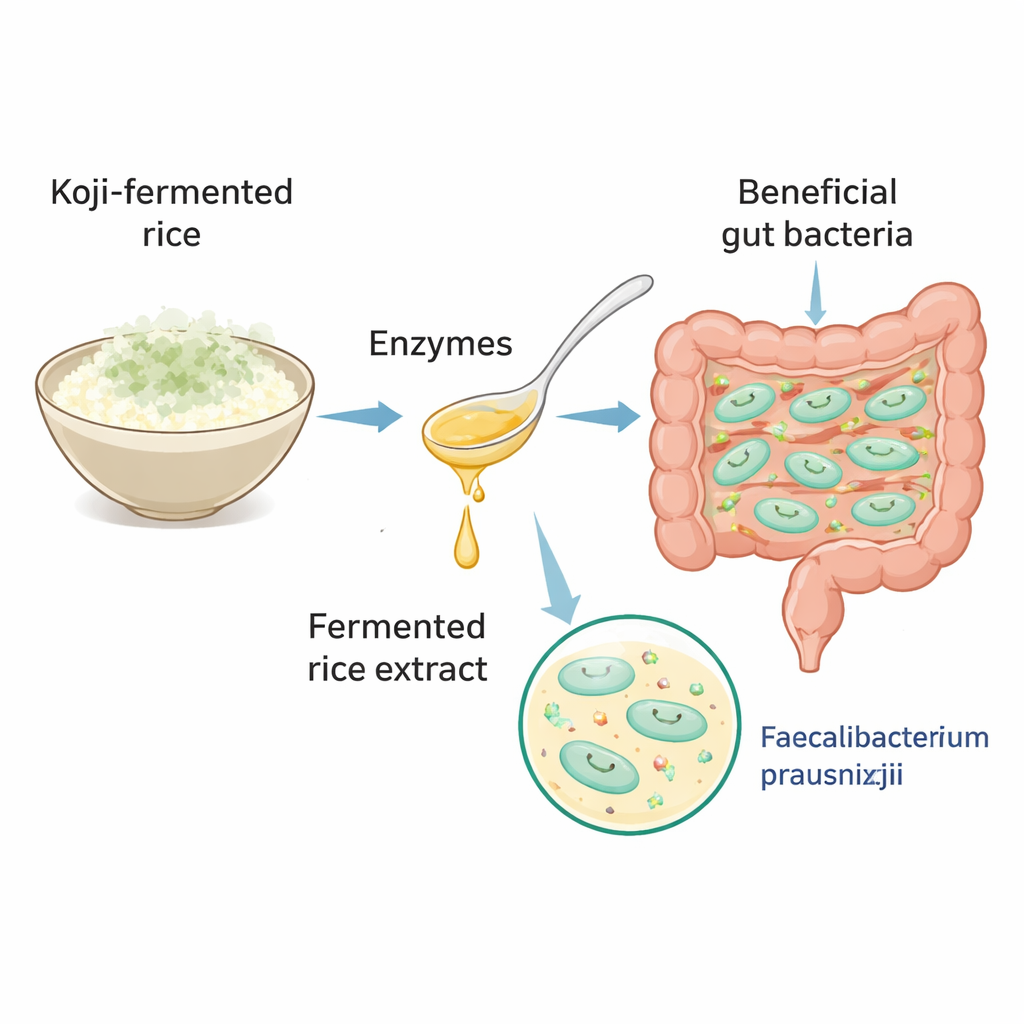
Tracing the helper back to an enzyme
To find the active ingredient, the team separated the proteins in the rice-koji extract into multiple fractions using a charged column. Only a narrow group of fractions stimulated growth and energy production in F. prausnitzii. Protein analysis of the most active fraction showed that it was rich in α-amylase, a starch-digesting enzyme produced by Aspergillus oryzae, along with several other digestive enzymes. Activity tests confirmed that these fractions contained strong α-amylase activity, and that heating the extract—enough to destroy enzymes—also destroyed the growth-promoting effect. This pointed to a heat-sensitive enzyme, rather than a simple nutrient, as the key factor.
How fermented rice makes starch easier to use
The scientists then asked how this enzyme support actually helps the bacterium. They grew F. prausnitzii in media containing different carbohydrate sources. When only complex starch and related chains were present, the α-amylase–rich fraction and the original rice-koji extract both improved growth, ATP levels, and production of butyrate. But when they supplied only simple glucose, the α-amylase fraction no longer helped, while the full extract still gave some benefit. This pattern suggests that α-amylase breaks down starch into shorter sugar chains that F. prausnitzii can take up more easily, saving the bacterium the energy cost of making all its own enzymes. At the same time, other components in the crude extract—such as additional enzymes, peptides, or vitamins—likely provide extra support beyond starch digestion. 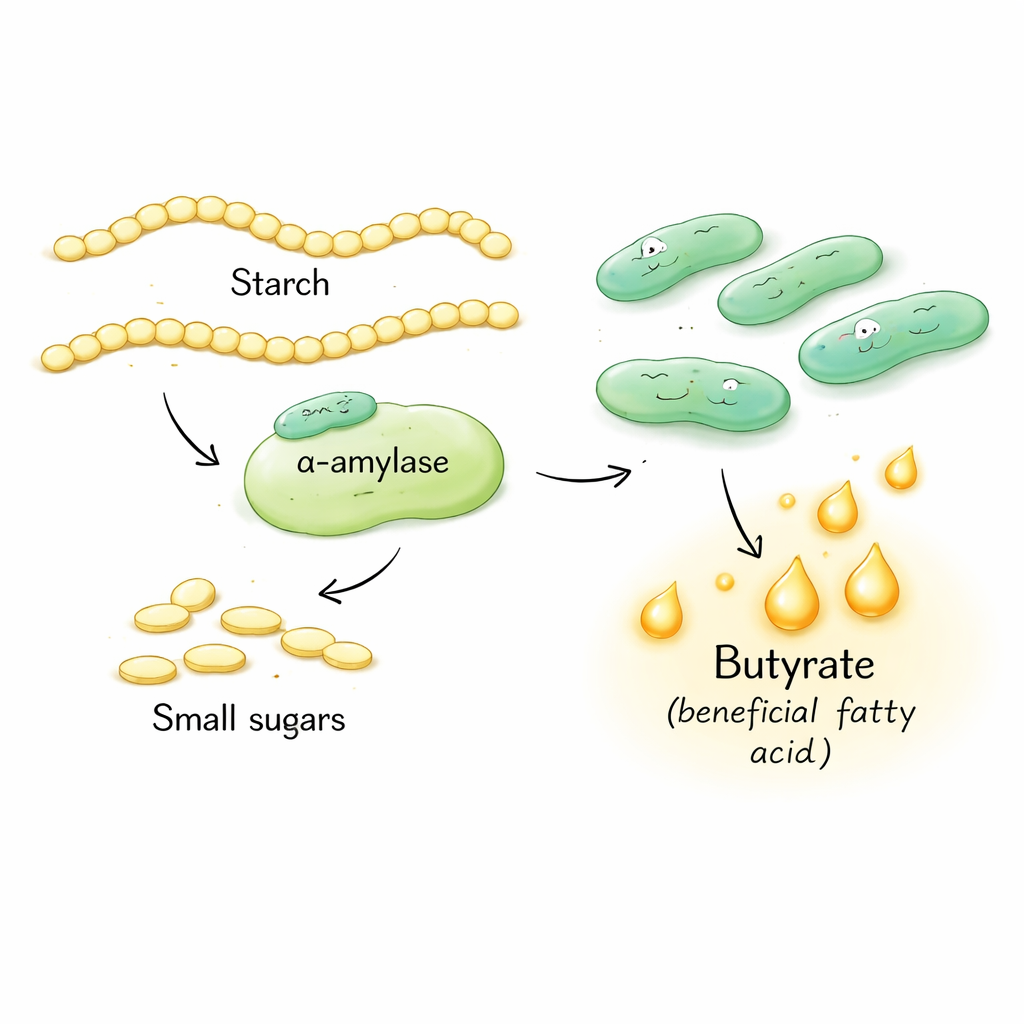
Fermented foods as smart gut helpers
Finally, the team compared the rice-koji extract with a purified preparation of Aspergillus α-amylase at the same activity level. Both boosted the bacterium when starch was the only fuel, but the whole fermented rice extract worked better, emphasizing the power of an enzyme “cocktail” plus micronutrients rather than a single isolated ingredient. Although these experiments were done in test tubes with one bacterial species, the work suggests that traditional fermented foods may aid gut health not only by adding fiber and nutrients, but also by supplying ready-made digestive enzymes that help beneficial microbes like F. prausnitzii flourish and produce more butyrate. In the long term, this principle could guide the design of new functional foods and synbiotics that combine prebiotic starches with targeted enzymes to support a healthier gut ecosystem.
Citation: Nakayama-Imaohji, H., Tada, A., Ogiwara, S. et al. α-Amylase in Aspergillus oryzae-fermented rice promotes the growth of human symbiotic Faecalibacterium Prausnitzii. Sci Rep 16, 5792 (2026). https://doi.org/10.1038/s41598-026-36928-x
Keywords: fermented foods, gut microbiome, Faecalibacterium prausnitzii, prebiotics, butyrate