Clear Sky Science · en
Increased and varied radiation during the Sun’s encounters with cold clouds in the last 10 million years
A shifting cosmic shield around Earth
Earth sits inside a vast bubble blown by the Sun’s wind, a shield that normally deflects much of the high‑energy radiation flying through our galaxy. This paper asks a surprising question: what happens when that shield is crushed by dense interstellar “cold clouds” that the Sun may have plowed through a few million years ago? The authors combine modern space data and powerful computer models to argue that Earth’s surroundings were flooded with unusually strong and long‑lasting radiation during those encounters, with possible consequences for climate, the atmosphere, and even life’s evolution. 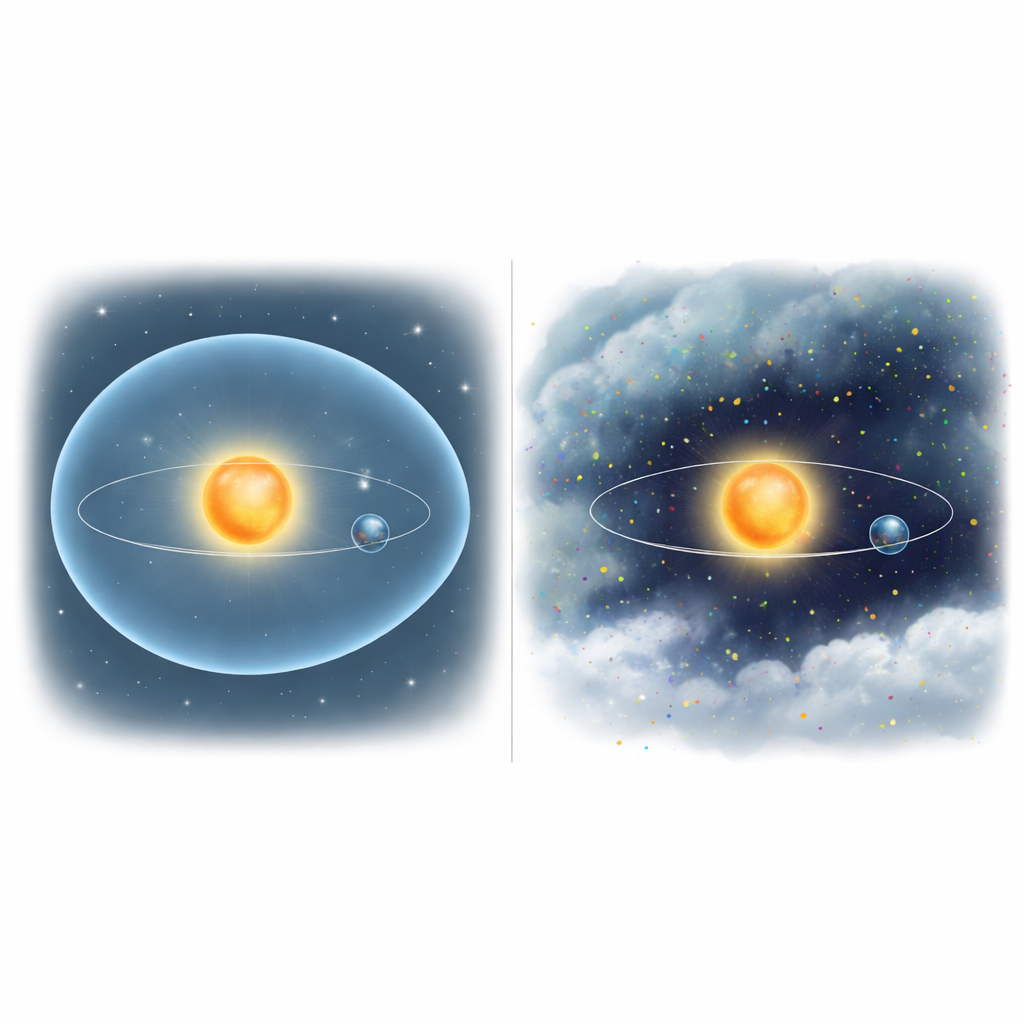
When the Sun’s bubble shrinks
Stars race through the Milky Way, carrying with them bubbles of hot, magnetized gas created by their winds. Our Sun’s bubble, the heliosphere, usually stretches well beyond Pluto and blocks about 70% of incoming galactic cosmic rays at certain energies. Recent mapping of nearby interstellar gas using the Gaia mission suggests that 2–3 and 6–7 million years ago, the Sun probably crossed massive, frigid clouds packed with neutral hydrogen atoms. Using detailed magnetohydrodynamic simulations, the authors show that in such a cloud the pressure of the surrounding gas would crush the heliosphere to a radius of only about a fifth of Earth’s orbital distance. For large parts of its yearly path, Earth would then orbit outside this bubble, directly immersed in the raw galactic environment.
A new kind of long‑lasting space weather
With the protective bubble collapsed inward, Earth’s radiation environment would have changed in two distinct ways. When our planet dipped inside the shrunken heliosphere, it would be bathed in what the authors call heliospheric energetic particles: protons accelerated at the Sun’s outer shock, now sitting extremely close to the Sun. When Earth moved outside the bubble, it would instead face the full force of galactic cosmic rays that are usually partially filtered out. Unlike today’s solar storms, which last hours to days, this pattern—months of intense particle exposure each year—would persist for as long as the Sun remained in the cloud, potentially thousands to hundreds of thousands of years. 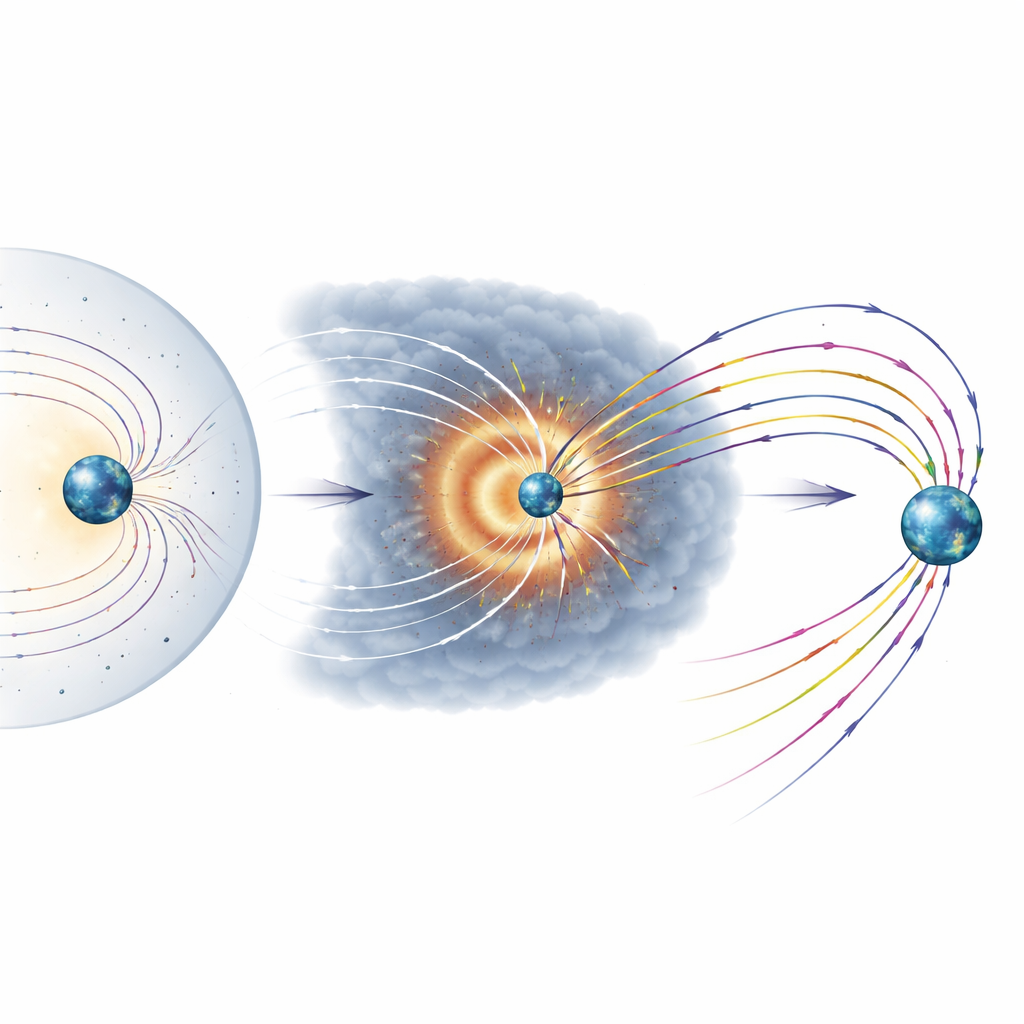
Simulating invisible bullets
To estimate just how intense this radiation could become, the team combined three levels of modeling. First, a three‑dimensional fluid simulation tracked how the heliosphere deforms inside a cold cloud. Second, a “hybrid” plasma simulation zoomed in on the shock where the solar wind slams into the surrounding gas, following individual protons as they are heated and flung into a high‑energy tail. Third, a transport model traced how these particles diffuse and gain even more energy as they bounce back and forth across the shock. Together, these tools show that sub‑10‑million‑electron‑volt protons near Earth would be at least ten times more intense than during the strongest solar particle storm measured in the modern era, and at certain energies vastly outnumber the usual galactic cosmic rays.
Clues in rocks, ice, and atoms
Such radiation does not just vanish; it leaves fingerprints. When high‑energy particles strike our atmosphere, they trigger nuclear reactions that create rare isotopes like beryllium‑10 and carbon‑14, which can be preserved in ice cores, sediments, or mineral crusts. The authors argue that a prolonged increase in heliospheric energetic particles and cosmic rays during a cloud crossing should appear as broad anomalies in these isotopes. Intriguingly, deep‑sea archives already show pulses of radioactive iron‑60 and plutonium‑244 around 2–3 and 6–7 million years ago, hinting at nearby stellar events and enriched interstellar material—consistent with the cold‑cloud scenario. However, current beryllium‑10 records paint a mixed picture, so the team calls for high‑resolution reanalysis using dating methods that do not assume a constant cosmic‑ray background.
Possible effects on climate and life
Increased radiation near Earth could influence both the atmosphere above us and the biosphere below. When energetic particles penetrate the upper air, they create cascades of secondary particles and ionize molecules like nitrogen and oxygen. This chemistry can deplete ozone, alter temperatures in the upper layers, and subtly change how heat is distributed around the globe. Previous work suggests that passing through such clouds could enhance noctilucent clouds, reshape ozone in the mesosphere, and potentially contribute to the cooling and climate swings seen 2–3 and 6–7 million years ago. At the same time, penetrating particles such as muons can reach deep underground and into the oceans, damaging DNA and increasing mutation rates. The authors stress that any biological impacts remain speculative, but note that shifts in radiation could, in principle, affect rates of aging, cancer, and evolution.
A moving Sun and a changing Earth
Overall, the study proposes that Earth’s radiation and climate history cannot be understood by looking only at our orbit around the Sun; we must also consider the Sun’s own journey through the galaxy. Encounters with cold clouds appear rare but plausible, and may offer a new way to connect astrophysical events with geological and biological changes on Earth. The work encourages future research that marries detailed climate and atmospheric models with refined reconstructions of the Sun’s path, to test whether these episodes of amplified radiation really helped nudge Earth’s climate and ecosystems onto new trajectories.
Citation: Opher, M., Giacalone, J., Loeb, A. et al. Increased and varied radiation during the Sun’s encounters with cold clouds in the last 10 million years. Sci Rep 16, 8312 (2026). https://doi.org/10.1038/s41598-026-36926-z
Keywords: heliosphere, cosmic rays, interstellar clouds, space climate, cosmogenic isotopes