Clear Sky Science · en
Updated seismotectonic framework of Abu Dabbab Egypt based on focal mechanisms and stress inversion
Why a Quiet Desert Keeps Rumbling
Along Egypt’s otherwise tranquil Red Sea coast lies Abu Dabbab, a patch of desert famous among local Bedouin for strange underground “knocking” sounds. Scientists now know these sounds come from swarms of tiny earthquakes. This study digs deep beneath Abu Dabbab to find out why this small area shakes so often, what that means for earthquake risk, and how it might also point to a valuable source of clean geothermal energy.
A Hotspot Hidden in the Eastern Desert
Abu Dabbab sits about 30 kilometers inland from the Red Sea, within a broader zone where Africa is slowly pulling away from Arabia, opening the Red Sea Rift. The region has a long record of unusual seismic behavior, including moderate earthquakes in 1955 and 1984 and repeated swarms of thousands of small quakes that occur without a single large “main” event. Previous work revealed higher-than-usual heat flowing out of the crust and hints of molten rock at depth, suggesting that both the stretching of the Earth’s crust and underground magma might be involved. The new study focuses on the intense seismic activity of 2004, when more than 4,000 tiny earthquakes rattled this compact area over just a few months. 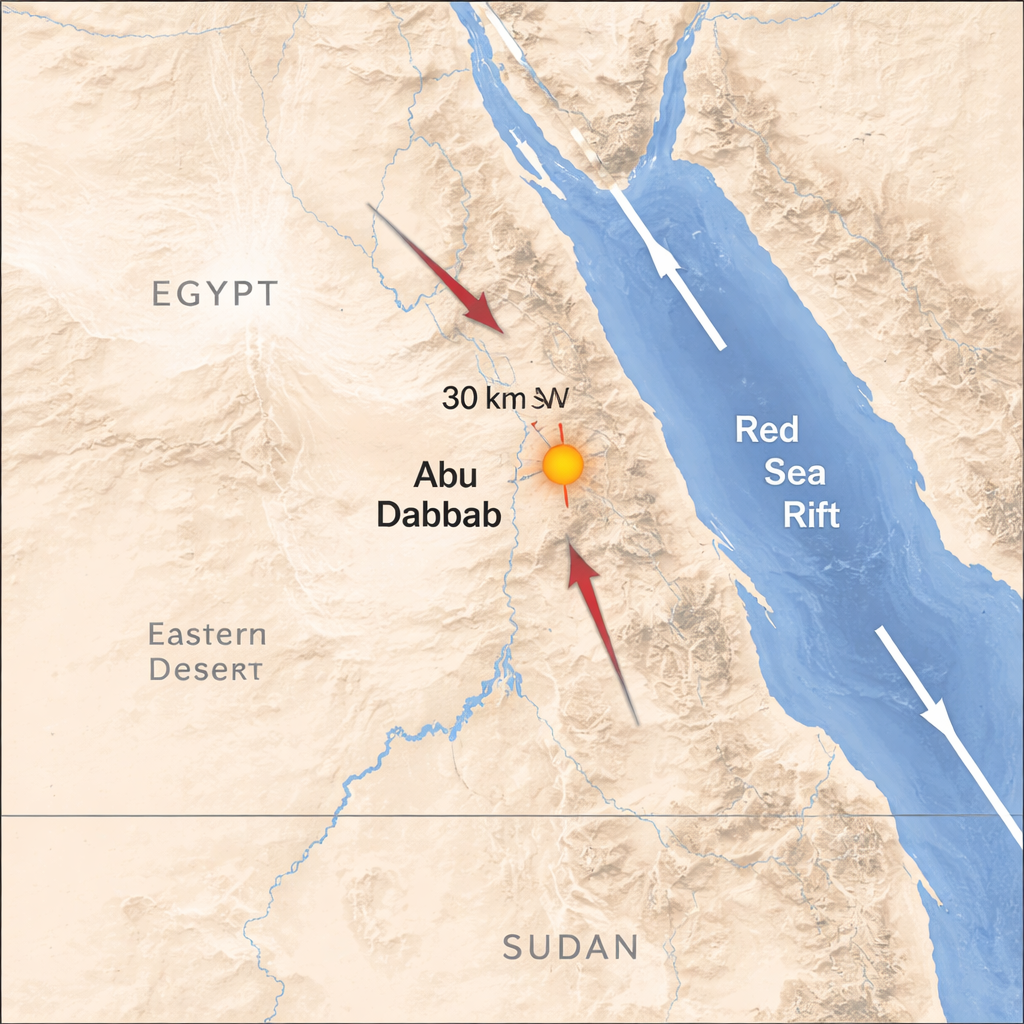
Listening Closely to Hundreds of Small Quakes
To understand what is driving these events, the researchers installed a temporary network of ten sensitive seismometers across Abu Dabbab. From the 2004 swarm, they selected 408 earthquakes, each too small to be felt by most people, and carefully analyzed their digital waveforms. By looking at the first tiny wiggles of seismic waves reaching each station, they reconstructed the “focal mechanisms” of the quakes—essentially, how the rocks broke and along which directions they slipped. They then grouped the earthquakes by depth: shallow (0–5 km), intermediate (5–10 km), and deep (10–20 km), and used a technique called stress inversion to infer the overall push and pull acting on the crust in each layer.
Three Layers, Many Ways to Break Rock
The picture that emerges is of a vertically layered and surprisingly complicated system. In the shallow crust, most earthquakes reflect stretching, where the ground pulls apart and blocks drop down, but some also show sideways motion and even local squeezing. At intermediate depths, all types of faulting coexist—normal, sideways (strike-slip), and reverse—indicating a patchwork of stresses rather than a single simple pattern. Deeper than 10 kilometers, the behavior becomes more uniform again, dominated by oblique normal faulting consistent with long-term pulling apart of the Red Sea margin. Overall, the region experiences NE–SW compression and SE–NW extension, which favor slip along two main families of faults that cut across one another.
Magma as a Hidden Stress Engine
These depth-dependent patterns suggest that regional plate motions alone cannot explain Abu Dabbab’s restless nature. The authors argue that a mid-crustal magmatic intrusion—a body of hot, possibly partially molten rock—acts as a local stress “engine.” As magma presses into the surrounding rocks, it squeezes the crust along its sides and stretches it above its advancing tip. This creates closely spaced zones of both compression and tension, matching the observed mix of faulting styles and the migration of earthquake swarms over time. Seismic images from earlier studies that found unusual wave speeds beneath Abu Dabbab support this view of an active magmatic system feeding the seismicity. 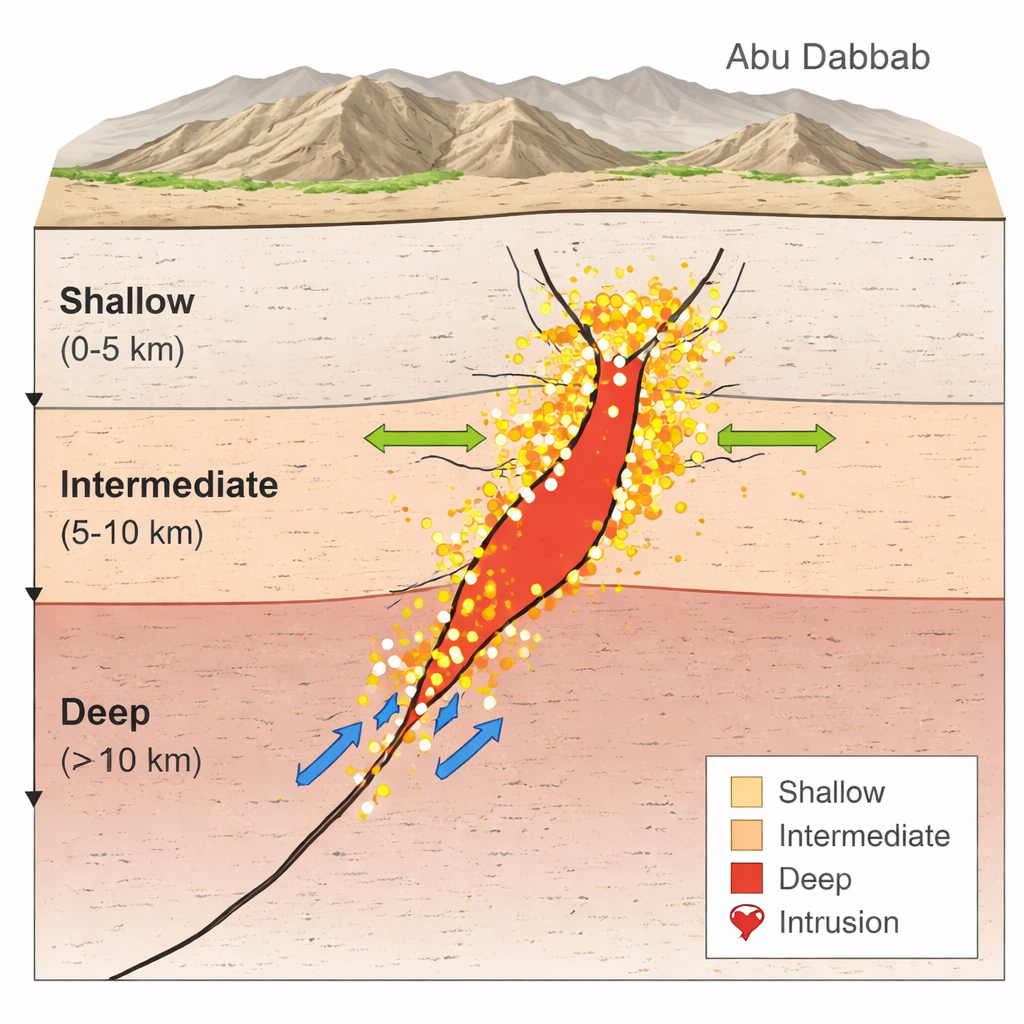
Shaking Risks and Clean Energy Rewards
For people living and working near Abu Dabbab, the findings carry a double message. On one hand, the presence of multiple fault types means that future earthquakes may not all behave in the same way; some may involve more vertical motion, others more sideways slip, making hazard assessments more challenging. The clustering of quakes at shallow and intermediate depths, especially in the southern part of the zone, marks areas where the crust is storing and releasing stress and where monitoring should be most intense. On the other hand, the same features that make Abu Dabbab seismically active—an enduring magmatic heat source and a heavily fractured crust that lets fluids circulate—also make it a prime candidate for geothermal power. In this view, Abu Dabbab is not just a problem to manage, but also a potential contributor to Egypt’s future renewable energy mix.
Citation: Abdelazim, M., Youssef, S.E., Gaber, H. et al. Updated seismotectonic framework of Abu Dabbab Egypt based on focal mechanisms and stress inversion. Sci Rep 16, 6527 (2026). https://doi.org/10.1038/s41598-026-36922-3
Keywords: Abu Dabbab earthquakes, Red Sea rift, crustal stress, magma intrusion, geothermal energy