Clear Sky Science · en
Study on the fast response characteristics and mechanical reliability of high-voltage circuit breaker solenoid valves
Keeping the Lights On When Things Go Wrong
Modern cities rely on vast high-voltage power grids that must keep electricity flowing smoothly even when a fault—like a short circuit—strikes. In these emergencies, special switches called circuit breakers must open in a tiny fraction of a second to protect equipment and prevent blackouts. This article reports on a new ultra-fast “repulsion valve” that helps high-voltage circuit breakers react more quickly and more reliably, promising safer and more resilient power systems.
Why Speed Matters in Power Grids
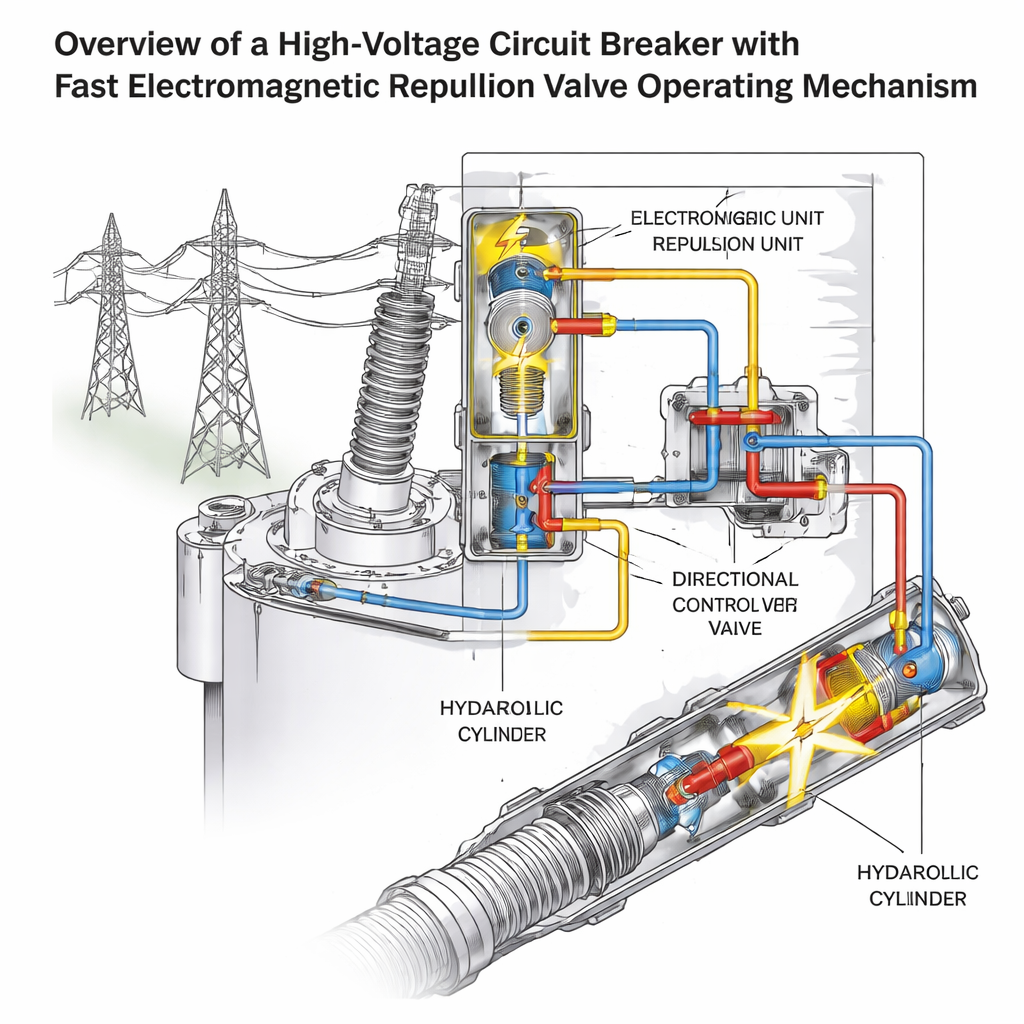
As China’s power demand has surged, transmission voltages and network complexity have grown, and with them the size of possible short-circuit currents. When a fault occurs on a 500 kilovolt line, currents can spike to enormous values that threaten transformers, lines, and breakers themselves. One way to cope is to install bigger and more expensive equipment everywhere, but that quickly becomes uneconomical. A smarter approach is to make key devices, such as high-capacity circuit breakers, react faster so they interrupt dangerous currents before they can do damage. In today’s large breakers, hydraulic operating mechanisms are widely used to provide the force needed to pull contacts apart, yet their internal control valves are driven by relatively slow solenoid coils. This limits how fast the breaker can begin to open.
A New Way to Snap a Valve Open
The researchers propose replacing the traditional magnetic actuator on the control valve with a special electromagnetic “repulsion” mechanism. When a strong pulse of current flows through a coil, it induces swirling eddy currents in a nearby metal disk. The interaction between the coil’s magnetic field and these eddy currents produces a powerful repulsive force that hurls the disk—and a connected drive rod—away from the coil. In the new design, this motion pushes the valve spool of the hydraulic system, instantly switching oil paths from low pressure to high pressure and launching the breaker’s piston and linkages that open the contacts. The study focuses on a dual-disk, dual-coil arrangement designed for a 550 kilovolt fast circuit breaker, where the mechanical shocks and stresses are especially severe.
Simulating Forces, Motion, and Wear
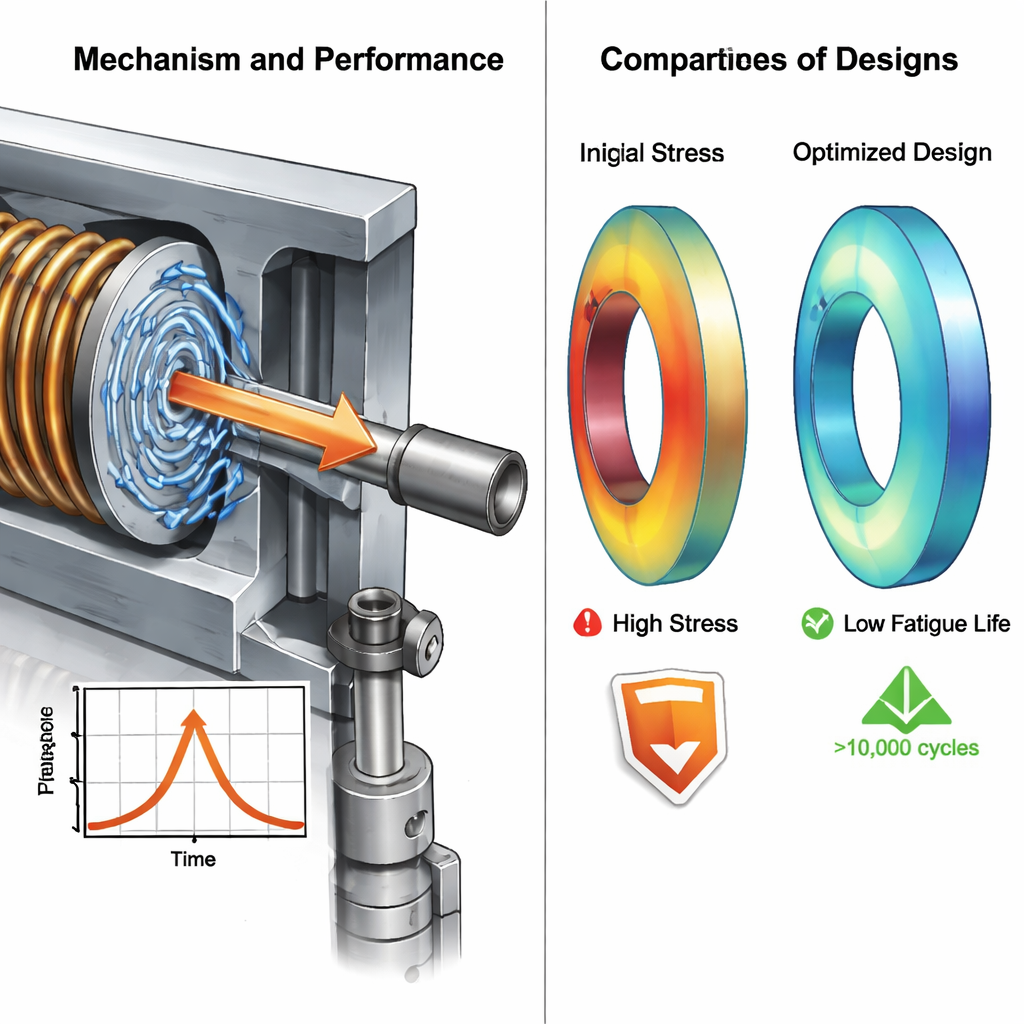
Because no prior design experience existed for such a high-power repulsion device, the team built a detailed computer model that combined electrical circuits, changing magnetic fields, moving mechanical parts, and long-term fatigue behavior of the materials. First, they simulated how an energy-storage capacitor discharges through the coil, generating a brief but intense current pulse. This fed into an electromagnetic model that calculated how much force acts on the metal disk over time. Those forces then drove a structural and motion model to predict how far and how fast the disk and valve move, and what stresses develop in key components. Finally, a fatigue module estimated how many open-close cycles the parts could survive before cracks might appear. The initial design produced an impressive peak force of about 135 kilonewtons in only 0.24 milliseconds and moved the valve through its full 15 millimeter travel in about 1.56 milliseconds—fast enough to sharply cut breaker response time. But the stresses concentrated around the disk’s hub and edges nearly reached the material’s yield strength, giving a projected life of only about 4,600 operations, far short of the 10,000-cycle target for high-voltage breakers.
Tuning the Design for Speed and Strength
To fix this, the researchers turned to a multi-objective evolutionary optimization algorithm—essentially a guided search through many possible designs. They varied parameters such as capacitor size, charging voltage, number of coil turns, and disk thickness and radius, while enforcing practical limits on coil current, part speed, and total stroke time. The algorithm sought designs that still moved the valve quickly but lowered the peak force and mechanical loading on the disk. After hundreds of iterations, it identified a configuration with slightly reduced voltage and re-dimensioned coil and disk geometry. In this optimized design, the peak repulsive force dropped from about 135 to 97 kilonewtons, the force pulse became smoother and longer, and the valve still completed its 15 millimeter stroke within 1.8 milliseconds. Crucially, the maximum stress in the repulsion disks fell enough that their calculated fatigue life exceeded 10,000 cycles, satisfying mechanical reliability requirements.
From Computer Model to Working Hardware
The team then built a full high-voltage circuit breaker prototype using the optimized repulsion valve and tested it on a dedicated mechanical test platform with precise sensors. The breaker was operated 10,000 times in succession, while the opening startup time was recorded regularly. Results showed that the new mechanism consistently began moving in about 2.6 milliseconds, with very small variation from operation to operation—roughly 75–80% faster than traditional hydraulic systems. No component damage was observed, and the measured motion of the repulsion disk closely matched the model’s predictions, including the characteristic “steep then flat” displacement curve as the built-in polyurethane cushion absorbs the final impact.
What This Means for Everyday Power Users
For non-specialists, the key takeaway is that the researchers have developed and validated a new way for high-voltage circuit breakers to react much more quickly without sacrificing durability. By using a powerful but carefully controlled electromagnetic “kick” to snap a hydraulic valve open, they cut response times while keeping stresses within safe limits over many thousands of operations. This combination of computer-aided multiphysics design, optimization, and real-world testing points the way toward faster, more reliable protection for large power grids, reducing the risk that faults will cascade into widespread outages that affect homes and industries alike.
Citation: Zhang, Y., Zhang, G., Wang, X. et al. Study on the fast response characteristics and mechanical reliability of high-voltage circuit breaker solenoid valves. Sci Rep 16, 7119 (2026). https://doi.org/10.1038/s41598-026-36911-6
Keywords: high-voltage circuit breakers, electromagnetic repulsion, hydraulic operating mechanisms, power grid protection, multiphysics simulation