Clear Sky Science · en
Research on inter-well connectivity in CO2 flooding based on long short-term memory graph attention network
Why this study matters for energy and climate
Much of the world’s oil still comes from aging fields where it is increasingly difficult and costly to extract the remaining crude. One promising approach, CO2 flooding, injects carbon dioxide underground to push out more oil while also storing CO2 that would otherwise enter the atmosphere. But operators often cannot see how injected gas actually travels between wells. This paper presents a new data-driven way to "map" those hidden connections in real time, helping make CO2 flooding more efficient and potentially more climate friendly.
Making invisible underground highways visible
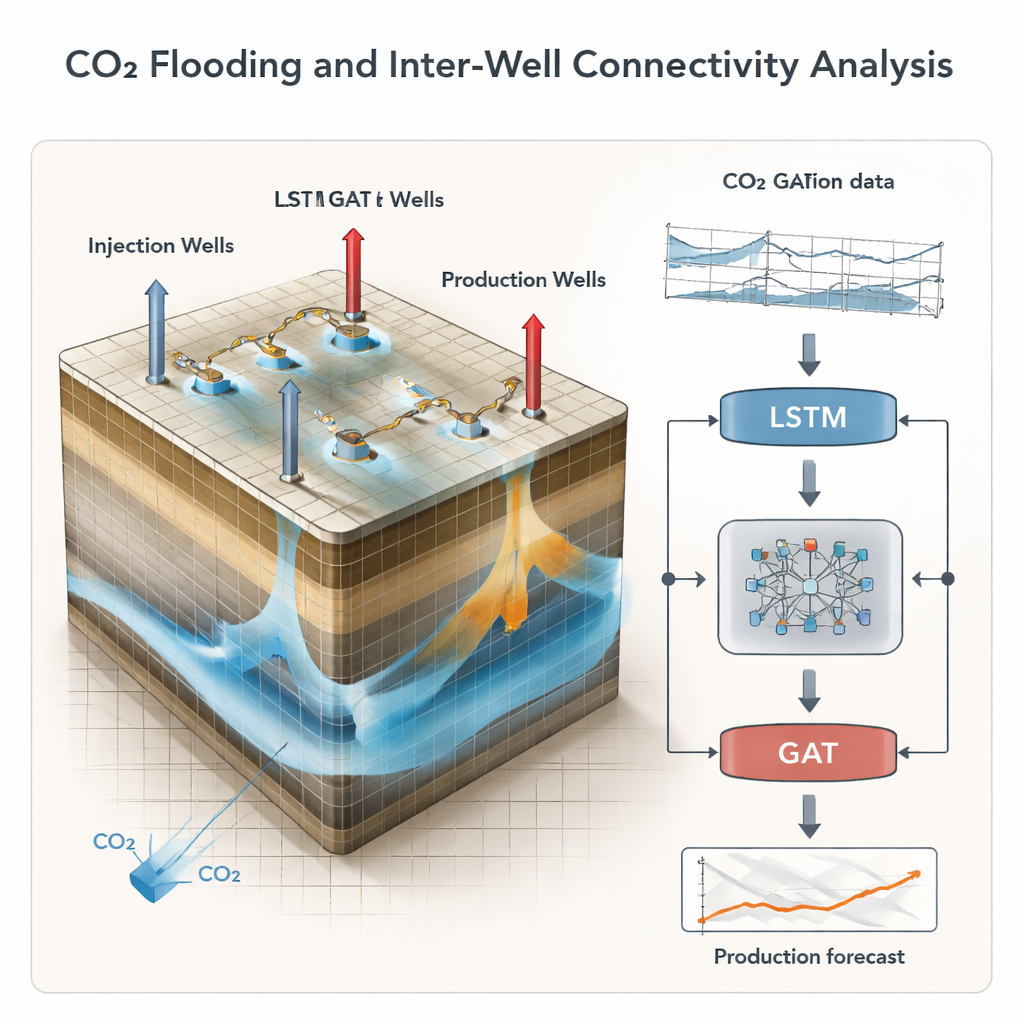
When CO2 is injected into an oil reservoir, it does not spread evenly. Instead, it follows preferred underground paths — like hidden highways — created by variations in rock permeability and existing fractures. Some injection wells strongly affect certain production wells; others barely matter. This pattern, called inter-well connectivity, controls how effectively CO2 can sweep oil toward producing wells and how much gas bypasses useful zones or breaks through too quickly. Accurately tracking these connections is crucial for tuning injection and production plans, but traditional methods often require costly field tests or simplified assumptions that struggle in complex reservoirs.
Limitations of conventional tools
Engineers have long relied on techniques such as pressure interference tests, chemical tracers, and streamline simulations to infer how wells communicate underground. More recently, statistical tools and classic machine learning models have been added to the toolkit. While each method brings insights, they also have drawbacks: field tests are slow and expensive; simplified physical models can miss important details in highly variable rocks; and standard machine learning often treats wells as isolated data streams, ignoring the evolving network of interactions between them. These approaches also tend to assume that the pattern of connections is fixed in time, even though CO2 fronts, pressures, and flow channels change as injection continues.
A smart network that learns time and space together
The authors introduce a hybrid artificial intelligence model that is designed to follow both how wells change over time and how they influence one another in space. One part of the model, called a long short-term memory network (LSTM), specializes in learning patterns from time series — here, the daily injection and production rates at each well. The other part, a graph attention network (GAT), treats the wells as nodes in a network and learns which pairs are most strongly connected, assigning higher weights to more influential links. Together, this LSTM–GAT system can both forecast future production and estimate the strength of connections between injection and production wells in a way that updates as the reservoir evolves.
Building a living map of well connections
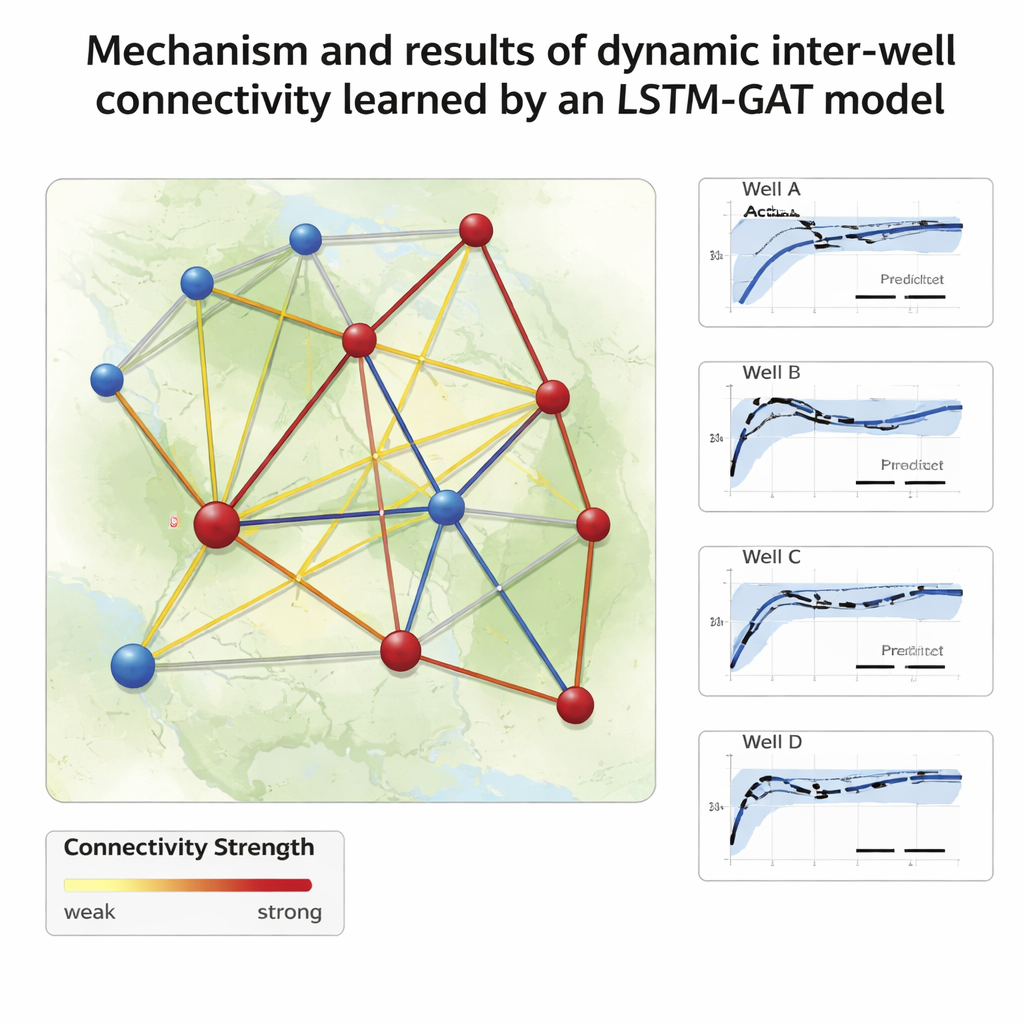
To feed this model, the researchers used a widely studied three-dimensional synthetic reservoir called the EGG model and simulated CO2 flooding over a decade for eight injection wells and four production wells. They constructed a “living” map of connections by examining how fluctuations in injection at one well show up, with a time delay, in the production at another. A measure called maximum lagged cross-correlation was used to infer the likely strength and timing of each connection within sliding time windows. Only pairs that were both sufficiently correlated and reasonably close in space were kept as edges in the network. This evolving graph was then passed to the GAT, which further refined the importance of each link while the LSTM captured the day-to-day behavior of each well.
How well the new approach performs
The hybrid model was rigorously tuned and tested on thousands of simulated days of data. It achieved high accuracy in predicting gas production rates, with a test R² of about 0.94, meaning it explained most of the variation in the simulated field. When the inferred connectivity maps were compared with detailed flow patterns from traditional numerical simulations, strong links in the learned network lined up with high-permeability zones and dense flow paths. The authors also compared their method to a range of other models, from simple regression to standalone graph networks and time-series methods. Across the board, the LSTM–GAT framework provided more accurate forecasts and more realistic connectivity patterns, while purely static graph models lagged significantly behind.
Implications for cleaner and more efficient oil recovery
For a lay reader, the core message is that this study offers a smarter, more flexible way to track how injected CO2 moves through the subsurface, using the data that modern fields already collect every day. By turning production histories into a dynamic map of underground connections, operators could better decide where to inject, which wells to throttle back, and how to avoid wasteful gas channeling. Although the work is demonstrated on a controlled synthetic model rather than real, messy field data, it points toward future tools that could make CO2 flooding both more economical and more effective at locking away carbon, aligning short-term energy needs with longer-term climate goals.
Citation: Dong, Z., Xu, Y., Lv, W. et al. Research on inter-well connectivity in CO2 flooding based on long short-term memory graph attention network. Sci Rep 16, 6664 (2026). https://doi.org/10.1038/s41598-026-36910-7
Keywords: CO2 flooding, inter-well connectivity, graph neural networks, production forecasting, enhanced oil recovery