Clear Sky Science · en
Endangered bowhead whales might buffer climate change with individual variability in movement patterns
Why these Arctic giants matter
High in the Arctic Ocean, a tiny population of bowhead whales is trying to survive in one of the fastest-warming regions on Earth. These whales, some of which can live for more than 200 years, were nearly wiped out by commercial whaling and now face a new threat: rapid climate change that is transforming their icy home. This study asks a simple but urgent question with big implications for conservation: can endangered bowhead whales in the East Greenland–Svalbard–Barents Sea region cope with a warming Arctic by changing the way they move and feed?
Tracking whales with space-age tags
To explore this question, researchers attached small satellite tags to 38 bowhead whales between 2017 and 2021. These devices sent back more than 80,000 location signals, allowing scientists to follow the whales for weeks to almost two years at a time. Using advanced statistical tools, the team filtered out noisy data, connected the dots between positions, and estimated how fast and how straight each whale was swimming. From this, they could distinguish between long, direct travel and slower, more meandering movements that likely signal feeding. The result was one of the most detailed movement records ever collected for this endangered population.
A surprising year-round Arctic stronghold
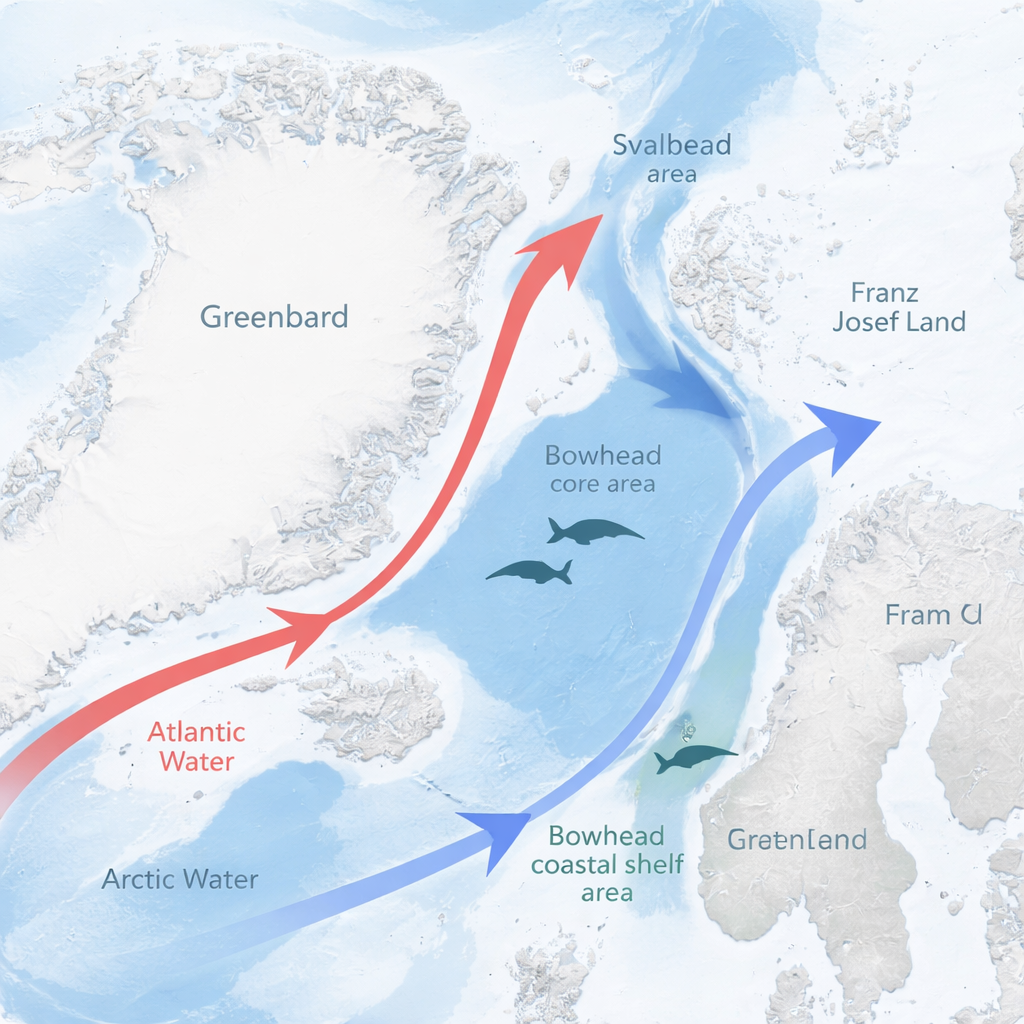
The tagged whales did not behave like classic migrants that commute predictably between separate summer and winter grounds. Instead, they occupied a huge home range stretching from the East Greenland continental shelf, across the Fram Strait, to waters around Franz Josef Land. Within this range, the whales showed a strong and almost exclusive preference for frigid Arctic surface waters—typically well below 0 °C—and for areas inside the sea ice edge. They split their time between relatively shallow continental-shelf waters and a deep offshore hotspot over part of the Fram Strait, where depths exceed 4,000 meters. This offshore core area, unusual for a coastal-feeding whale, was used in almost every month of the year and likely serves both as a key feeding site and as a breeding ground.
Feeding where ice, currents, and seafloor meet
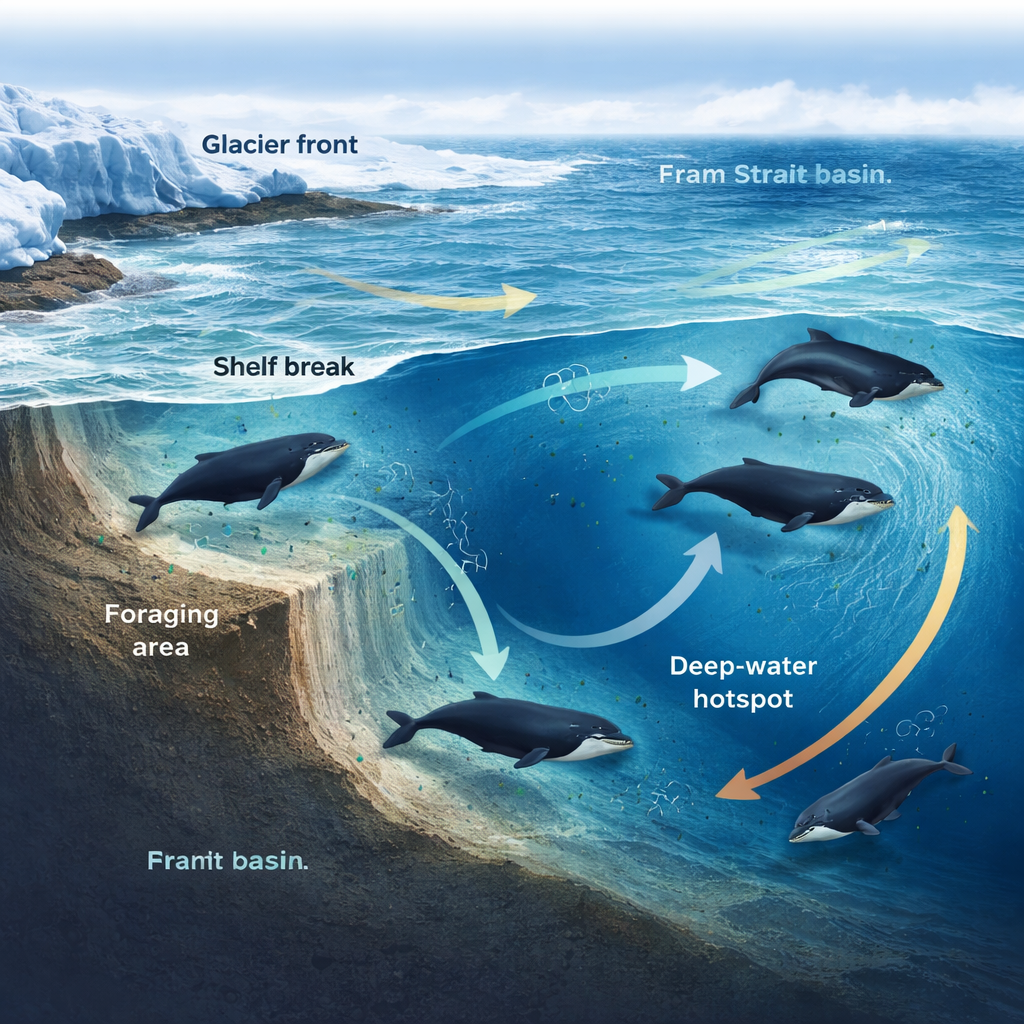
The study found that whale movements closely followed features known to concentrate plankton, the tiny crustaceans that bowheads filter from seawater. Whales favored the deeper parts of the East Greenland Shelf and especially the shelf break, where the seafloor drops steeply toward the deep basin. They also spent more time near the fronts of glaciers that terminate in the sea, where meltwater and upwelling draw nutrients and zooplankton toward the surface. In the deep offshore hotspot, swirling eddies and the collision of cold Arctic Water with warmer Atlantic Water appear to create a stable “oasis” of food beneath sea ice. Whales slowed down and showed more resident, likely feeding, behavior in places where sea surface height and temperature patterns signaled such productive mixing zones.
Many strategies in a changing Arctic
Despite sharing the same icy environment, individual bowhead whales did not use it in the same way. Some animals stayed mostly on the East Greenland Shelf, while others made repeated trips between Greenland and Franz Josef Land. A few ranged far north over deep basins but quickly turned back, suggesting those waters offered little food. These travel choices did not follow a strict seasonal schedule, and whales used both inshore and offshore hotspots in different months. This kind of individual variation—multiple movement and feeding strategies within a single small population—may reduce competition for food and spread risk as conditions shift from year to year.
Climate risk and a possible buffer
The study concludes that these bowhead whales are tightly tied to cold, ice-covered waters and to ocean fronts where Arctic and Atlantic waters meet. As the Arctic continues to warm, sea ice will shrink and the structure of currents and fronts in the Fram Strait is expected to change, potentially disrupting the food oases on which the whales depend. Because bowheads reproduce slowly and live in a highly specialized environment, they are intrinsically vulnerable. Yet the wide range of movement patterns observed here hints at a form of resilience: if different individuals use different habitats and routes, the population as a whole may be better able to adjust as the Arctic transforms. In that sense, the whales’ varied ways of moving through the seascape could act as a natural buffer against climate change, buying crucial time for conservation efforts.
Citation: Nowak, B.V., Lydersen, C., Heide-Jørgensen, M.P. et al. Endangered bowhead whales might buffer climate change with individual variability in movement patterns. Sci Rep 16, 6309 (2026). https://doi.org/10.1038/s41598-026-36908-1
Keywords: bowhead whales, Arctic warming, sea ice, animal movement, marine conservation