Clear Sky Science · en
Sustainable spectrofluorimetric determination of berberine in dietary supplements via Erythrosin B Ion-Pair complexation with mechanistic investigation, Box-Behnken optimization, and green chemistry assessment
Why this bright yellow plant compound matters
Berberine, a natural yellow compound found in plants like barberry and goldenseal, has become a popular ingredient in dietary supplements for blood sugar, cholesterol, and heart health. As sales soar, so do concerns that the actual amount of berberine in capsules may not match the label. This paper describes a new, simple, and environmentally friendly lab test that can accurately measure berberine in supplements using light, helping protect consumers and reduce the chemical footprint of quality control.
Turning plant pills into light signals
The authors focus on a colorful dye called Erythrosin B, already used as a food colorant, and discover that it can serve as a sensitive probe for berberine. When Erythrosin B is illuminated with greenish light, it usually emits a strong pink glow. But when berberine is present, it forms a tight pair with the dye, and this pairing dims the glow in a predictable way. By dissolving a capsule, mixing the solution with the dye in water, and measuring how much the light fades, scientists can deduce exactly how much berberine is in the product. 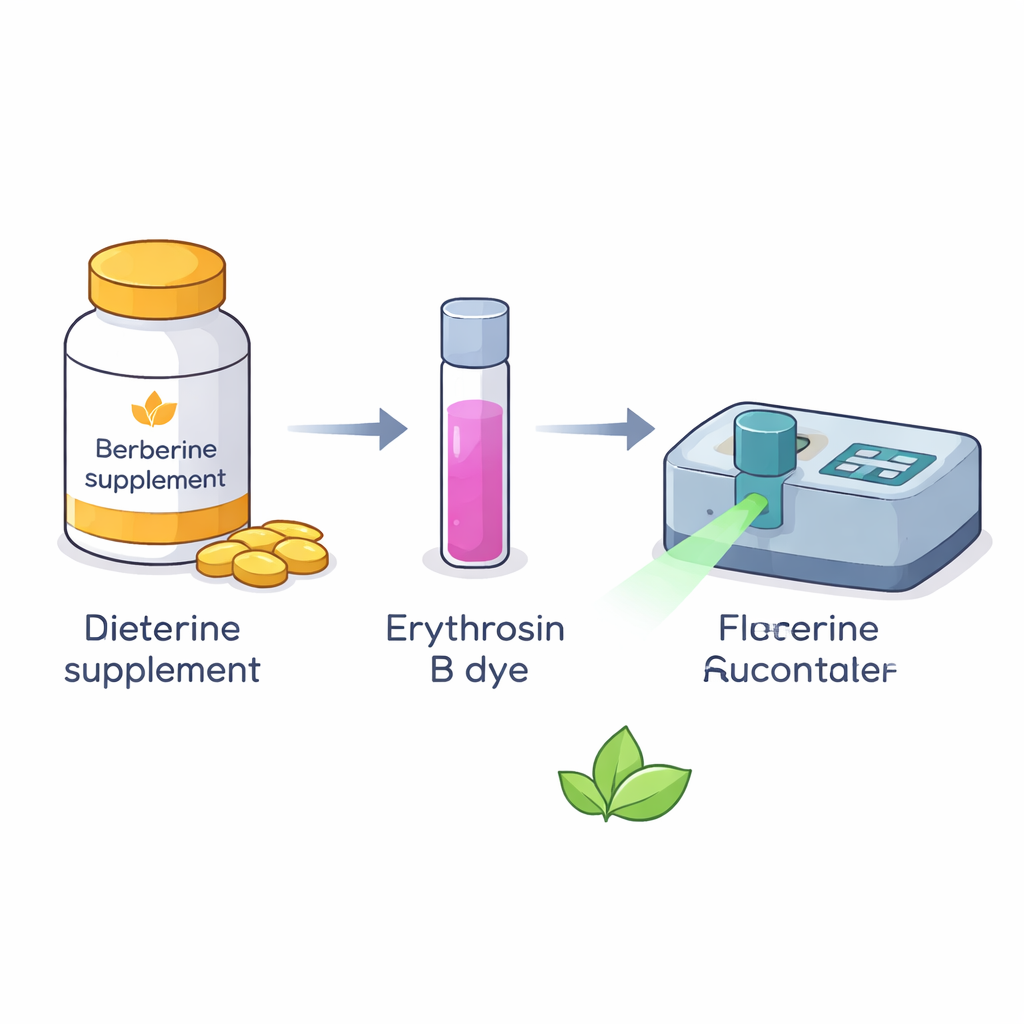
Peeking under the hood of the light-dimming trick
To be sure this effect is reliable, the team investigates why the glow fades. They show that berberine and Erythrosin B join together before the dye is excited by light, forming a stable pair rather than just bumping into each other at random. This is confirmed by studying how the effect changes with temperature and by analyzing small shifts in how the mixture absorbs and emits light. Computer models at the molecular level support this picture: the dye and berberine line up so that opposite charges attract, tiny hydrogen bonds form, and even subtle interactions with iodine atoms help hold the pair together. All these forces make the dye–berberine pair stable enough to produce a consistent analytical signal.
Tuning the test for real-world use
Designing a practical test means finding conditions that work every time. Instead of trial and error, the researchers use a statistical approach (Box–Behnken design) to map how factors such as acidity (pH), dye amount, buffer volume, and waiting time influence the light-dimming effect. They find that mildly acidic conditions, a specific dye level, and only a few minutes of waiting give the strongest and most reproducible response. Under these conditions, the fading of the pink glow tracks berberine concentration in a straight line over a wide range, down to tiny amounts that rival or exceed the sensitivity of standard high-performance liquid chromatography (HPLC) systems.
Putting the method to the test on real supplements
Armed with the optimized procedure, the authors analyze commercial berberine capsules from two brands. The measured contents fall comfortably within accepted pharmaceutical limits and closely match results from a validated HPLC method, a workhorse of modern drug analysis. Statistical comparisons show no meaningful differences between the new light-based method and HPLC in either accuracy or precision. One important nuance emerges: the dye also pairs with other closely related plant alkaloids that share similar charge and shape. That means this approach is ideal for standardized products where berberine is overwhelmingly the main alkaloid, but not for crude plant extracts containing many similar compounds. 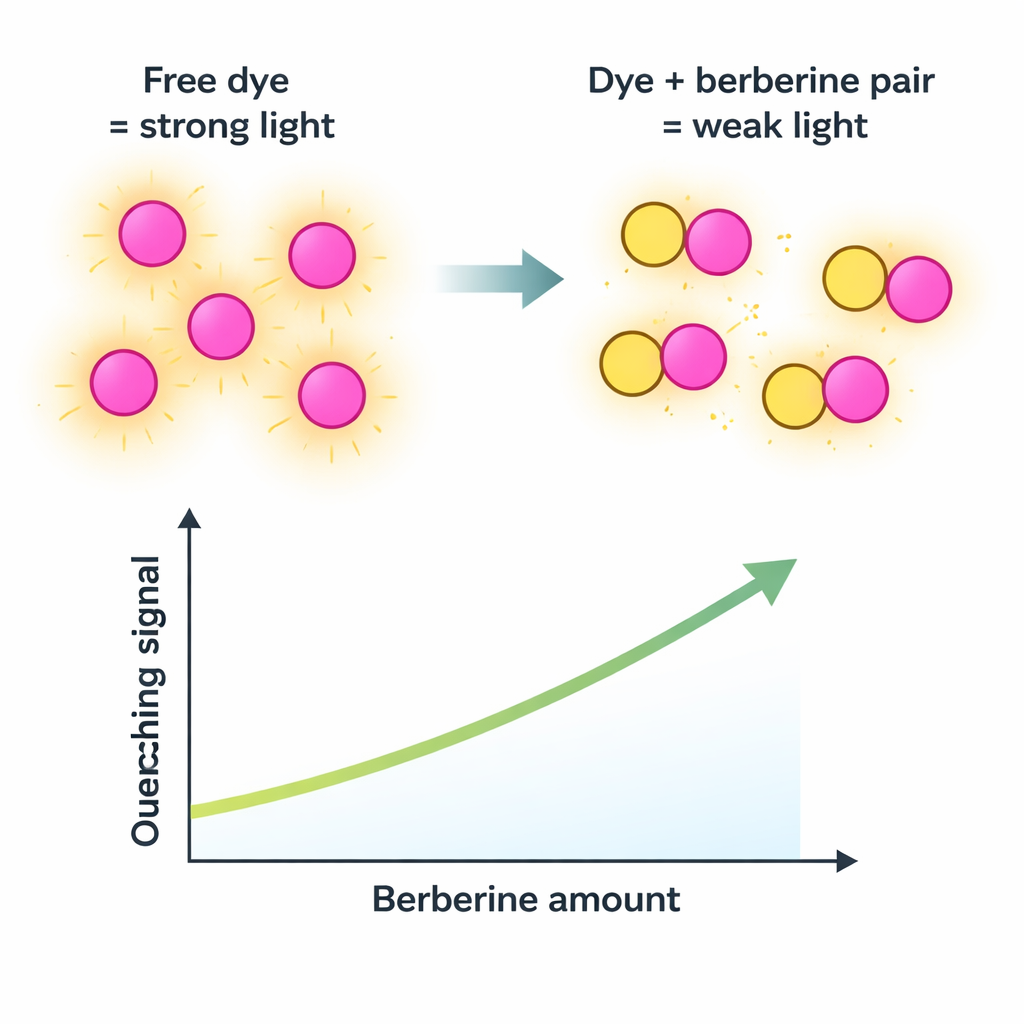
Greener measurements for a growing supplement market
Beyond performance, the method is designed to be kind to both budgets and the environment. It uses water instead of harmful organic solvents, relies on modest, widely available fluorescence instruments, and produces very little chemical waste. Independent “green chemistry” scoring tools rate the method highly for low energy use, minimal hazards, and strong practical usability. For non-specialist readers, the bottom line is straightforward: this study delivers a quick, affordable, and sustainable way to check whether berberine supplements contain what they claim, providing a useful tool for regulators, manufacturers, and ultimately consumers who depend on these products.
Citation: Al Shmrany, H., Alqahtani, A., Alqahtani, T. et al. Sustainable spectrofluorimetric determination of berberine in dietary supplements via Erythrosin B Ion-Pair complexation with mechanistic investigation, Box-Behnken optimization, and green chemistry assessment. Sci Rep 16, 4712 (2026). https://doi.org/10.1038/s41598-026-36903-6
Keywords: berberine, dietary supplements, fluorescence, green analytical chemistry, quality control