Clear Sky Science · en
Near-infrared spectroscopy for moisture content prediction in soil-mixed woody biomass
Why Moisture in Wood Fuel Matters
As societies look for cleaner energy, wood chips and other plant leftovers are becoming important fuel sources. But there is a simple detail that can make or break their usefulness: how much water they contain. Too much moisture means less energy, more mold, and even the risk of self-heating fires during storage. The challenge grows when bits of soil are mixed in with the wood during harvesting. This study explores whether a light-based method called near‑infrared (NIR) spectroscopy can quickly measure moisture in these soil‑contaminated biomass piles, offering a faster alternative to slow, oven‑based tests.
From Forest Leftovers to Test Samples
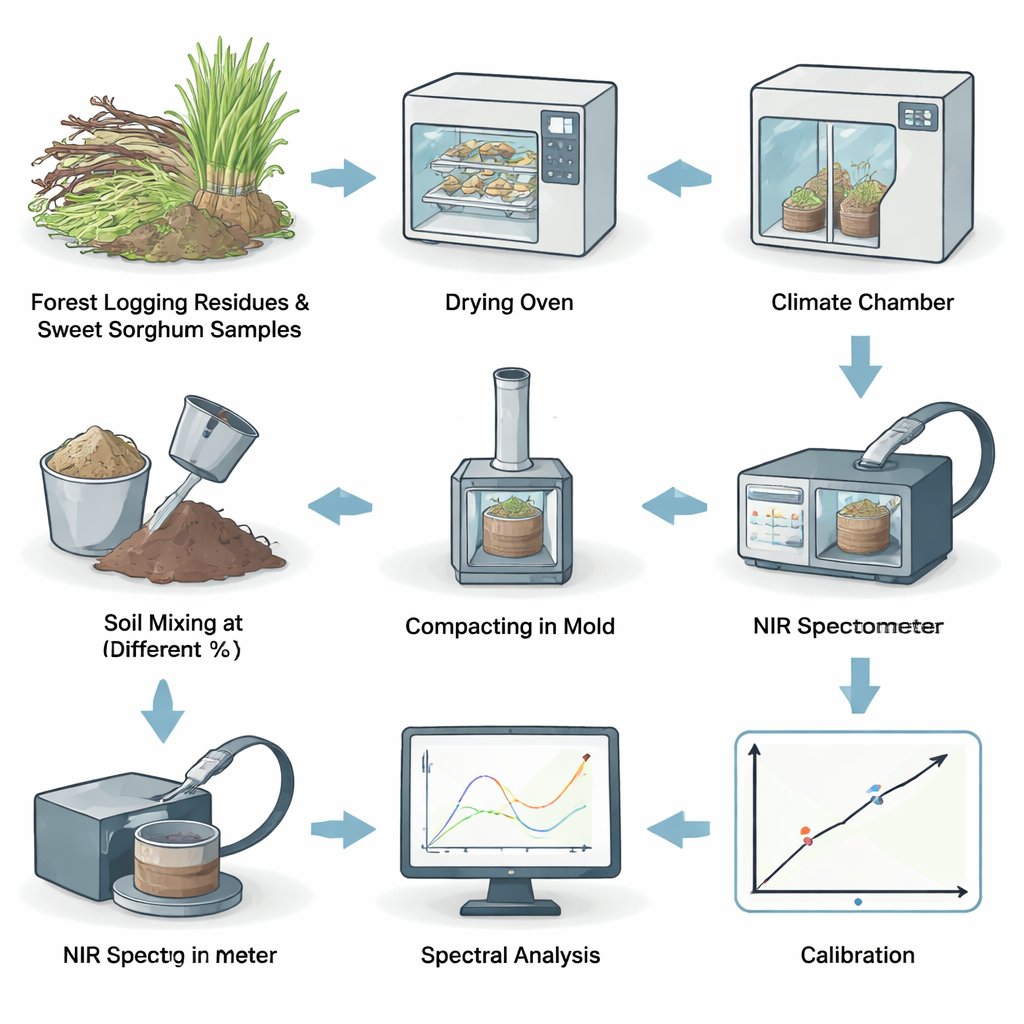
The researchers focused on two types of biomass that represent common fuel sources. One was logging residues—branches and tops left over after trees are cut. These are dense, woody pieces with tough cell walls and relatively stable structure. The other was sweet sorghum, a tall grass with more porous tissues and high sugar content. Sweet sorghum behaves very differently under light, making it a good stand‑in for herbaceous crops used in bioenergy. To mimic real‑world conditions, the team dried all samples, then re‑wetted them in a climate chamber set to different temperatures and humidity levels, creating a wide range of moisture contents from about 3% to 16%.
Adding Realistic Dirt to the Mix
In actual logging operations, biomass rarely stays clean. Soil clings to branches dragged along the ground or stored in open piles. To capture this reality, the scientists carefully mixed a controlled forest soil into the biomass at six levels: 0, 1, 5, 10, 20, and 30% by weight. Lower levels resemble clean operations; higher levels represent badly contaminated piles. For each combination of biomass type and soil level, they formed compact, uniform “pucks” in a mold. This step reduced the effect of irregular packing density, which can otherwise distort how light travels through the material and confuse moisture measurements.
Shining Light and Cleaning Up the Signal
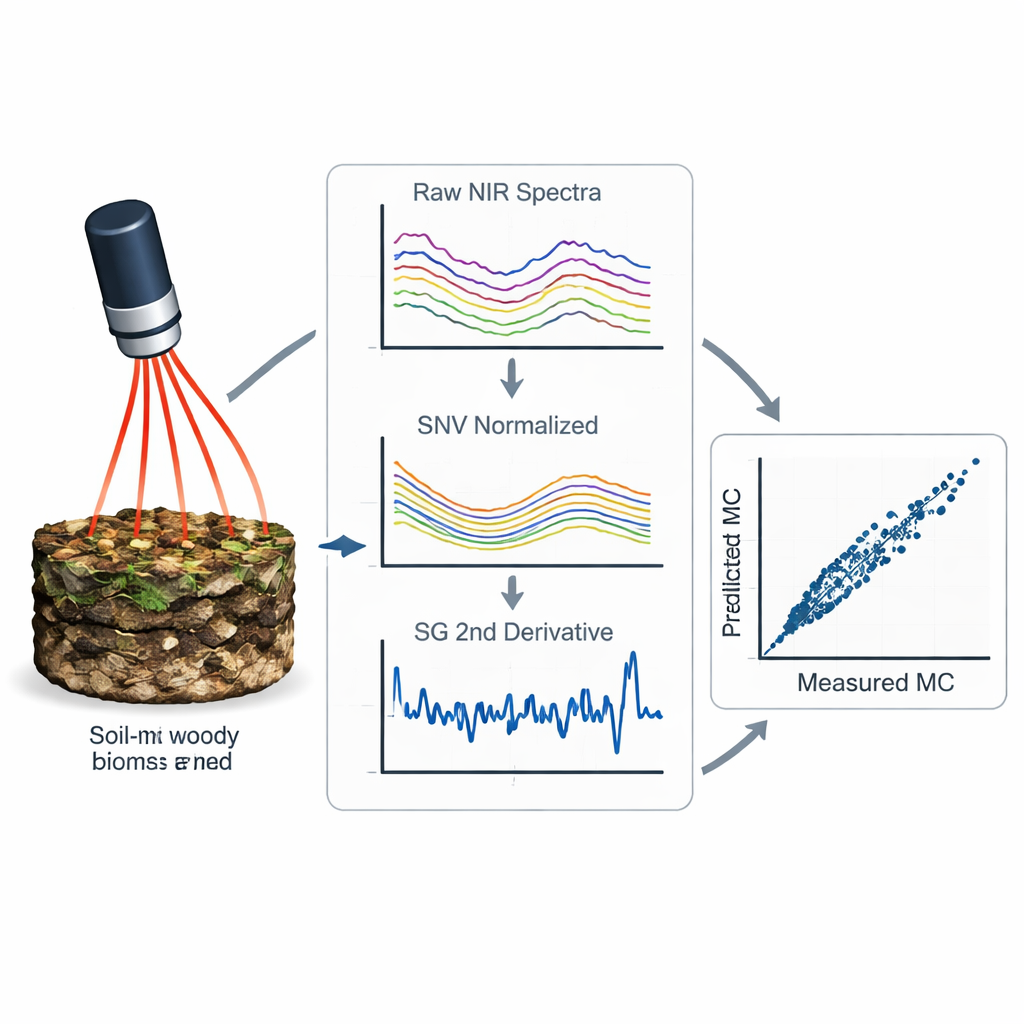
Next, the team measured how the samples reflected near‑infrared light across wavelengths from 870 to 2,500 nanometers. Water inside the biomass absorbs light especially strongly near certain wavelengths, so the reflected pattern contains clues about moisture content. However, soil particles and uneven surfaces scatter the light, adding “noise” to the signal. To tackle this, the researchers applied two data‑cleaning steps to the spectra. The first, called Standard Normal Variate (SNV), removes much of the variation caused by scattering and uneven sample surfaces. The second, a Savitzky–Golay second‑derivative filter, sharpens overlapping peaks and flattens drifting baselines. Together, these steps make the hidden moisture signatures stand out more clearly.
Turning Light Patterns into Moisture Numbers
With cleaner spectra in hand, the researchers used a statistical method known as partial least squares regression to link light patterns to actual moisture contents measured by oven drying. They found that for logging residues, the combination of SNV and Savitzky–Golay gave the best performance, with predicted values closely matching real moisture levels. Sweet sorghum, with its more complex structure and sugar‑rich chemistry, proved harder to model but still gave reasonably accurate results. Importantly, model quality stayed fairly stable even as soil content climbed from 0 to 30%, showing that the preprocessing steps successfully reduced the disruptive effects of dirt. When data were grouped by known soil level, accuracy improved further, suggesting that including information about contamination can refine predictions.
What This Means for Real‑World Biomass Use
The study shows that near‑infrared spectroscopy, combined with smart data cleaning, can rapidly and non‑destructively estimate moisture in woody biomass contaminated with soil. For operators managing forest residues or energy crops, this could mean checking the quality of incoming loads in seconds rather than hours, helping prevent spoilage, improve combustion efficiency, and reduce safety risks. The method is not yet perfect: it struggled to determine exactly how much soil was present, and tests were limited to one soil type and laboratory settings. Still, the results point toward practical handheld or on‑line NIR devices that could monitor moisture in real time across biomass supply chains, making renewable solid fuels more reliable and efficient.
Citation: Batjargal, BU., Kang, M., Cho, Y. et al. Near-infrared spectroscopy for moisture content prediction in soil-mixed woody biomass. Sci Rep 16, 6096 (2026). https://doi.org/10.1038/s41598-026-36901-8
Keywords: near infrared spectroscopy, biomass moisture, woody residues, soil contamination, bioenergy