Clear Sky Science · en
Adverse effects of 6PPD-quinone bioaccumulation at environmentally relevant concentrations on Cyprinus carpio growth and development
From Car Tires to River Fish
Most drivers never think about what happens to their tires as they slowly wear down. Yet each trip on the road sheds microscopic rubber fragments and chemicals that can wash into streams and rivers. This study follows one such tire‑derived chemical, called 6PPD‑quinone, to see how it affects carp, a common freshwater fish. The findings reveal that even low, environmentally realistic exposures can quietly weaken fish growth and health, raising broader concerns for the rivers and lakes we rely on for food, recreation, and biodiversity.
How a Tire Chemical Reaches the Water
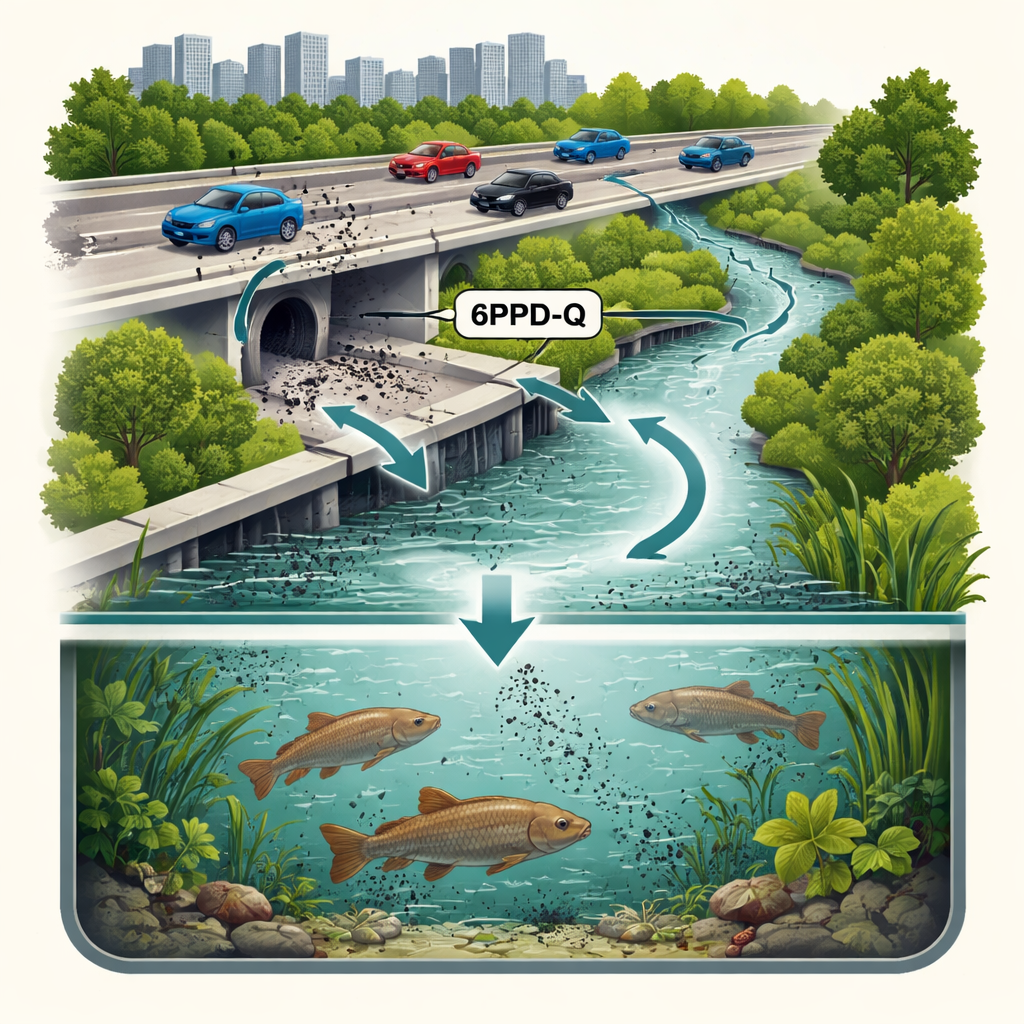
Modern tires contain additives that keep rubber flexible and safe. One widely used ingredient, known as 6PPD, reacts with ozone in the air and transforms into 6PPD‑quinone (6PPD‑Q). Unlike its parent compound, 6PPD‑Q dissolves more easily in water, so particles and dust from tires can be swept off roads by rain, carried through storm drains, and delivered directly to streams, rivers, and ponds. Around the world, scientists have now detected 6PPD‑Q in urban runoff and surface waters, sometimes at levels measured in micrograms per liter—concentrations high enough to be dangerous to some fish species.
Why Carp Were Put to the Test
Earlier work showed that 6PPD‑Q can rapidly kill certain salmon, especially coho, at trace levels. But scientists knew far less about what this chemical might do to other fish that do not die outright but instead live for weeks or months in polluted water. In this study, researchers focused on carp (Cyprinus carpio), an abundant freshwater species that often serves as a stand‑in for wild fish in toxicity tests. They built large tanks that mimicked natural pond conditions and exposed carp for eight weeks to two realistic levels of 6PPD‑Q: a low dose similar to what has been measured in the environment, and a higher dose representing worst‑case conditions near heavily trafficked, urban areas.
Chemicals That Fade from Water but Linger in Bodies
The team closely tracked how much 6PPD‑Q stayed in the water and how much accumulated inside the fish. In water, the chemical broke down quickly, with most of it disappearing within about a day. However, the story inside the carp was very different. In fish from the high‑exposure tanks, 6PPD‑Q levels in the liver and gills remained elevated over weeks, even as water concentrations dropped. This pattern suggests that the chemical can build up in key organs faster than it is cleared—a classic sign of bioaccumulation. That means brief spikes of pollution after storms may leave a lasting imprint inside aquatic animals long after the waterways themselves appear cleaner.
Hidden Damage to Growth and Internal Defenses
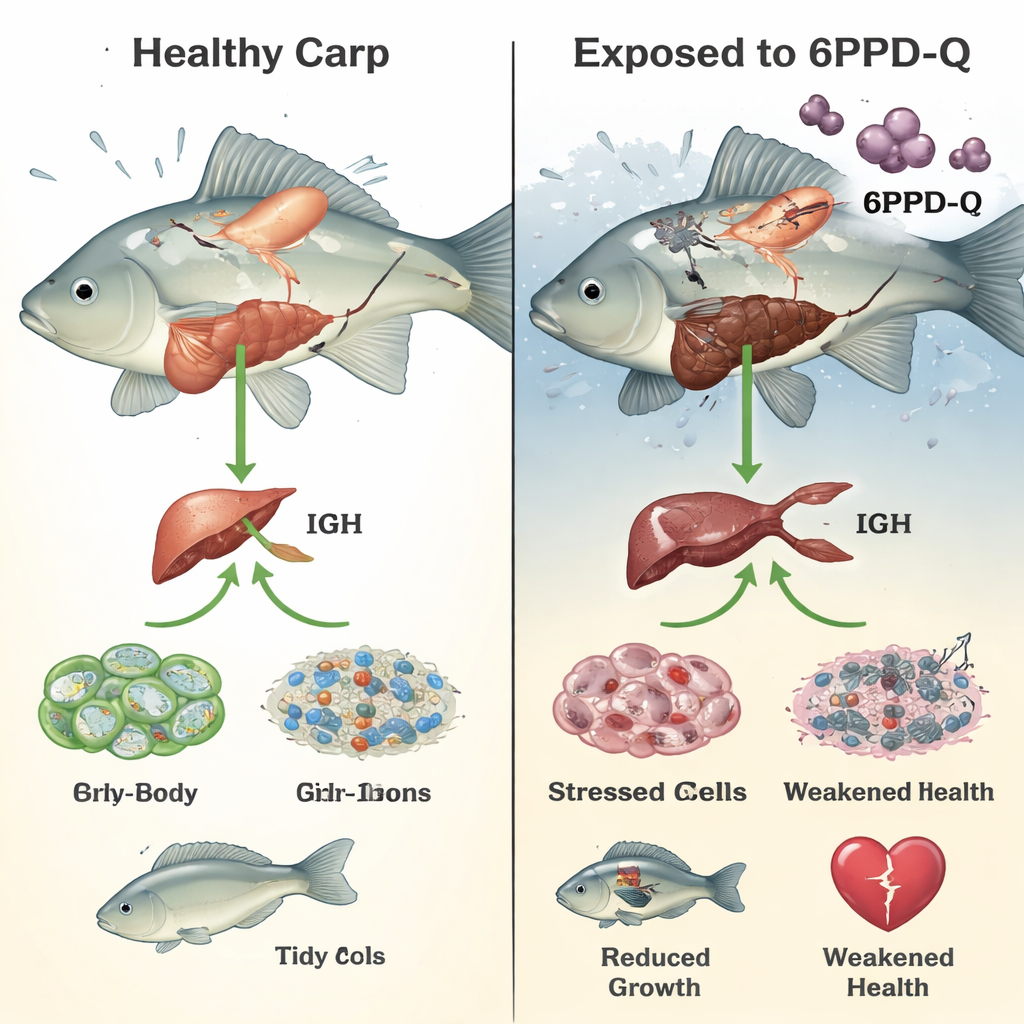
Beyond measuring chemicals, the researchers examined how the carp’s bodies responded. They used a growth indicator called the condition factor, which compares a fish’s weight to its length—essentially a measure of how well‑fed and robust it is. Both the low and high 6PPD‑Q groups showed a significant drop in this index, indicating thinner, less healthy fish. Inside the brain, the activity of a key protective enzyme, catalase, fell, signaling that the fish’s natural defenses against harmful oxygen‑based molecules were weakened. In the liver, detailed protein surveys and gene tests painted a picture of cells under chronic stress: structural proteins that hold cells together were altered, and crucial growth‑related signals, including growth hormone and its receptor, were dialed down at both the gene and blood‑hormone levels.
What This Means for Rivers and Lakes
Put together, the results show that 6PPD‑Q does more than cause sudden fish kills in a few sensitive species. In carp, long‑term exposure at levels already found in the environment quietly disrupts the internal scaffolding of cells, weakens antioxidant defenses, and interferes with hormone systems that control growth and development. The outcome is slower‑growing, less robust fish—even when they do not die outright. Because carp share waterways with many other species, and because global tire use continues to rise, these findings suggest that a common road‑runoff chemical could subtly reshape freshwater ecosystems. The study underscores the need to better regulate tire‑related pollutants and to design safer additives that protect both drivers and aquatic life.
Citation: Chae, Y., Kwon, YS., Kim, S. et al. Adverse effects of 6PPD-quinone bioaccumulation at environmentally relevant concentrations on Cyprinus carpio growth and development. Sci Rep 16, 6289 (2026). https://doi.org/10.1038/s41598-026-36900-9
Keywords: tire wear pollution, 6PPD-quinone, freshwater fish, endocrine disruption, aquatic toxicology