Clear Sky Science · en
Climate-driven reproductive decline in Southern right whales
Why these whales are sounding an alarm
Southern right whales are one of the great conservation success stories of the last century, slowly rebounding after being hunted to near extinction. But new research from three decades of monitoring off southern Australia shows that this recovery is stalling. By linking whale births to shifting sea ice, warming waters and changes in ocean productivity, the study reveals that these giants are warning us about deep changes unfolding across the Southern Ocean food web.
Whales that live off stored energy
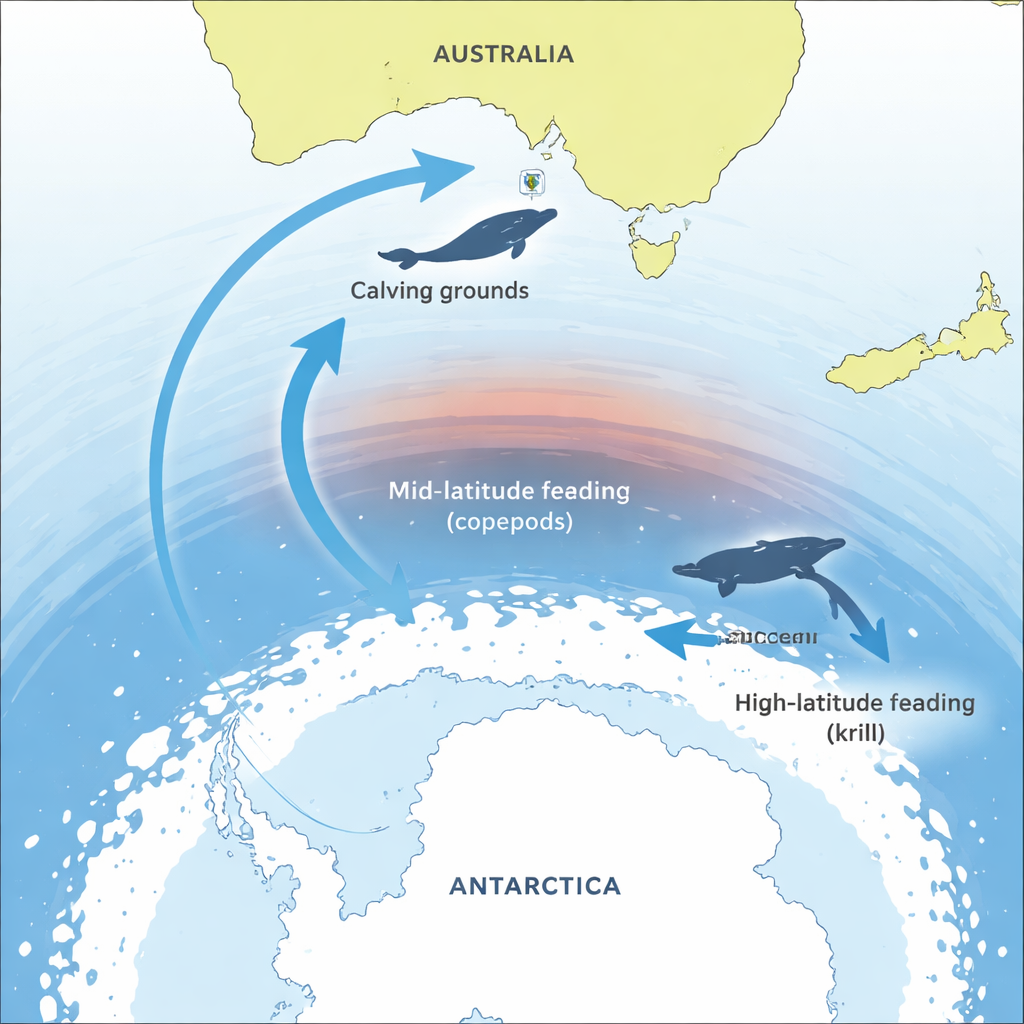
Southern right whales are "capital breeders": they gorge on food in the Antarctic and sub-Antarctic during summer, then migrate to sheltered coastal bays to give birth and nurse their calves while largely fasting. A typical healthy female once followed a three-year rhythm: one year pregnant, one year nursing, one year resting and refueling. Because this cycle depends on how much energy she can store on the feeding grounds, any disruption to her food supply can ripple through to the timing and success of future pregnancies.
Decades of watching who returns with a calf
The researchers drew on a unique, 34-year photo-identification program at Head of Bight in South Australia, one of the main calving sites for the western Australian population. Individual whales are recognized by the distinctive callosities—pale, rough skin patches—on their heads, allowing scientists to track when particular females return with new calves. From 1996 to 2024 they documented 1,144 calving intervals for 696 females. Over time, the once-common three-year interval between calves has become rarer, while four- and five-year gaps have become much more frequent.
Climate signals written into birth schedules
To find out why calving intervals were stretching, the team compared these whale records with long-term satellite measurements of Antarctic sea ice, sea surface temperature and chlorophyll-a, a pigment that tracks the amount of microscopic plant life at the base of the food chain. They also included two large-scale climate indices: the Antarctic Oscillation, which influences winds and ice around the continent, and the El Niño–Southern Oscillation. Using cross-correlation and principal component analysis, they looked for time-lagged links between changing environmental conditions and the average time between calves.
A tale of shrinking ice and warming seas
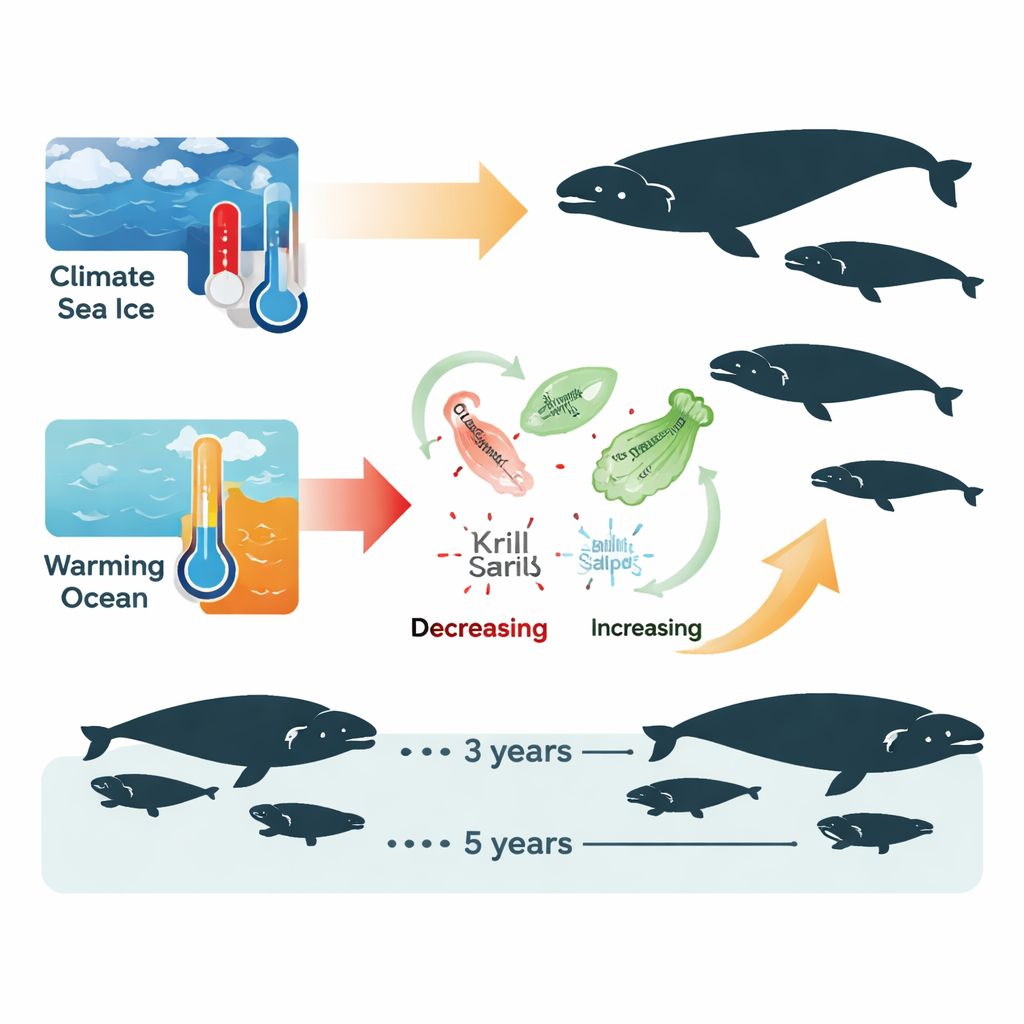
The patterns were striking. Since about 2010, Antarctic sea ice in the whales’ key high-latitude feeding zone has shown a sustained decline, while surface waters in mid-latitudes have warmed and become less productive. High-latitude waters showed more frequent and intense phytoplankton blooms, but these likely reflect disrupted timing and structure of the food web rather than a simple increase in food. At the same time, mid-latitude regions where copepods—another major prey—are common have warmed and lost productivity, and have been hit by extreme marine heatwaves. Together, these shifts point to a Southern Ocean where the quality and reliability of prey, especially energy-rich krill, are eroding.
When both feeding zones get worse
The statistical models showed that longer gaps between calves are strongly associated with a combination of lower sea ice, warmer mid-latitude waters, and declining productivity in these temperate regions, along with increasingly positive phases of the Antarctic Oscillation. In simple terms, conditions that are bad for krill and copepods are bad for whales. As both their main feeding zones degrade at once, females appear to need more years to rebuild the fat reserves needed to sustain pregnancy and nursing, slowing population growth even though numbers are still far below pre-whaling levels.
What this means for whales and the ocean
To a lay observer, the message is clear: these whales are struggling to keep up with a rapidly changing climate. Longer intervals between calves are an early-warning signal that their food supply—and the broader Southern Ocean ecosystem that supports it—is under strain. The authors argue that protecting southern right whales now will require not only local safeguards against ship strikes, entanglement and disturbance, but also global action to curb climate change and carefully manage krill fisheries. In listening to the quiet slowdown in their reproduction, we are hearing a larger warning about the health and resilience of polar seas.
Citation: Charlton, C., Germishuizen, M., O’Shannessy, B. et al. Climate-driven reproductive decline in Southern right whales. Sci Rep 16, 5352 (2026). https://doi.org/10.1038/s41598-026-36897-1
Keywords: southern right whales, climate change, Antarctic sea ice, krill and food webs, marine conservation