Clear Sky Science · en
Intelligent decision-making systems for early detection of alzheimer’s disease using wearable technologies and deep learning
Why Your Watch Might One Day Spot Memory Problems
Most of us think of smartwatches and fitness bands as step counters and sleep trackers. This study explores a more ambitious use: turning everyday wearables, combined with advanced pattern-finding software, into an early warning system for Alzheimer’s disease. Catching the condition before noticeable memory loss could give patients and families more time to plan, and doctors a better chance to slow its progress.
From Hospital Scans to Everyday Sensors
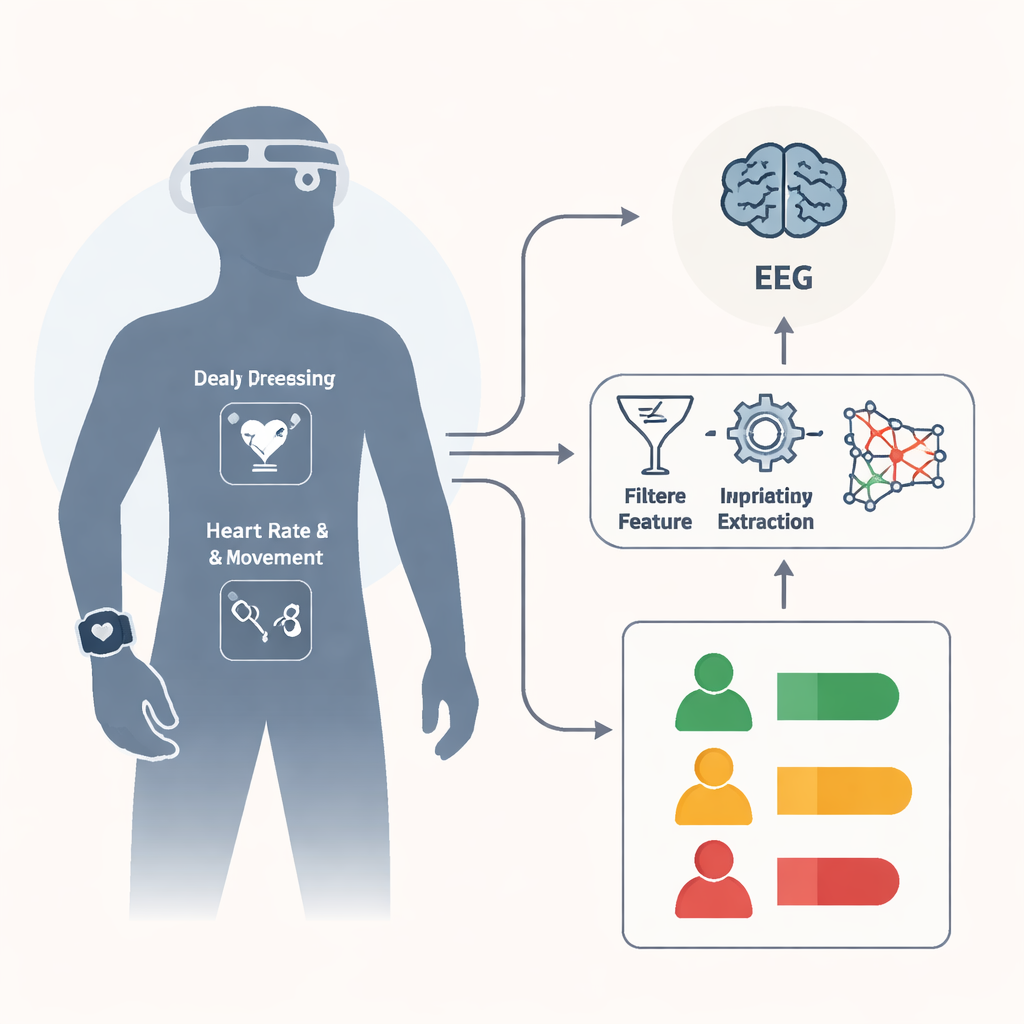
Today, Alzheimer’s is usually detected with brain scans, medical imaging, and long, in-person memory tests. These methods are expensive, time‑consuming, and often miss the very earliest signs of trouble, when brain changes are still mild and potentially more treatable. Meanwhile, consumer wearables quietly collect round‑the‑clock information about heart rate, sleep, and movement. The authors argue that these continuous, non‑invasive streams of data can reveal subtle changes in daily life and body rhythms that appear before full‑blown symptoms, turning the home into an extension of the clinic.
Teaching Machines to Read the Body’s Daily Rhythm
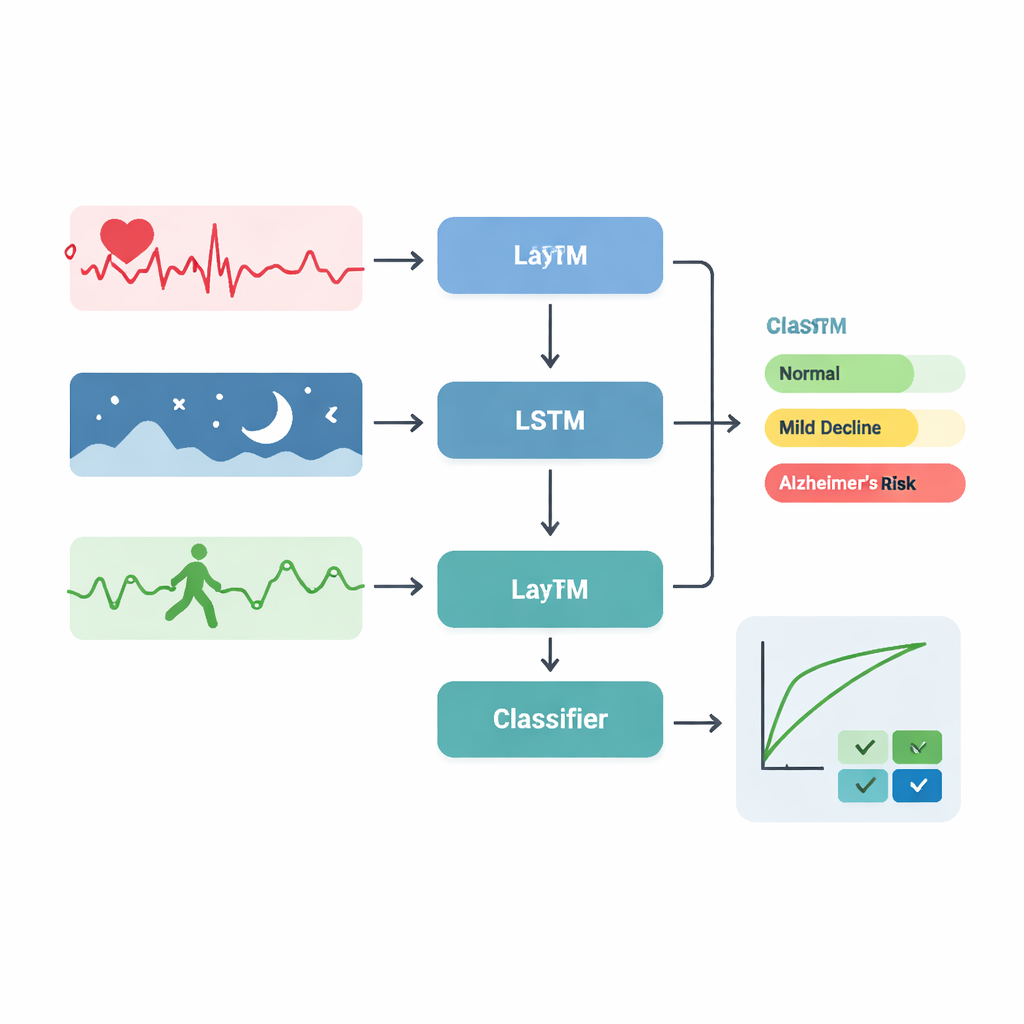
The core of the proposed system, called Early Detection using Deep Learning Algorithm (ED‑DLA), is a type of artificial intelligence known as a recurrent neural network. Rather than looking at single measurements in isolation, this model examines how signals evolve over time—how sleep patterns shift across weeks, how walking speed changes, or how heart‑rate variability drifts. The researchers use a specific form, Long Short‑Term Memory (LSTM) networks, stacked in three layers. These networks are designed to remember long sequences, making them well suited to spotting the slow, creeping changes that may signal early Alzheimer’s rather than day‑to‑day noise.
How the Wearable‑AI Pipeline Works
In the system, sensors on the wrist and head collect data on heart rate, motion, sleep behavior, and even brain activity. Before reaching the learning model, the signals are cleaned to remove noise and scaled so they can be compared fairly across people. The team then transforms the data to highlight hidden patterns, for example using mathematical tools that capture complex relationships between movement and heart rhythm. The processed information flows through the LSTM layers, which gradually build a compact “signature” of each person’s behavior and physiology. A final decision module turns this signature into risk categories, and the system can send alerts through a simple dashboard to clinicians or caregivers.
Putting the Approach to the Test
To check whether this idea has practical promise, the authors trained and tested their model on a large set of time‑series signals from 1,200 adults and older volunteers monitored over a year. They compared ED‑DLA to several other artificial‑intelligence‑based approaches used in dementia research. Statistical tests showed that the new system performed significantly better than the alternatives. It correctly identified early Alzheimer’s‑related changes with an overall accuracy of about 96 percent, a sensitivity near 98 percent (few true cases were missed), and strong performance in recognizing meaningful patterns over time. Just as importantly, it maintained high reliability while processing data continuously, suggesting it could support near real‑time monitoring rather than one‑off checkups.
What This Could Mean for Patients and Families
In everyday terms, this work points to a future in which routine gadgets help flag brain changes long before a crisis forces a hospital visit. The proposed framework does not replace doctors or detailed brain scans, but it could act as an early radar, nudging people toward evaluation and treatment sooner and helping clinicians track whether therapies are working. Because the method relies on comfortable, non‑invasive wearables and scalable software, it could be deployed widely at relatively low cost. The authors see this as a step toward more proactive, personalized dementia care, where continuous gentle monitoring gives patients, families, and health systems extra time to respond.
Citation: Sathish, R., Muthukumar, R., Kumaran, K.M. et al. Intelligent decision-making systems for early detection of alzheimer’s disease using wearable technologies and deep learning. Sci Rep 16, 6025 (2026). https://doi.org/10.1038/s41598-026-36895-3
Keywords: Alzheimer's early detection, wearable sensors, deep learning, recurrent neural networks, digital health monitoring