Clear Sky Science · en
Quantifying inner corridor space design elements for embedded retirement facilities based on eye-tracking
Why hallway design matters for healthy aging
For many older adults, especially those living in community-based retirement facilities, much of daily life happens indoors. Long, plain corridors are more than just passages: they can shape mood, safety, and social life. This study asks a deceptively simple question with big consequences for aging societies: what specific features of these indoor hallways make older adults feel safer, more comfortable, and more willing to spend time there—and how can we measure that objectively using their eyes?
Everyday spaces, growing older
Embedded retirement facilities are small, multipurpose care centers built into ordinary neighborhoods rather than on isolated campuses. Their inner corridors are not only routes to bedrooms and dining rooms; they double as spaces for light exercise, chance encounters, and quiet rest, particularly in bad weather when going outdoors is hard. Yet these corridors are often long, closed-in, and visually dull, which can leave residents feeling boxed in or lonely. The authors argue that if we can tune corridor design more precisely to older adults’ needs—lighting, views, seating, handrails, color, and greenery—we can turn a necessary circulation space into a healthier everyday environment.
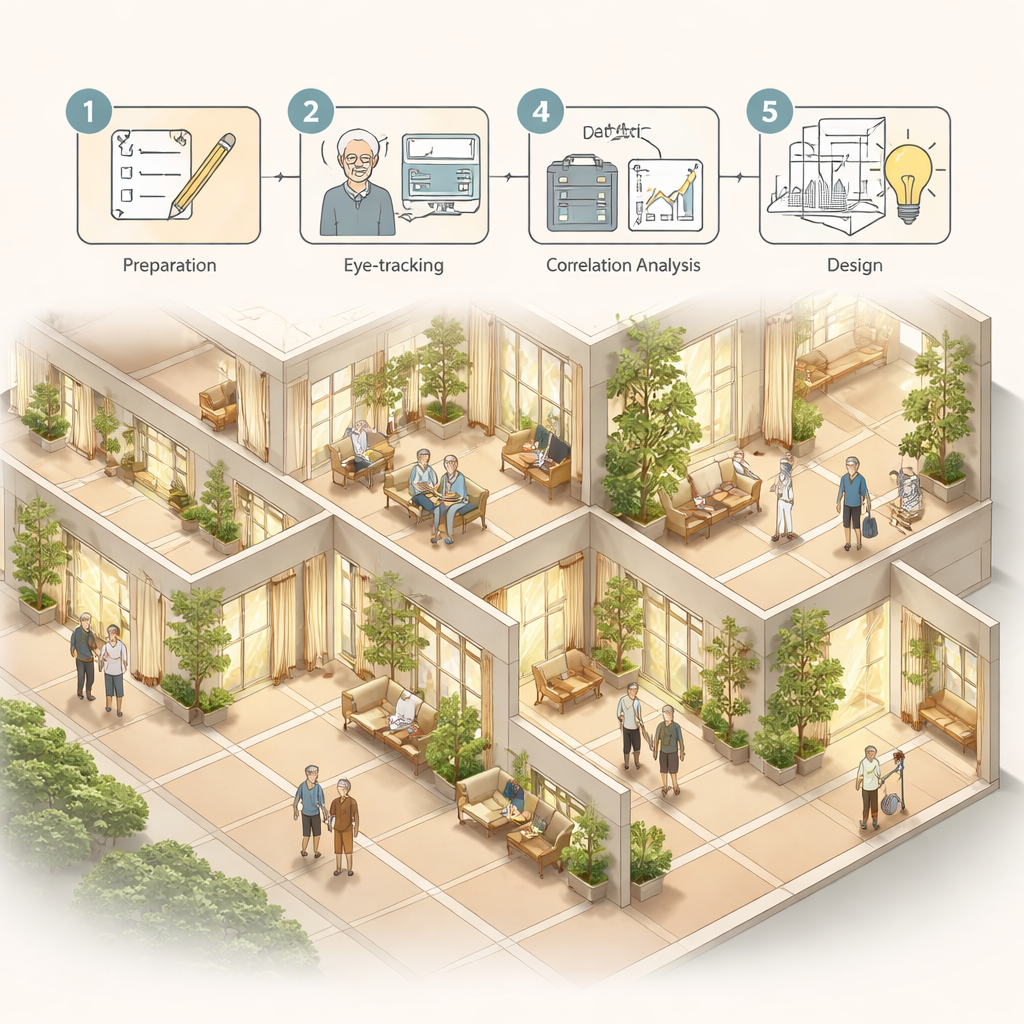
Letting the eyes reveal what really matters
Instead of relying only on interviews and surveys, the researchers used eye-tracking technology, which records exactly where and how long a person looks at different parts of a scene. They first collected and carefully screened photographs of 80 real corridor scenes in embedded retirement facilities, ultimately selecting 20 pictures that clearly showed typical layouts and details but deliberately excluded people, so that social cues would not distract from the physical design. Thirty-six volunteers aged 60 and above, all in good health, looked at these photos on a monitor while an eye-tracking device measured how their gaze moved. Afterward, each participant rated how satisfied they felt with every corridor image on a five-point scale and discussed what caught their attention and why.
Four corridor types, many subtle choices
The team examined four common corridor layouts. "Parallel" corridors are the classic straight, enclosed hallway. "Open" corridors widen locally to include lounges or service counters. "Atrium" corridors open vertically, with double-height areas and more daylight. "Transitional" corridors include angled or turning nodes that connect two stretches of hallway. For each type, the researchers broke down the scene into three groups of elements: the basic surfaces (floors, walls, ceilings, windows), the overall atmosphere (decorations, color, greenery), and practical facilities (seating, handrails and other accessibility features, and service points like nurse stations). Eye-tracking heatmaps and gaze paths showed not just what older adults noticed first, but where their eyes kept returning—clues to which features demanded thought, promised safety, or sparked interest.
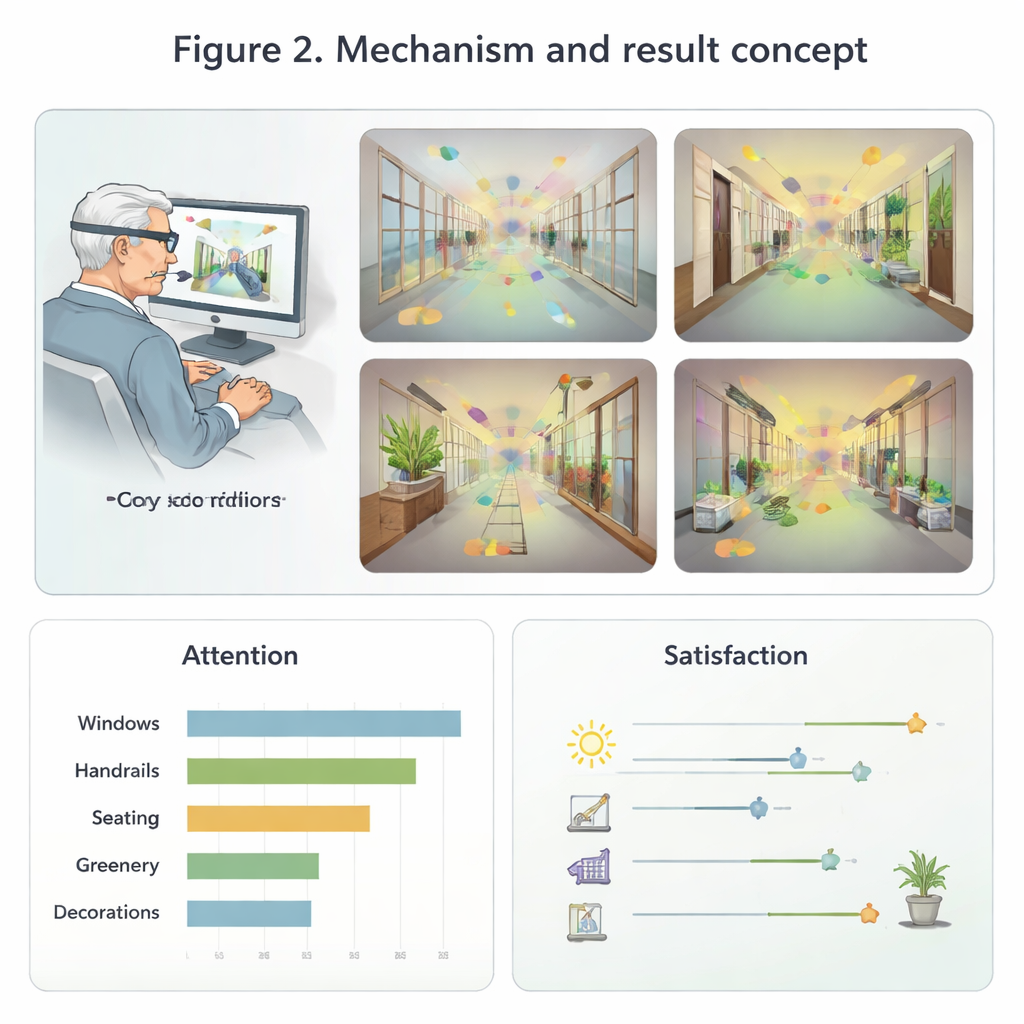
What older adults look at—and care about most
Across all corridor types, certain patterns stood out. In long, straight corridors, windows at the far end and handrails along the walls were especially important. Bright natural light, pleasant views, and a clear, supportive handrail system were strongly tied to higher satisfaction, while heavy, closed window designs and harsh or cluttered wall colors made spaces feel oppressive. In open and atrium-style corridors, well-placed seating and service counters turned hallways into inviting places to pause, chat, or watch activity, raising both visual attention and comfort. In turning or transitional corridors, clear directional cues—such as decorations or plants at corners, continuous handrails, and good lighting—helped older adults understand where to go and feel safer when changing direction. Interestingly, some surfaces like long stretches of plain wall attracted many glances simply because they dominated the view, but did not actually improve how people felt about the space.
From eye movements to better buildings
By combining where people looked with how they said they felt, the study produced a practical ranking of design priorities for each corridor type—for example, “windows first, then handrails” in straight corridors, or “seating and service counters first” in open nodes. The authors turned this into a general workflow that other designers and researchers can follow: choose representative scenes, collect eye-tracking data and simple satisfaction scores, analyze how attention and liking relate, and then use those links to focus design improvements. For a layperson, the takeaway is straightforward: small, targeted changes—more daylight and views, safer and more continuous handrails, comfortable seating, thoughtful decorations, and greenery—can make the everyday walk down a hallway feel brighter, safer, and more human, and careful measurement of where older adults actually look helps ensure those changes truly matter.
Citation: Fu, G., Zhang, X., Jiang, Y. et al. Quantifying inner corridor space design elements for embedded retirement facilities based on eye-tracking. Sci Rep 16, 7285 (2026). https://doi.org/10.1038/s41598-026-36894-4
Keywords: aging-friendly design, retirement facilities, eye-tracking, corridor architecture, older adults