Clear Sky Science · en
Towards multi-modal and cross-modal integration in LiFi-based sensing
Lights That Do More Than Shine
Imagine if the lamps above your head could not only light the room and connect your phone to the internet, but also sense where people are, how they move, and even help keep buildings safer and more efficient. This article explores how future wireless networks can turn everyday lighting into a powerful tool for seeing and understanding the world, using light instead of crowded radio waves.
Why We Need Smarter Sensing
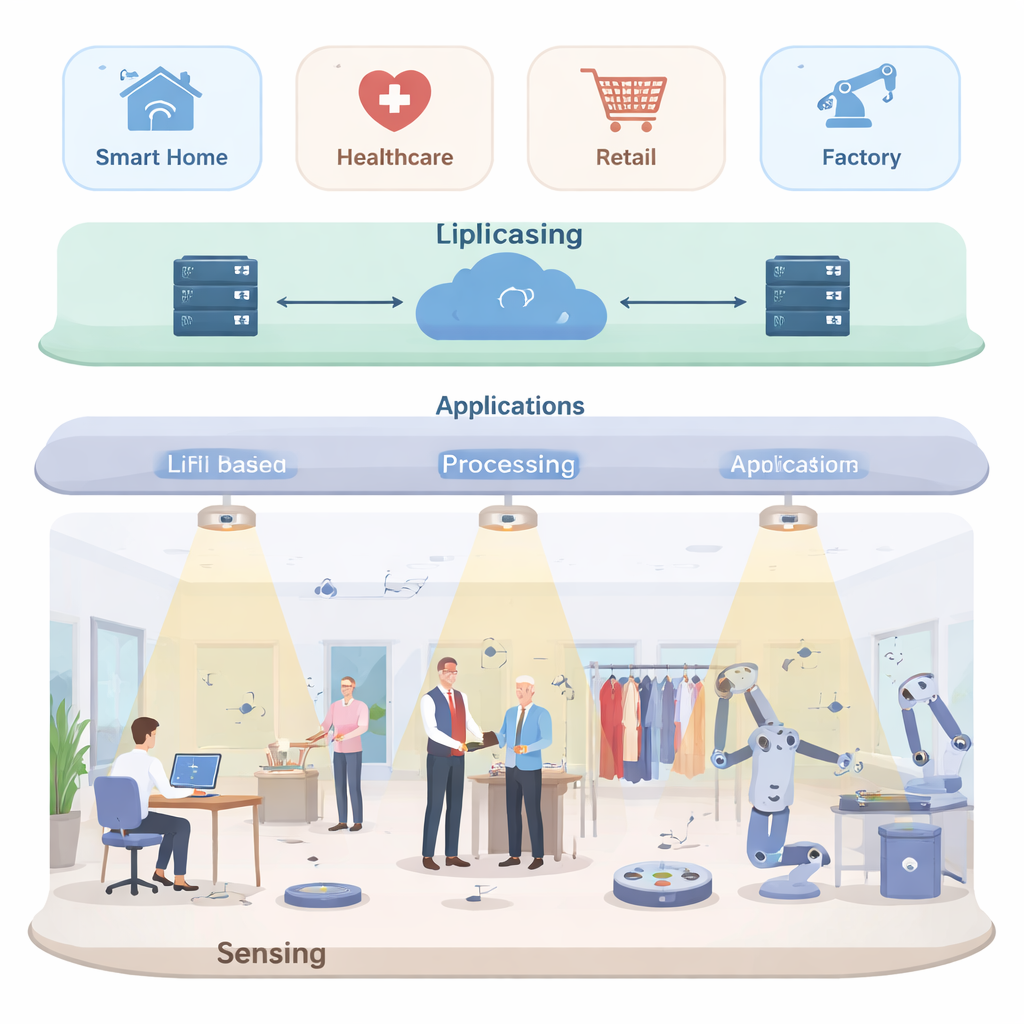
As our homes, offices, factories, and cities fill with connected devices, knowing where things are and what is happening around them becomes crucial. New services such as indoor navigation, asset tracking, immersive games, and remote-controlled machines demand location accuracy down to centimeters, not just a few meters. Current systems based on radio signals, satellite navigation, or cameras often struggle indoors, suffer from interference, raise privacy concerns, or require expensive hardware. At the same time, radio frequencies are becoming overcrowded. The authors argue that tapping into unused parts of the spectrum, especially visible light, can ease this pressure while enabling more precise and secure sensing.
Turning Light into a Sensor
Light Fidelity, or LiFi, uses LED lamps to transmit data by rapidly modulating their brightness in ways invisible to the human eye. Special light sensors, called photodetectors, pick up these small changes and convert them into information. Because light travels in straight lines and does not pass through walls, LiFi signals can be highly focused and less prone to interference. This makes them ideal not only for fast wireless communication but also for pinpointing positions and detecting movement. Experiments have shown that LiFi can reconstruct 3D body poses, track objects with centimeter-level accuracy, and sense room occupancy with over 90% reliability, all using patterns in light reflections and shadows.
Different Ways Light Can Sense
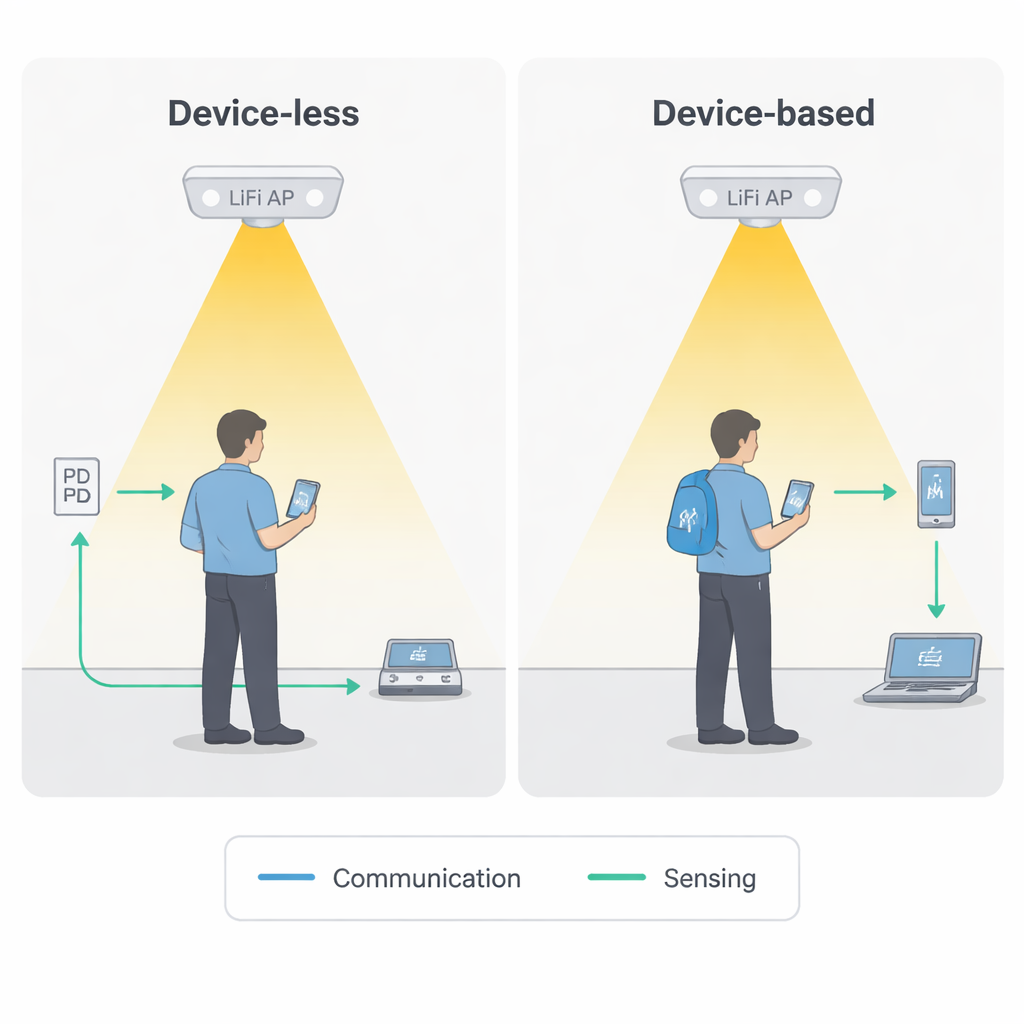
The paper explains that LiFi-based sensing can work in several modes. In device-based sensing, the object or person carries a light sensor or a camera that reads changes in the illumination and reports them back to the network. In device-less sensing, the environment itself holds the sensors; for example, a photodetector in the ceiling or floor watches how light patterns shift when someone walks by. LiFi signals can be tailored specifically for sensing (active sensing) or re-used from normal data transmissions (passive, or communication-aided, sensing). Multiple LiFi access points working together can act as a distributed "light radar," giving a detailed view of a room. However, challenges remain, such as blocking of line-of-sight, limited range, sensitivity to ambient light, and the cost of installing many sensors.
Combining Light with Other Senses
Because no single sensing method works perfectly in all conditions, the authors propose a shift from purely LiFi-based sensing to multi-modal sensing. In this approach, LiFi is combined with radio, sound, and cameras so that the strengths of one technology cover the weaknesses of another. For example, LiFi can give very fine position estimates when there is direct light, while radio can still detect motion through walls or in the dark, and cameras can add rich visual details when privacy rules allow. Artificial intelligence plays a central role by fusing these different data streams, deciding when to trust which signal, and learning patterns that help recognize activities, gestures, or occupancy even in complex, changing environments.
Building the Networks of Tomorrow
Looking ahead, the article highlights several emerging directions. Intelligent reflective surfaces on walls could steer light around obstacles to improve both coverage and sensing. Hybrid networks that blend LiFi with traditional radio access points could maintain seamless connections as people move. Advanced learning techniques, including generative AI, can create realistic synthetic data to train sensing algorithms when real data are scarce. At the same time, designers must carefully address privacy, security, synchronization, and scalability so that these systems can be trusted and widely deployed in smart buildings, factories, hospitals, and public spaces.
What This Means for Everyday Life
In simple terms, the paper shows how tomorrow’s wireless networks may transform ordinary lighting into a silent partner that helps buildings understand their occupants and surroundings. By merging LiFi with other sensing methods and intelligent software, the same lights that brighten a room could guide your steps, adjust energy use, protect privacy, and support immersive digital experiences. If these research directions succeed, 6G networks will not just move data faster—they will give our built environments a new kind of "vision" that makes them safer, more efficient, and more responsive to human needs.
Citation: Naser, S., Alhussein, O. & Muhaidat, S. Towards multi-modal and cross-modal integration in LiFi-based sensing. Sci Rep 16, 6038 (2026). https://doi.org/10.1038/s41598-026-36891-7
Keywords: LiFi, multi-modal sensing, indoor localization, 6G networks, smart buildings