Clear Sky Science · en
A multiomics profile of coordinated defense and key candidate genes against bacterial wilt in tobacco
Why farmers and breeders should care
Bacterial wilt is a notorious plant disease that can wipe out fields of tobacco and many other crops. Once the soil is polluted with the culprit bacterium, plants can suddenly wilt and die, leaving farmers with heavy losses. This study asks a practical question with modern tools: what makes some tobacco varieties better at fighting this disease than others? By tracking thousands of plant molecules and genes at once, the researchers uncover how a moderately resistant tobacco variety mounts a layered defense and pinpoint a key gene that breeders can target to build stronger, wilt-resistant crops.
Two tobacco varieties, two very different fates
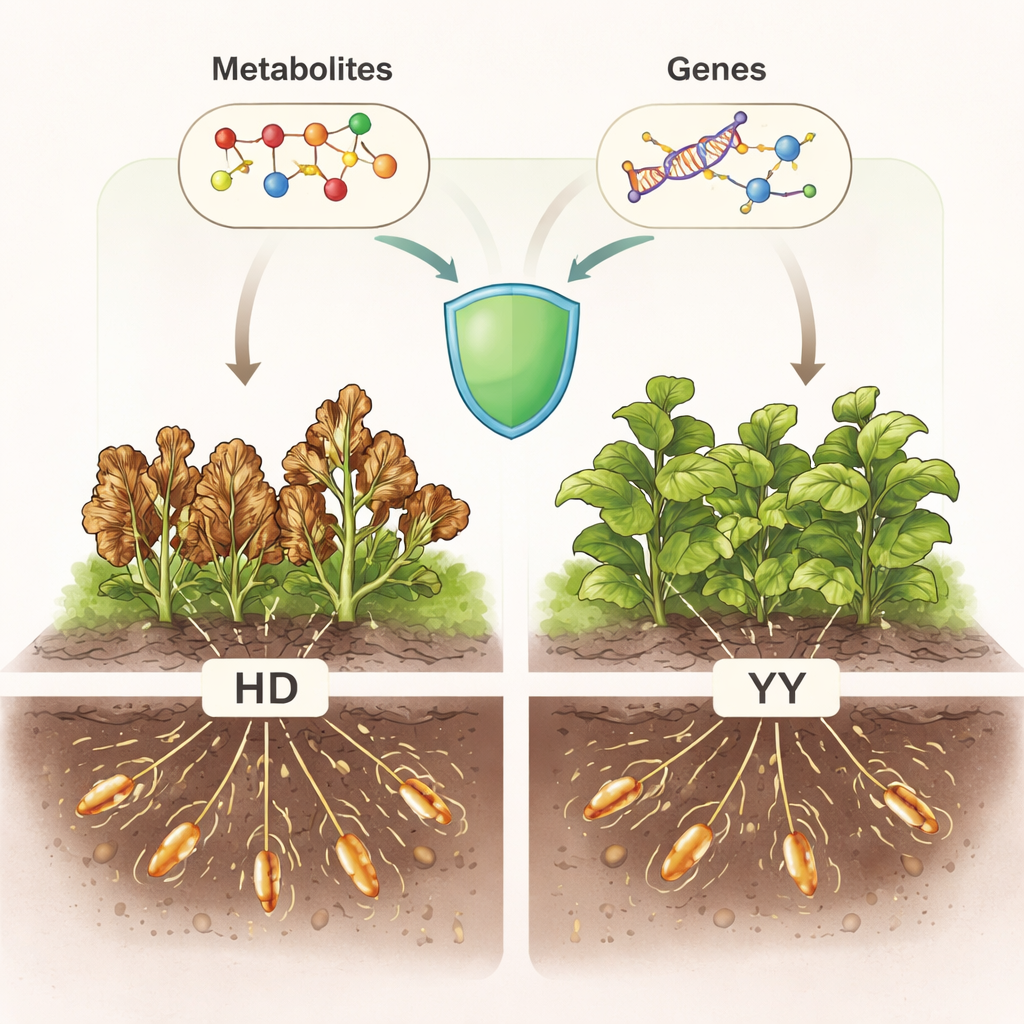
The team compared a susceptible tobacco cultivar called Honghua Dajinyuan (HD) with a moderately resistant one named Yanyan 97 (YY). Grown in a disease-infested field, HD plants were almost completely sick by late June, while YY plants became diseased more slowly and never reached the same level of damage. This contrast in the field set the stage for a deeper dive into what was happening inside the plants. The scientists collected leaves from both healthy-looking and infected plants of each variety at the peak of the outbreak to see how their internal chemistry and gene activity differed.
Tracking thousands of small molecules
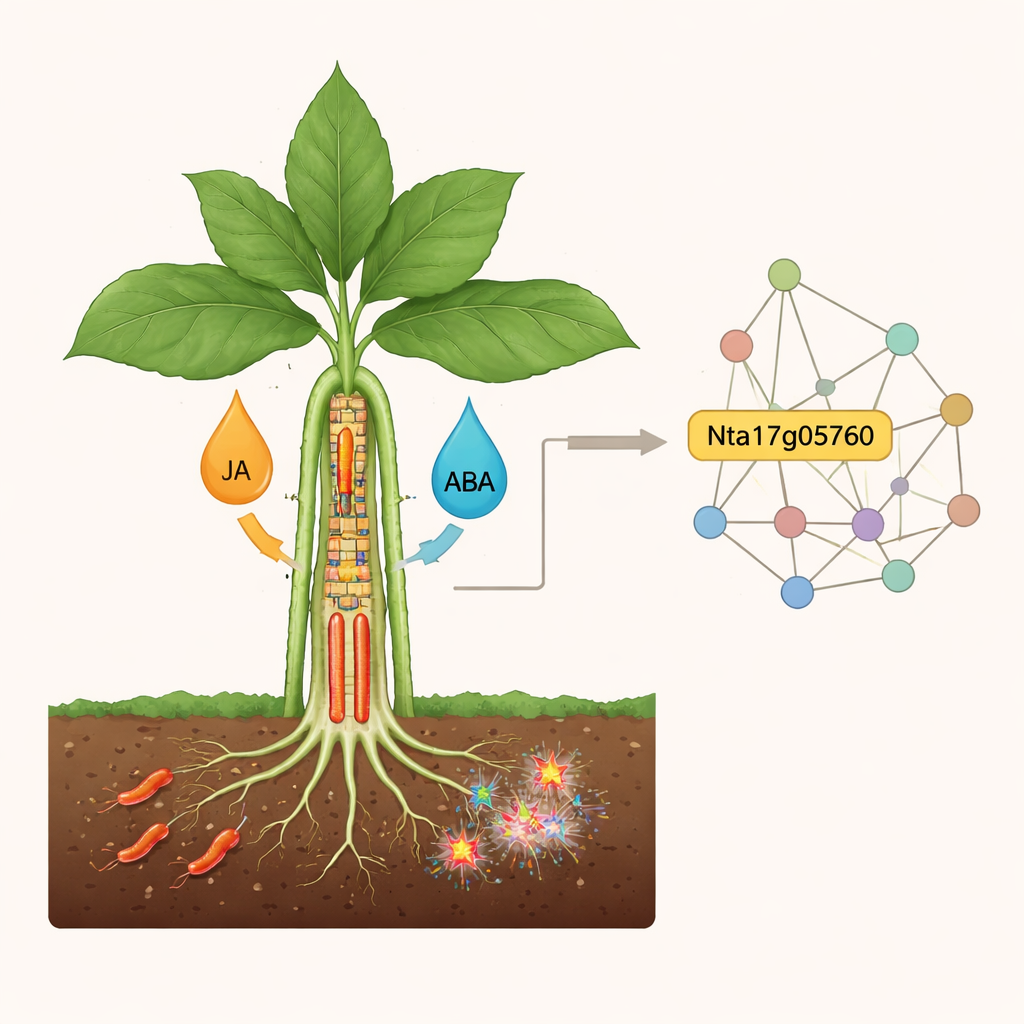
Using advanced chemical profiling, the researchers measured nearly 1,500 distinct small molecules in the leaves, from fatty substances to amino acids and other metabolites. Even before infection, YY and HD showed clearly different metabolic "backgrounds," suggesting that some resistance is built into the plant’s baseline chemistry. When the wilt bacterium struck, YY reshuffled hundreds of metabolites. Many of the changes were concentrated in compounds such as prenol lipids and organooxygen molecules, which are often linked to signaling and defense. Pathway analysis showed that, in YY, infection especially boosted routes that feed into the plant hormones jasmonic acid (JA) and abscisic acid (ABA), both known to help plants respond to attack and stress.
Listening in on the plant’s genes
In parallel, the team sequenced RNA to see which genes were turned on or off during infection. Thousands of genes responded in each comparison, but 818 genes stood out as a shared "core" set linked to YY’s resistance. Many of these genes are involved in reinforcing cell walls, managing oxidative stress, and handling signals from hormones and other chemicals. Network analysis grouped genes into clusters that behaved in a coordinated way, and two large clusters were strongly associated with susceptibility versus resistance. Within these clusters, the researchers homed in on a single standout gene, Nta17g05760, located in a genomic region previously tied to wilt resistance in genetic mapping studies.
A suspect gene in the defense chain
Nta17g05760 showed a telling expression pattern. In healthy plants, it was expressed at higher levels in the susceptible HD than in the resistant YY. After infection, its expression dropped sharply in HD but remained low and relatively stable in YY. This behavior, together with its position in a resistance-linked region, suggests that Nta17g05760 may act more like a brake than an accelerator on defense: plants with naturally lower activity of this gene may be freer to mount strong immune responses. By correlating gene activity with metabolite changes, the study also highlighted shared pathways—such as those producing specialized antimicrobial compounds called diterpenoids—that likely help YY hold back the invading bacteria.
What this means for future crops
For non-specialists, the take-home message is that wilt resistance in tobacco is not governed by a single switch, but by a carefully coordinated network of defensive chemistry and gene activity. The resistant variety YY prepares and deploys protective molecules, strengthens its cell walls, and activates hormone defenses more effectively than the susceptible HD. Among the many genes involved, Nta17g05760 emerges as a prime candidate that breeders and molecular biologists can target to develop new, wilt-resistant tobacco lines. While further experiments are needed to test its exact role, this work provides a roadmap and concrete genetic targets to help protect crops from a costly and persistent disease.
Citation: Qing, Y., Wei, L., Yong, L. et al. A multiomics profile of coordinated defense and key candidate genes against bacterial wilt in tobacco. Sci Rep 16, 6043 (2026). https://doi.org/10.1038/s41598-026-36889-1
Keywords: bacterial wilt, tobacco resistance, plant immunity, multiomics, crop breeding