Clear Sky Science · en
A scalable UWB-to-reconfigurable MIMO filtenna with single-varactor tuning and enhanced isolation for adaptive 5G and cognitive radio systems
Why smarter antennas matter
Every time you stream a video or send a message, tiny metal shapes hidden inside your phone or router quietly launch and catch radio waves. As wireless networks move from 4G to 5G and beyond, these antennas are being pushed to do far more in the same crowded airwaves. This paper explores a new class of compact, tunable antennas that can scan a wide range of frequencies, lock onto the best available channel, and work in teams to boost speed and reliability—features that are crucial for future 5G and cognitive radio systems that must adapt to changing spectrum on the fly.
Finding empty lanes in a crowded air
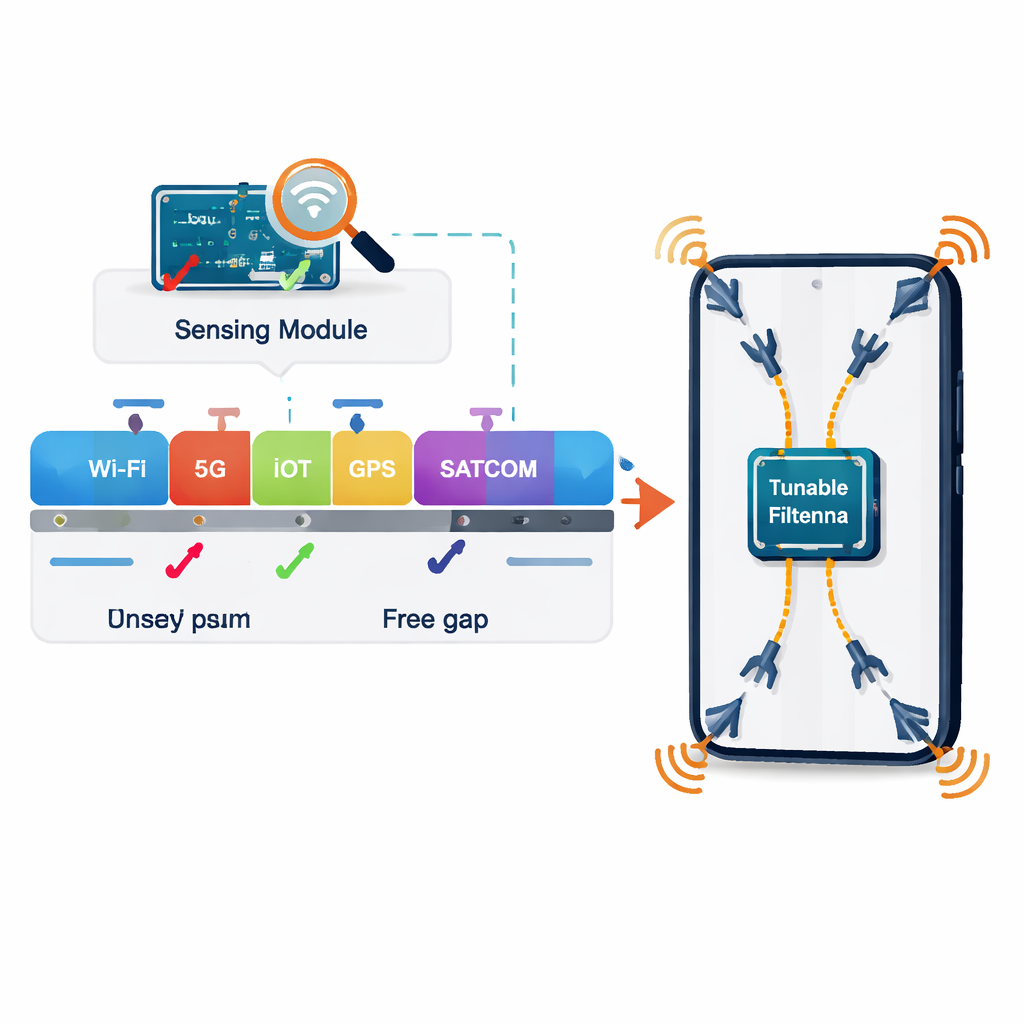
Radio spectrum is like a multilane highway: some lanes are jammed, others sit empty, and the situation changes from moment to moment. Cognitive radio is a concept in which smart devices first “listen” to the air, detect which frequency lanes are busy, and then slip into unused gaps without disturbing primary users. To make this work in practice, the hardware at the front end—the antenna—must be agile, efficient, and selective. The authors start by explaining why traditional narrowband antennas, which are tuned to just one band, and simple wideband antennas, which listen to everything at once, both fall short. Narrowband designs lack flexibility, while plain wideband designs are vulnerable to interference and waste power handling unwanted signals. The challenge is to combine wide coverage, sharp selectivity, and the ability to retune on demand, all in a small footprint suitable for phones, vehicles, and Internet‑of‑Things gadgets.
From wide listeners to smart filters
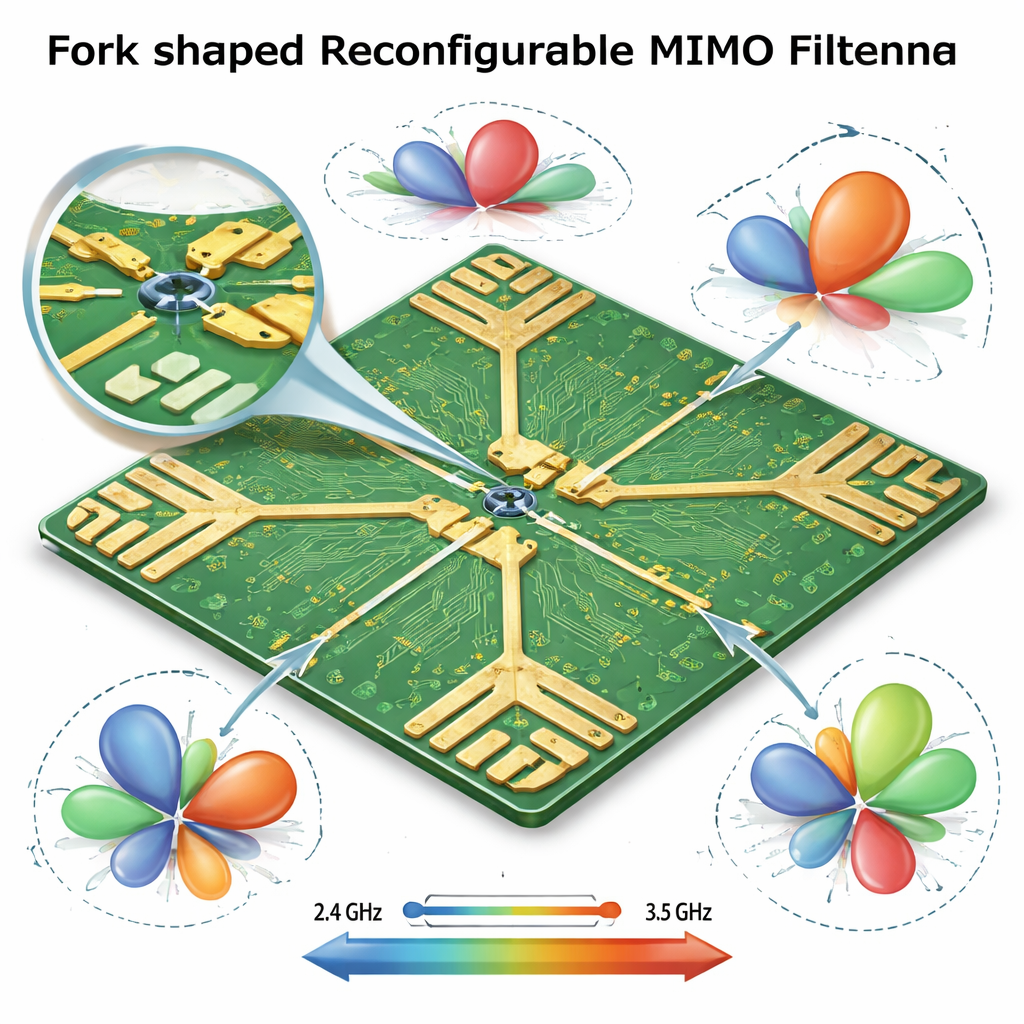
The researchers first build a new ultra‑wideband “listener” antenna with a fork‑shaped metal patch on a small circuit board. By carefully carving slots in the metal and reshaping the ground plane beneath it, they coax the antenna into working efficiently from 2.4 to 8 gigahertz—a span that covers Wi‑Fi, WiMAX, sub‑6 GHz 5G, and many IoT services. Tests show that this single element radiates evenly in most directions and wastes very little power as heat, with efficiency exceeding 90 percent at higher frequencies. They then arrange four of these elements at right angles in a square, creating a multiple‑input multiple‑output (MIMO) array. Because each element points and “hears” in a slightly different way, the array can exploit reflections in the environment to move more data without using extra spectrum. The layout keeps unwanted interaction between elements very low, so the signals they pick up remain largely independent—exactly what high‑speed MIMO links need.
Turning the antenna into a tunable gate
Next, the team tackles the problem of selectivity and agility. Instead of bolting a separate filter in front of the antenna, they merge the two into a single device called a filtenna. In this design, a tiny electronic component known as a varactor diode is placed across a gap in the antenna’s metal. By changing a small control voltage, the electrical length of the structure shifts and the antenna’s preferred frequency slides smoothly from about 2.45 to 3.48 gigahertz. Additional features in the ground metal and feed line help this tunable element act as a sharp gate, letting through only the desired band and rejecting out‑of‑band clutter. Measurements on fabricated samples show that the tuned filtenna keeps good efficiency—around 75 to 80 percent—and maintains a solid radiation pattern as it moves across the tuning range, confirming that the filtering action does not come at the expense of basic antenna performance.
Antennas that work together without clashing
To harness the full power of MIMO in an adaptive radio, the authors extend the filtenna concept into 2×2 and 4×4 arrays. Here, the main challenge is preventing the elements from “hearing” too much of each other, which would blur their independent channels. The designers introduce several tricks: thin decoupling lines between elements, carefully shaped ground extensions, and high‑impedance paths that deliver the control voltage to the varactor diodes without letting radio‑frequency energy leak into the bias network. In the four‑element version, pairs of antennas even share thoughtfully routed bias lines to keep the layout compact. Simulations and lab measurements show that these structures keep mutual coupling very low and preserve nearly ideal diversity gain and channel capacity—engineering shorthand for the ability to carry a lot of separate data streams with minimal crosstalk—while still offering continuous frequency tuning across the target band.
What this means for future wireless devices
In everyday terms, the work demonstrates an antenna family that can listen to a very broad stretch of spectrum, transform into a sharp, movable filter, and then scale up into multi‑antenna arrays that trade signals among themselves as little as possible. For users, this translates into wireless gadgets that can automatically hop to cleaner channels, maintain faster and more stable links in cluttered cities or factories, and fit more functionality into a small space without extra hardware. For network designers, it offers a practical building block for sub‑6 GHz 5G and emerging cognitive radio systems, where radios must be frugal with spectrum yet generous with data. By marrying ultra‑wideband coverage, tunable filtering, and MIMO in one compact platform, the authors point toward front‑end hardware that can grow with the demands of 5G, 6G, and beyond.
Citation: Fouda, H.S., Hamoud, A.S. & Attia, M.A. A scalable UWB-to-reconfigurable MIMO filtenna with single-varactor tuning and enhanced isolation for adaptive 5G and cognitive radio systems. Sci Rep 16, 6525 (2026). https://doi.org/10.1038/s41598-026-36882-8
Keywords: cognitive radio, 5G antennas, reconfigurable filtenna, MIMO systems, ultra wideband