Clear Sky Science · en
Increasing the compressive strength of a high clay content sandstone reservoir by chemical sand consolidation with minimal permeability reduction
Why keeping sand in place matters
Deep underground, much of the world’s oil and gas is stored in rocks that are more like loose beach sand than solid stone. When companies pump these fluids to the surface, grains of sand can break loose and rush up the well as well. This “sand production” chews through pipes, clogs equipment, and can even destroy a well. The study summarized here explores a way to glue these grains together inside the rock using special resins, while still letting oil and gas flow—a delicate balance that could cut costs, improve safety, and reduce waste in many fields worldwide.
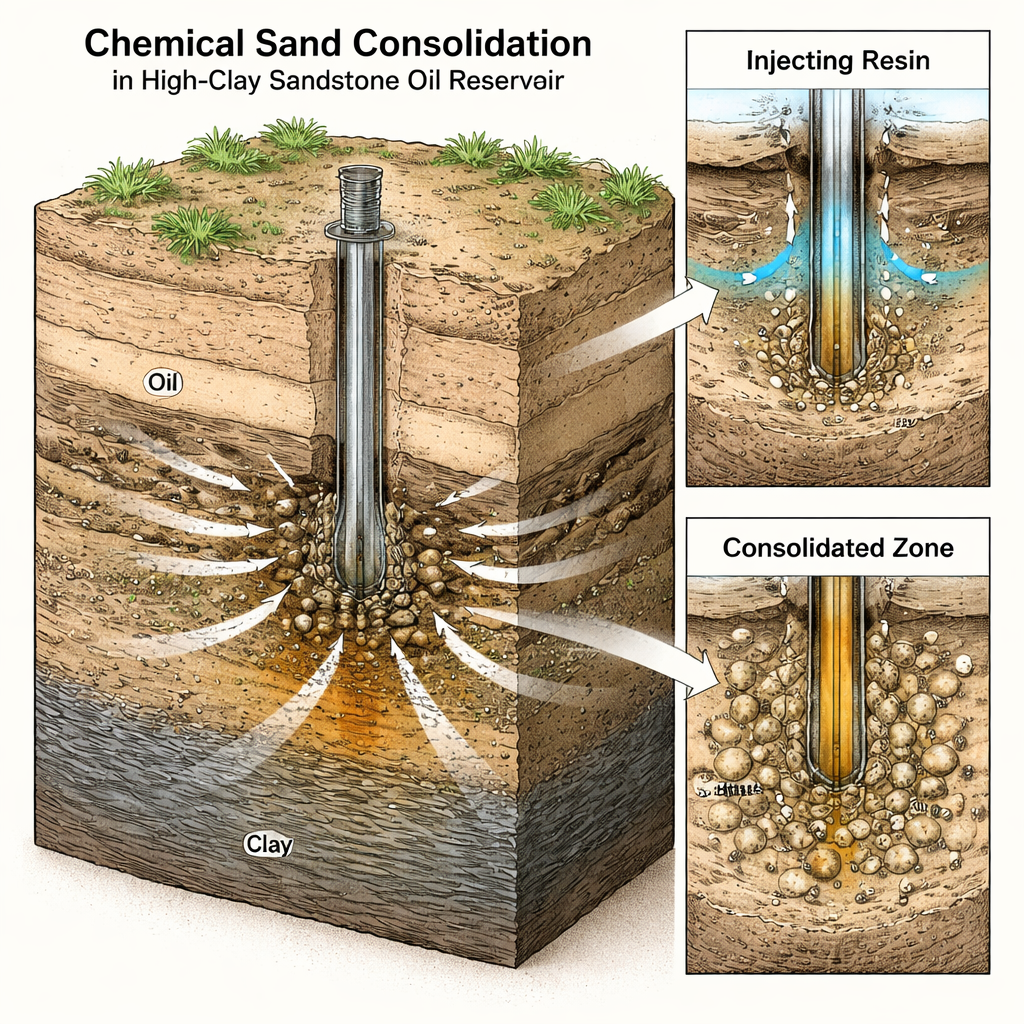
The problem with weak, clay-rich rocks
Many oil and gas reservoirs are made of soft sandstone whose natural grain-to-grain bonds are too weak to withstand production stresses. As pressure in the reservoir drops and fluid flow increases, grains can break free and travel toward the well, damaging everything in their path. A common fix is to install metal screens or gravel packs to physically filter out sand, but these are expensive, complex to install, and do not actually strengthen the rock. A more elegant option is chemical sand consolidation: injecting a liquid into the rock that later hardens into a glue between grains. However, in sandstones that contain a lot of clay—microscopic, sheet-like minerals—this approach becomes much harder. Clay can swell, block pore spaces, steal key ingredients from the resin, and coat sand grains so that glues adhere poorly.
Testing five “in‑rock glues” under realistic conditions
The researchers set out to see which types of resin could reliably strengthen a sandstone containing 15% clay, similar to a challenging real reservoir in Iran’s Ahvaz oil field. They evaluated five commercial systems: furan, epoxy, melamine formaldehyde, urea formaldehyde, and vinyl ester. First, they screened the materials in the lab at atmospheric pressure, adjusting the mix of resin, hardener, and solvent so each could cure properly without becoming too thick to inject. Next, they moved to a more realistic “dynamic” setup: cylindrical rock cores were saturated with actual field brine and oil, flushed, then injected with the resin solutions under flow. The samples were then held at 90 °C and 120 bar—representative reservoir conditions—to let the resin harden before measuring how strong the rock became and how much fluid flow it still allowed.
Finding the best trade-off between strength and flow
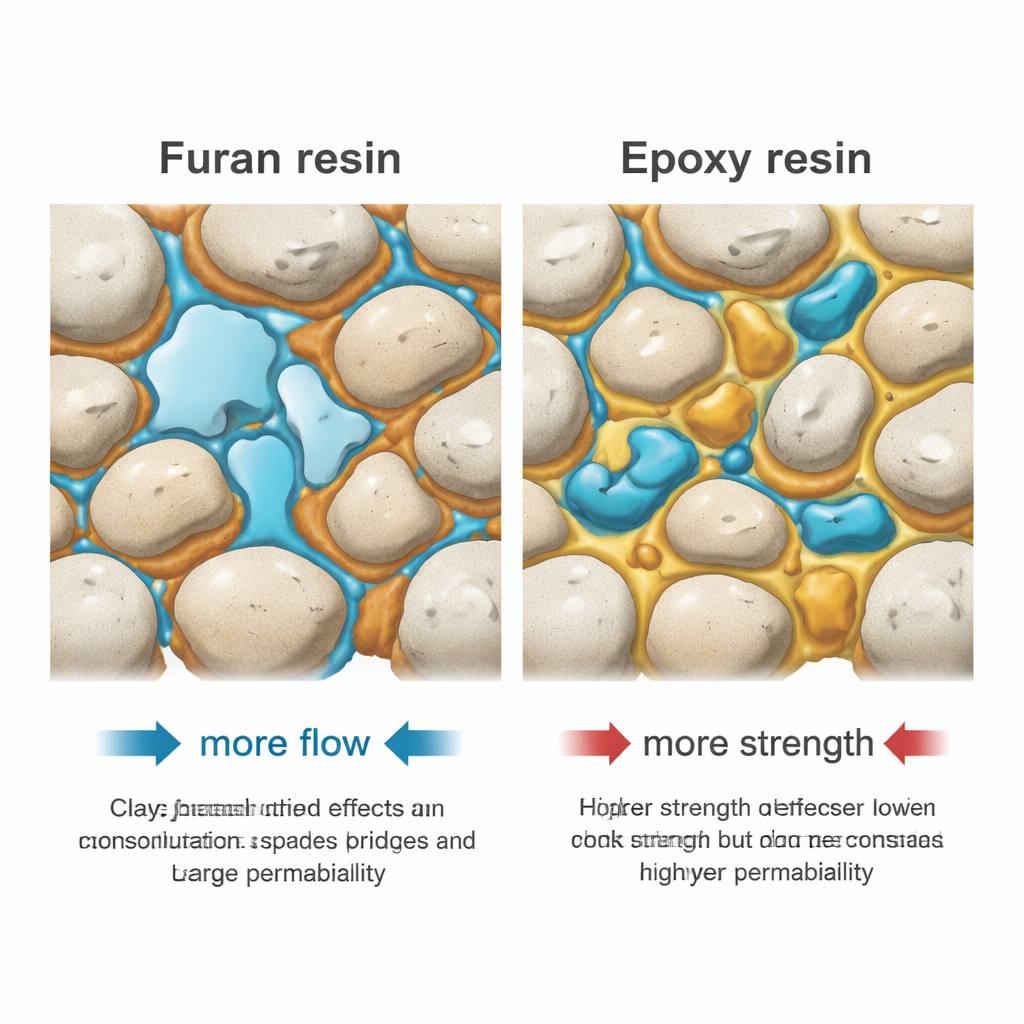
Two simple performance measures guided the work. First was compressive strength—the pressure the core can withstand before failing—which must be high enough to keep grains from breaking loose. Second was “regained permeability,” the percentage of the rock’s original ability to transmit fluids that remains after treatment. Higher strength normally comes at the cost of lower permeability, because more glue in the pores means less room for oil and gas to move. In this study, furan and epoxy stood out. Optimized furan formulations raised the rock’s strength to about 1668 psi while preserving 79% of its original permeability. Epoxy gave similar strength (about 1579 psi) but reduced permeability more, to about 62%. The other three resins either did not strengthen the rock enough or damaged flow too severely, especially in the presence of clay.
How the resins interact with sand and clay
To understand why some resins worked better, the team used imaging tools more familiar from medicine and materials science than from oil fields. High-resolution electron microscopes showed how the hardened resin coated grains and filled spaces between them, while CT scans provided three-dimensional pictures of the treated cores. Furan tended to form bridges at contact points between sand grains, leaving many of the passageways between them open, which explains its good balance between strength and flow. Epoxy, by contrast, produced a denser, more continuous network that wrapped around both sand and clay particles. This created a stronger “cement,” but also filled more of the pathways that fluids use to move. A water-based resin, melamine formaldehyde, barely bonded to the clay-coated grains at all, leaving the rock relatively weak despite not plugging as many pores.
What this means for future oil production
For a non-specialist, the take-home message is that not all underground glues are created equal, especially when clays are involved. In this carefully controlled comparison, furan resin proved best at keeping sand grains locked together while still letting most of the oil or gas pass through. Epoxy is a good choice where maximum mechanical stability is needed and some sacrifice in flow is acceptable. The work gives engineers a tested, mechanistic basis for choosing and formulating resins in difficult, clay-rich formations instead of relying on trial and error. If applied in the field, these insights could prolong the life of wells, reduce costly equipment failures, and make the extraction of existing reserves more efficient and reliable.
Citation: Banashooshtari, H., Khamehchi, E. & Rashidi, F. Increasing the compressive strength of a high clay content sandstone reservoir by chemical sand consolidation with minimal permeability reduction. Sci Rep 16, 6489 (2026). https://doi.org/10.1038/s41598-026-36880-w
Keywords: sand production, chemical sand consolidation, clay-rich sandstone, furan and epoxy resins, oil and gas reservoirs