Clear Sky Science · en
Robust consensus ordinal priority approach for improvisational emergency supplier selection under expert consensus ambiguity
Why fast, fair choices matter in disasters
When disaster strikes, responders must quickly decide which suppliers can deliver life‑saving goods like medicine, tents, and food. These choices are made under crushing time pressure, broken infrastructure, and incomplete information. The paper summarized here proposes a new way to pick emergency suppliers that is both fast and fair, even when experts disagree or are uncertain. It aims to help authorities move beyond ad‑hoc judgment calls toward decisions that are transparent, explainable, and robust when lives are on the line.
Choosing suppliers when the plan no longer fits
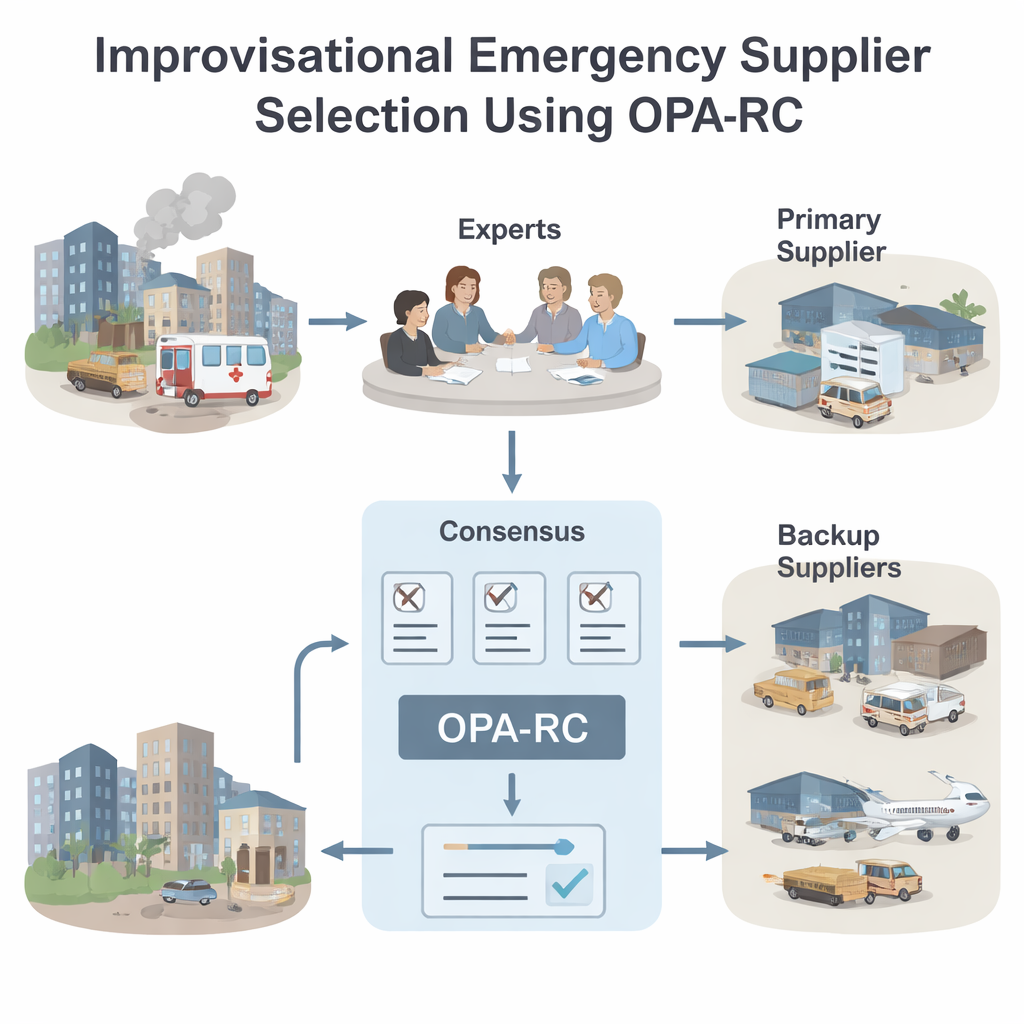
Most existing methods for selecting suppliers assume calm conditions: data are reliable, options are known in advance, and there is time to weigh costs and benefits. In major disasters, this picture falls apart. Officials must improvise with new suppliers, shifting constraints, and conflicting expert opinions. Traditional techniques often rely on subjective weightings of which expert or criterion matters most, hide how disagreements were resolved, and can be too slow or complex for real‑time use. The authors focus on this improvisational setting and argue that emergency supplier selection needs tools designed specifically for chaos, not just adapted versions of planning‑phase methods.
A new way to listen to experts
The study builds on an existing method called the Ordinal Priority Approach, which uses simple rankings rather than detailed scores. Experts rank what matters most (such as speed, reliability, or cost) and how different suppliers compare on these factors. Instead of asking decision‑makers to subjectively assign how important each expert is, the new method—named the Robust Consensus Ordinal Priority Approach (OPA‑RC)—lets the data speak. It measures how similar each expert’s rankings are to those of the group. Experts whose views align more closely with the emerging consensus are given somewhat higher influence, while still keeping room for diversity of opinion.
Designing for uncertainty, not ignoring it
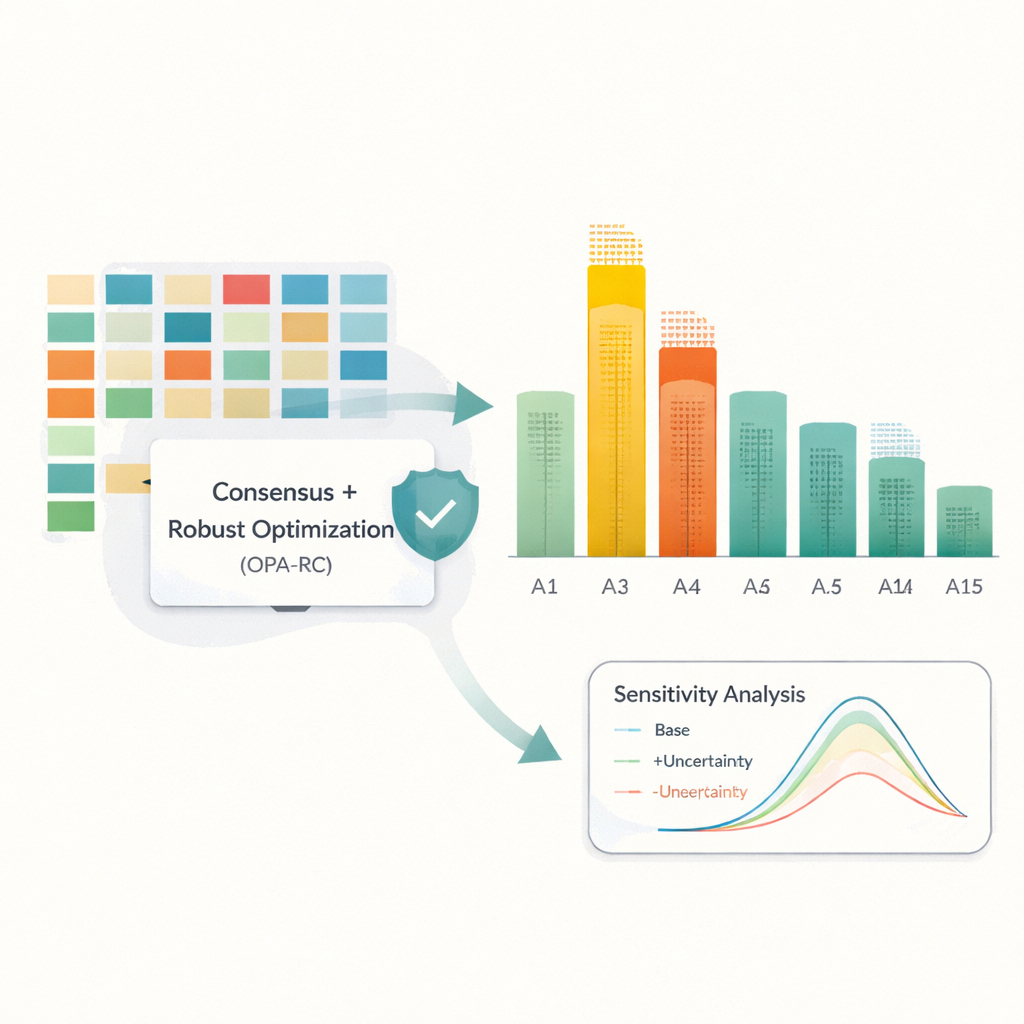
OPA‑RC goes further by treating expert influence itself as uncertain. Rather than assuming that the consensus‑based importance scores are perfect, the method surrounds them with a carefully defined “buffer zone” that captures plausible deviations. It then searches for supplier rankings that perform well under the worst allowed combination of expert disagreements. Behind the scenes this is a robust optimization problem, but the authors show it can be rewritten as a simple linear model with a neat closed‑form solution. That means the final weights for experts, criteria, and suppliers can be computed very quickly—crucial in fast‑moving emergencies—without sacrificing mathematical rigor.
Lessons from the Turkey–Syria earthquake
To show how the approach works in practice, the authors reconstruct a scenario based on the 2023 Turkey–Syria earthquake, evaluating 15 potential suppliers against eight criteria such as response speed, delivery reliability, geographic coverage, and cost‑effectiveness. A panel of five experts from public agencies, humanitarian organizations, and a logistics firm provided rankings. The OPA‑RC results highlight that, in crisis conditions, rapid mobilization and dependable delivery dominate traditional concerns like price and even small differences in quality. A few suppliers emerge as clear first‑line choices because they are fastest and most reliable, while a second tier of suppliers serve as backups that add resilience without displacing the leaders. Sensitivity tests show that the top and bottom supplier rankings remain stable even when assumptions about expert uncertainty or input noise are varied, with only mid‑ranked suppliers shifting slightly.
What this means for future disaster response
For non‑specialists, the key takeaway is that OPA‑RC offers a structured way to turn messy, uncertain expert judgments into clear, defensible supplier choices, without pretending that experts are infallible or that conditions are stable. By grounding expert influence in observed consensus and building uncertainty into the heart of the model, the method delivers rankings that are both robust and easy to compute. In practice, this can help emergency managers prioritize a small set of primary and backup suppliers quickly, justify their choices to stakeholders, and adapt as information improves—all of which can translate into faster, more reliable aid when it is needed most.
Citation: Mao, H., Wang, R. Robust consensus ordinal priority approach for improvisational emergency supplier selection under expert consensus ambiguity. Sci Rep 16, 6262 (2026). https://doi.org/10.1038/s41598-026-36876-6
Keywords: emergency supplier selection, disaster response logistics, decision-making under uncertainty, expert consensus, robust optimization