Clear Sky Science · en
Resonance suppression method for single-phase LCL Grid-tied inverter based on active damping superposition
Keeping Renewable Power Quiet and Stable
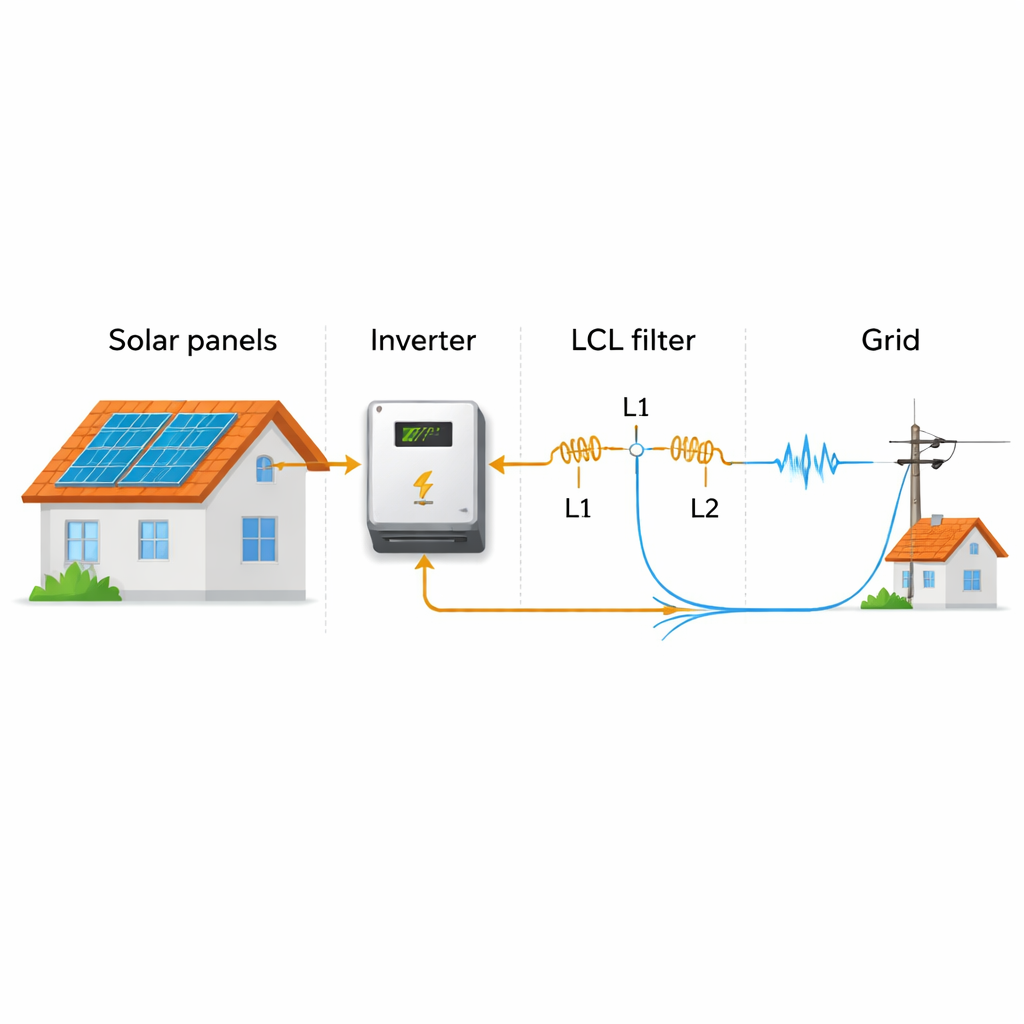
As more homes and businesses add rooftop solar panels and other small generators, their electronics must feed clean, stable power into an already complex grid. This paper tackles a subtle but important problem: how to keep these grid-tied inverters from "ringing" or resonating in a way that can damage equipment or upset the power system, all while keeping efficiency high and adapting to changing grid conditions.
Why Filters in Inverters Can Misbehave
Modern grid-tied inverters use a special three-part filter, called an LCL filter, to smooth out high-frequency switching ripples before electricity reaches the grid. This filter works very well at blocking unwanted high-frequency noise, but it also has a built-in resonance, like a tuning fork ringing at a certain pitch. Around that frequency, the current can spike and the electrical phase can jump abruptly, threatening the stability of the inverter and the grid connection, especially when the grid itself is weak or its impedance changes.
From Real Resistors to “Virtual” Ones
A traditional cure is to add extra damping, which acts like a shock absorber for the filter. One option is passive damping, where real resistors are wired into the filter. This is simple but wastes energy as heat and weakens the filter’s ability to screen out high-frequency noise. A more elegant option is active damping: instead of adding physical resistors, the inverter’s control system uses measured voltages or currents to create a “virtual” resistor through feedback. This avoids extra losses and can be tuned in software, but in digital hardware the resulting time delay shifts the natural resonance of the filter away from where it was designed to be.
Layering Two Smart Control Signals
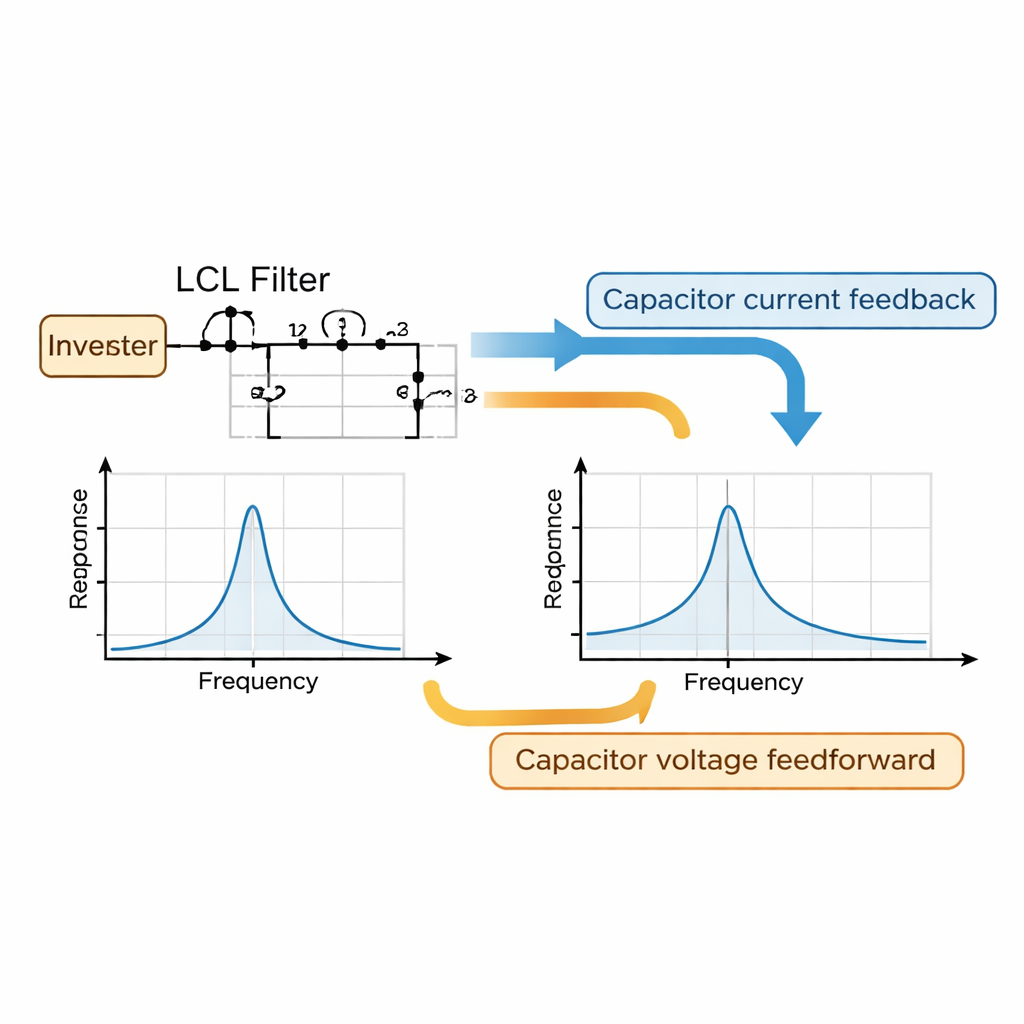
The authors analyze this shift using a virtual impedance model, which represents the effect of active damping as an equivalent combination of resistance and reactance added to the filter. They show that a widely used method—feeding back the capacitor current—introduces not just virtual resistance but also virtual reactance once digital delay is included, and this reactance moves the resonance frequency. To counter this, they propose superimposing two active damping actions: the existing capacitor current feedback and a second path that feeds the filter capacitor voltage forward into the inverter control. By choosing the gains of these two paths in a coordinated way, the unwanted reactive part of the virtual impedance can be made to cancel, so the filter’s natural resonance stays where it was designed while the overall damping is increased.
Wider Safety Margin, Same Sweet Spot
Using the virtual impedance framework, the researchers derive conditions that link the two control gains so that the resonance frequency remains fixed but the resonance peak is reduced. Under these conditions, the equivalent "virtual resistor" seen by the filter stays positive, meaning it genuinely damps oscillations rather than exciting them. Importantly, they show that with proper tuning the effective damping remains strong over a wide range of frequencies—up to roughly one third of the system’s switching frequency. This wider effective damping zone makes the inverter more robust to uncertainties in grid impedance and component values that are common in real-world installations.
Putting the Theory to the Test
To confirm that the concept works beyond equations, the team builds detailed simulations and a hardware-in-the-loop test setup using a single-phase LCL grid-tied inverter. They expose the system to different grid strengths, sudden changes in grid voltage, and abrupt load shifts. In all cases, the inverter’s current stays close to a clean sine wave, with very low harmonic distortion and no dangerous oscillations. Even when the grid becomes weak and distorted, the control strategy keeps the current stable, quickly tracks changes in voltage and load, and returns to steady operation in less than a cycle of the AC waveform.
What This Means for Everyday Power Users
For non-specialists, the takeaway is that the paper offers a smarter way to keep small-scale renewable generators quiet, efficient, and grid-friendly. By carefully layering two digital control signals instead of adding bulky hardware, the authors suppress the problematic ringing of the LCL filter without wasting energy or shifting its natural operating point. This makes inverters more tolerant of real-world grid fluctuations and helps ensure that as more solar roofs and other distributed sources connect to the grid, they do so smoothly, safely, and with high power quality.
Citation: Dongdong, C., Li, M., Shengqi, Z. et al. Resonance suppression method for single-phase LCL Grid-tied inverter based on active damping superposition. Sci Rep 16, 5708 (2026). https://doi.org/10.1038/s41598-026-36873-9
Keywords: grid-tied inverter, LCL filter, active damping, renewable energy integration, power quality