Clear Sky Science · en
Improved black-winged kite optimization algorithm with multi-strategy hybrid and its application
Smarter digital kites for tough engineering puzzles
From designing faster trains to tuning power grids, engineers constantly face problems that are too complex for traditional trial‑and‑error approaches. This paper presents a new computational "kite flock"—an improved black‑winged kite optimization algorithm (IMBKA)—that mimics how birds scout, attack, and migrate to home in on the best solution. The authors also show how this smarter flock can help predict a key safety factor in high‑speed rail: the electrical resistance where the train’s roof‑mounted pantograph touches the overhead wire.
Why we need better digital explorers
Modern engineering systems are highly complicated, with many interacting variables and conflicting requirements. Classic optimization tools can get stuck in "good enough" answers, missing better options hidden in a vast landscape of possibilities. In recent years, researchers have turned to nature‑inspired algorithms that imitate the behavior of animal groups: fish schools, wolf packs, and bird flocks searching for food. The black‑winged kite algorithm (BKA) belongs to this family and was originally built around the way these birds circle in the sky to scout and then dive to attack prey. While BKA already outperforms several well‑known methods in many tasks, it still suffers from two big weaknesses: its starting guesses can be poor, and its search can stall in local dead ends.
Four upgrades to a virtual flock
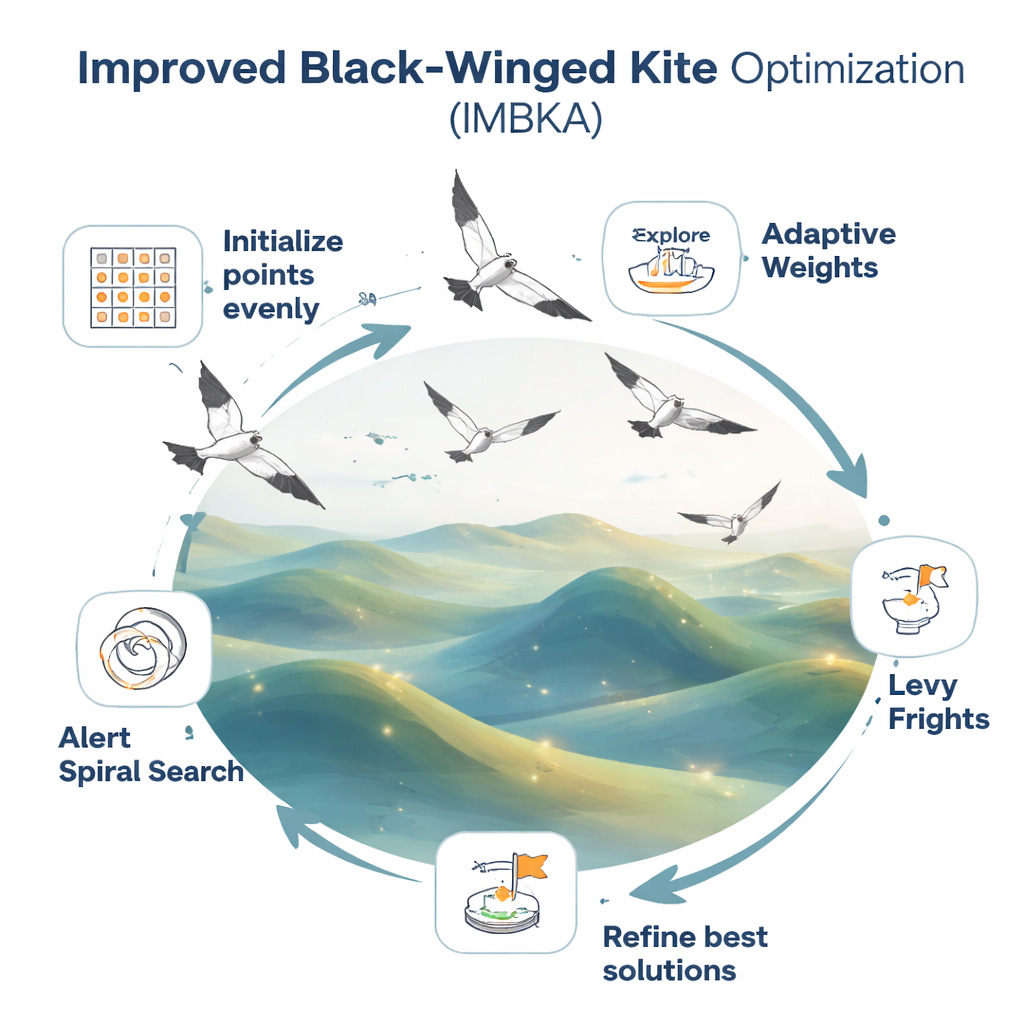
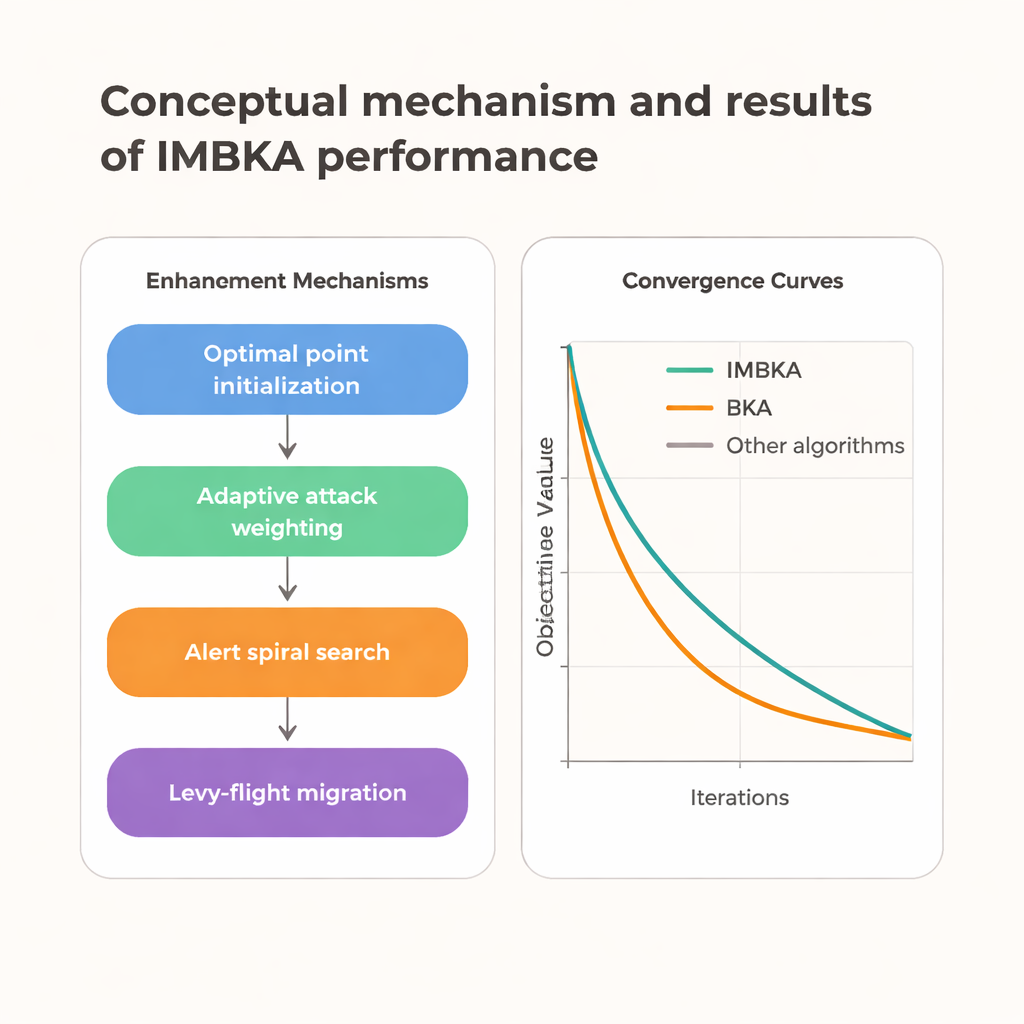
The improved version, IMBKA, refines BKA at four crucial moments in the search. First, instead of scattering the initial birds randomly, the algorithm uses a carefully designed “optimal point set” to spread them evenly across the search space. This simple change increases diversity and reduces the risk that all candidates begin in a bad corner of the problem. Second, the authors add an adaptive weight to the attack stage, similar in spirit to easing off the gas pedal as one approaches a destination. At the beginning of a run the algorithm takes bolder steps to explore widely; later, the steps shrink so it can fine‑tune promising solutions.
Alert flight patterns that dodge dead ends
Third, the researchers introduce a warning behavior inspired by another bird‑based method, the sparrow search algorithm, and a spiral motion pattern borrowed from a whale‑inspired optimizer. In nature, birds on the edge of a flock watch for danger and steer the group away from threats. In IMBKA, this translates into special moves that help individuals escape risky or unproductive regions while spiraling around good candidates to probe their surroundings more thoroughly. Fourth, the algorithm occasionally performs “Levy flights,” a kind of jump that mixes many short moves with rare long leaps. These leaps help the digital kites escape local traps and discover far‑off regions that might hold the true global optimum, without sacrificing the ability to search carefully near good spots.
Proving reliability and testing speed
To show that IMBKA is not just clever but also reliable, the authors build a mathematical model using Markov chains, a standard tool for describing random processes. This model supports a rigorous proof that, given enough time, the algorithm will find the globally best solution with probability approaching one. They then test IMBKA on a collection of twelve benchmark problems that are widely used to compare optimization methods. In controlled “ablation” studies, they turn each of the four improvements on and off, showing that every one of them helps—and that their combination works best. Against five other modern algorithms, IMBKA consistently converges faster, reaches lower error levels, and maintains more stable performance across both simple and highly rugged test landscapes.
Helping high‑speed trains keep the power on
Optimization tools matter most when they make a difference in real hardware. As a practical demonstration, the team uses IMBKA to tune a support vector machine, a popular machine‑learning model, to predict pantograph‑catenary contact resistance in rail systems. This resistance affects how efficiently and reliably power flows from the overhead wire to the train. Using data from a custom sliding contact test rig under different speeds, currents, pressures, and vibration conditions, they compare three models: a plain support vector machine, a version tuned by the original BKA, and one tuned by IMBKA. The IMBKA‑based model reduces prediction error by about a quarter and improves the measure of fit (R²) by roughly seventeen percent, indicating more accurate and trustworthy forecasts of contact resistance.
What this means for everyday technology
In plain terms, the study shows that giving a virtual flock of kites smarter ways to spread out, adapt, react to danger, and occasionally take big leaps leads to better solutions, faster. For engineers, IMBKA offers a more dependable search engine for complex design problems, from power equipment to transportation systems. And by demonstrating real gains in predicting the behavior of high‑speed train power contacts, the work suggests that such nature‑inspired algorithms can quietly improve the safety, efficiency, and cost‑effectiveness of technologies that millions of people rely on every day.
Citation: Hui, L., Kong, Y. Improved black-winged kite optimization algorithm with multi-strategy hybrid and its application. Sci Rep 16, 6768 (2026). https://doi.org/10.1038/s41598-026-36871-x
Keywords: metaheuristic optimization, nature-inspired algorithms, black-winged kite algorithm, support vector machine, pantograph-catenary resistance