Clear Sky Science · en
Removal of selected pharmaceutical pollutants from groundwater using colloidal activated carbon
Why pills in water matter
Many of the medicines we swallow do not stay in our bodies. Traces of painkillers, anti‑seizure drugs, and even caffeine can travel through sewers, survive treatment plants, and seep into underground water. This groundwater is a major source of drinking water around the world. The study described here explores a new way to trap some of these stubborn drug residues underground before they spread, using a highly porous form of carbon that can be injected directly into the subsurface.
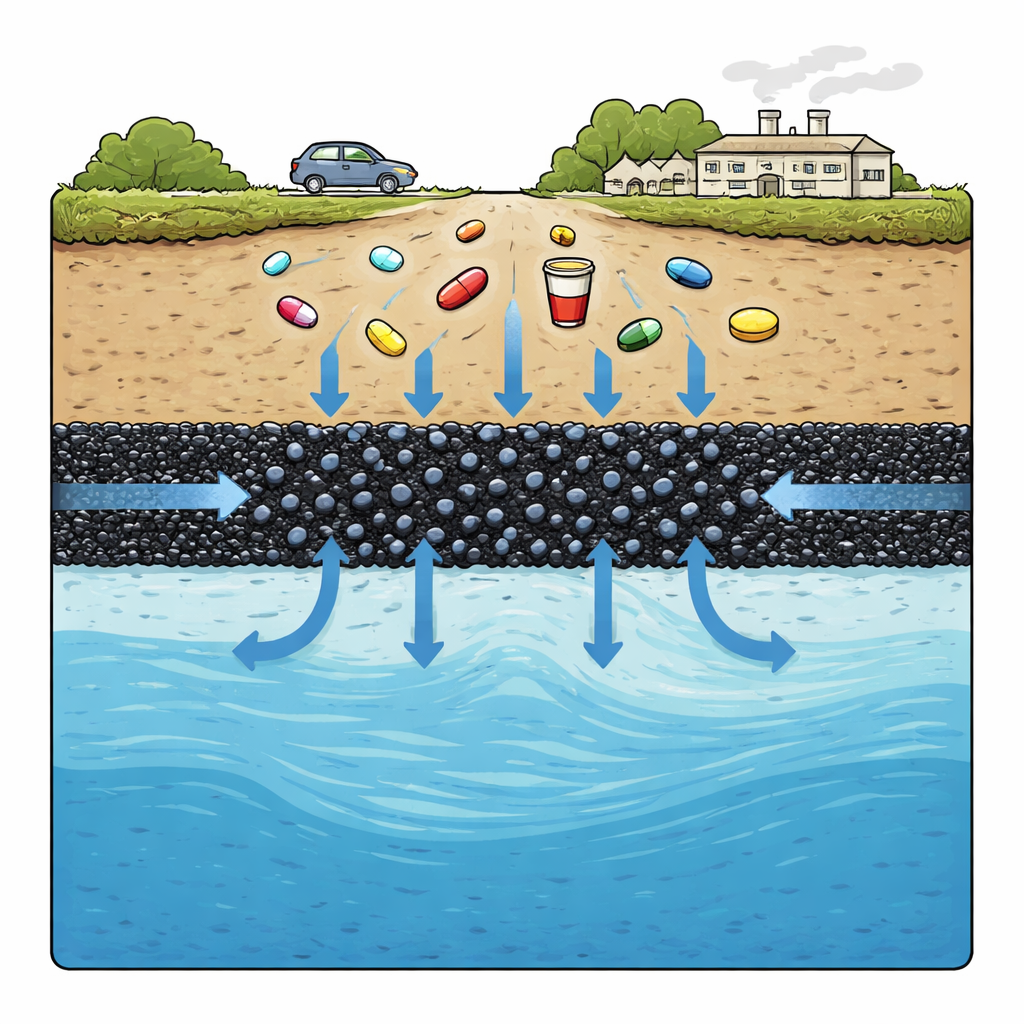
Invisible leftovers from everyday life
Modern life relies on pharmaceuticals, from common stimulants like caffeine to specialized anti‑epileptic drugs such as carbamazepine and lamotrigine. These compounds are built to resist breakdown in the body, and they often slip through conventional sewage treatment. As a result, scientists now detect them in rivers, lakes, and groundwater across Europe, the United States, Asia, and the Middle East, sometimes in remote aquifers. Even at very low levels, their constant presence raises concerns about long‑term effects on ecosystems, wildlife, and human health. Removing such "emerging contaminants" from water has become a growing challenge for engineers and regulators.
A fine carbon sponge in the ground
One promising approach is adsorption, where pollutants stick to the surface of a solid. Activated carbon is especially good at this because it is full of tiny pores that offer an enormous internal area for molecules to cling to. The team in this study focused on a special form called colloidal activated carbon, made of very small particles that form a stable slurry in water. This slurry can be injected into the ground, where the particles coat sand and carbonate grains, forming a kind of invisible filter zone through which groundwater must flow. The researchers first characterized this carbon and found it to be mostly carbon with a bit of potassium, extremely porous, and made up of particles only a few micrometers across with a negatively charged surface that helps them stay dispersed in water.
Testing a miniature underground filter
To see how well this carbon could capture pharmaceuticals, the scientists built small transparent columns packed with sand, carbonate rock, or a 50:50 mixture of both, mimicking layers of natural sediments. They pumped water spiked with caffeine, carbamazepine, and lamotrigine upward through the columns at controlled flow rates, adding measured amounts of colloidal carbon. By comparing the drug levels going in and coming out, they could track how quickly the filter began to "break through"—that is, when contaminants started to slip past—and how long it took before the carbon was nearly saturated. They also used a mathematical "dose‑response" curve to describe the shape of these breakthrough patterns and to estimate how much of each compound the carbon could hold under different conditions.
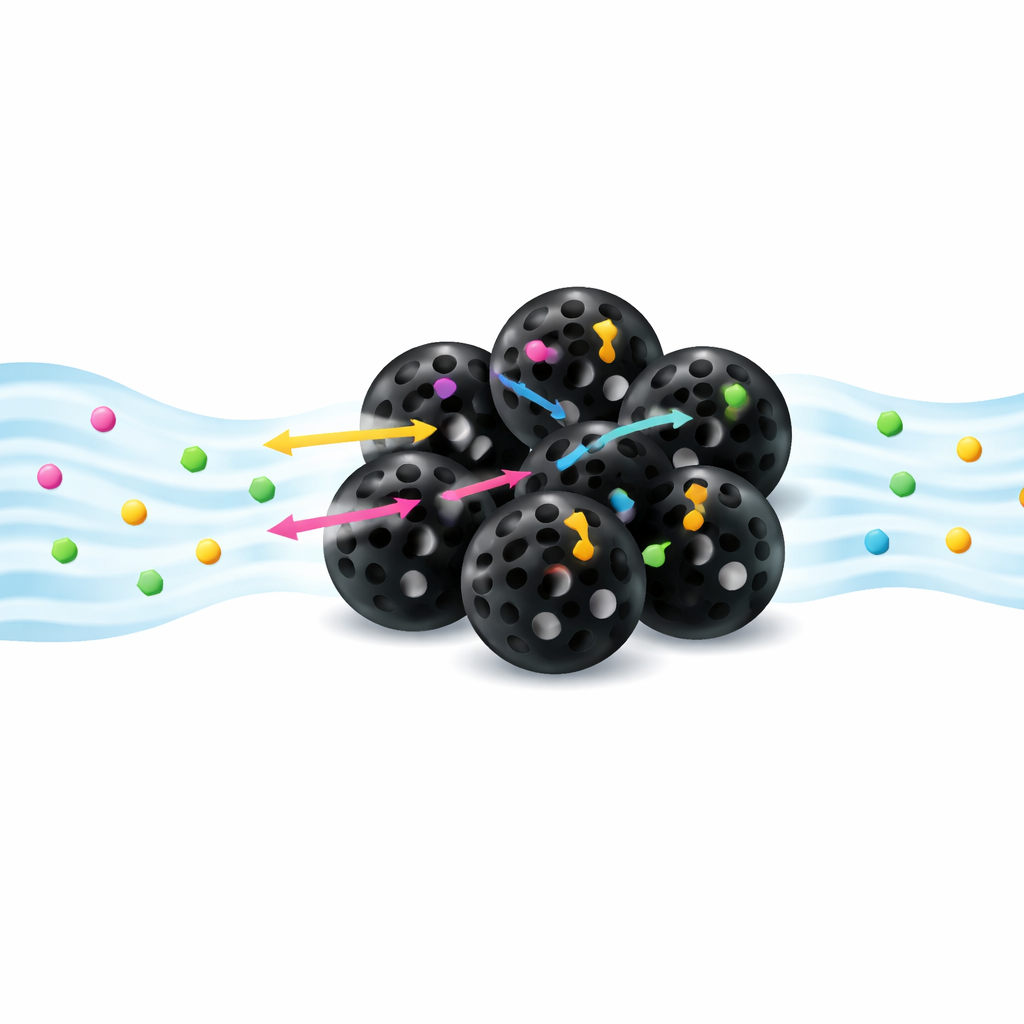
What controls how much is removed
The experiments revealed that operating conditions strongly affect performance. Slower flow allowed more contact time, delaying breakthrough, but the highest flow they tested showed the greatest uptake per gram of carbon before the column was fully exhausted, because more contaminated water passed through. Increasing the amount of carbon in the column extended both the time before breakthrough and the time before saturation, reflecting the larger number of available adsorption sites. Starting with more concentrated pollutant solutions caused faster breakthrough and steeper breakthrough curves, as binding sites filled more quickly, but also increased the total mass of drugs captured. The type of bed material mattered too: a mixed sand‑carbonate bed gave the longest protection before breakthrough and better overall retention, likely because it balanced chemical interaction with smooth, even flow.
From lab tests to real groundwater
Finally, the researchers tested real groundwater that had been spiked with the three target drugs, under the best conditions identified in their earlier runs: a moderate flow, a modest carbon dose, and a mixed sand‑carbonate bed. In this more realistic test, the carbon barrier delayed breakthrough for over two hours and continued to remove the pharmaceuticals for more than seven hours. Overall, it trapped roughly 40 percent of the incoming drug mass before becoming largely saturated. Given that colloidal activated carbon can be injected directly into aquifers, these results suggest engineers could create underground reactive zones that intercept and weaken plumes of pharmaceutical pollution, helping protect drinking water sources.
What this means for safer water
In simple terms, the study shows that a finely divided carbon "sponge" can be spread through underground sediments to catch traces of medicines moving with groundwater. While it does not remove everything, it significantly reduces the load of persistent drugs like caffeine, carbamazepine, and lamotrigine under realistic conditions. Because the material is highly porous and can be deployed in place, it offers a practical way to strengthen natural barriers in aquifers without building massive treatment plants. With further optimization and field trials, this in‑ground carbon shield could become an important tool in keeping the unseen leftovers of our medicine cabinet out of the water we drink.
Citation: Alghamdi, S., Tawabini, B., Abdullah, A. et al. Removal of selected pharmaceutical pollutants from groundwater using colloidal activated carbon. Sci Rep 16, 8470 (2026). https://doi.org/10.1038/s41598-026-36859-7
Keywords: groundwater contamination, pharmaceutical pollutants, activated carbon, water treatment, adsorption