Clear Sky Science · en
QSPR analysis of anticancer drugs using the Euler–Sombor index and theoretical insights on its minimum value for unicyclic graphs
Why the Shape of a Molecule Matters for Cancer Drugs
Cancer drugs are built from atoms linked together in intricate patterns, and even small changes in these patterns can alter how a drug behaves in the body. Measuring these differences usually demands slow, expensive laboratory work. This study explores a mathematical shortcut: using a single number, called the Euler–Sombor index, distilled from a molecule’s structure to estimate important physical properties of anticancer drugs—potentially helping chemists screen candidates faster and understand which shapes work best.

Turning Molecules into Simple Maps
Chemists often describe molecules as graphs, where atoms are dots and bonds are lines connecting them. From these graphs, researchers compute “topological indices” – carefully designed numbers that capture how connected and crowded the molecule is, without referring to 3D shape or quantum mechanics. The Euler–Sombor index is a new member of this family. It combines information about how many bonds each atom has and how those atoms are linked, producing a single numerical fingerprint for each molecule. Because it is easy to compute once the structure is known, this index is attractive for large-scale screening of drug candidates.
Predicting Key Properties of Cancer Medicines
The authors calculated the Euler–Sombor index for 17 known anticancer drugs, including agents such as Carmustine, Melatonin, and Daunorubicin. For each drug, they collected four basic but crucial physical properties from a chemical database: boiling point, melting point, enthalpy (related to the heat involved in changing state), and molar refraction (which reflects how the molecule interacts with light and, indirectly, how bulky its electrons are). They then used standard statistical tools, known as regression models, to see how well this single index could predict each property from the structural fingerprint alone.
How Well Does the Index Perform?
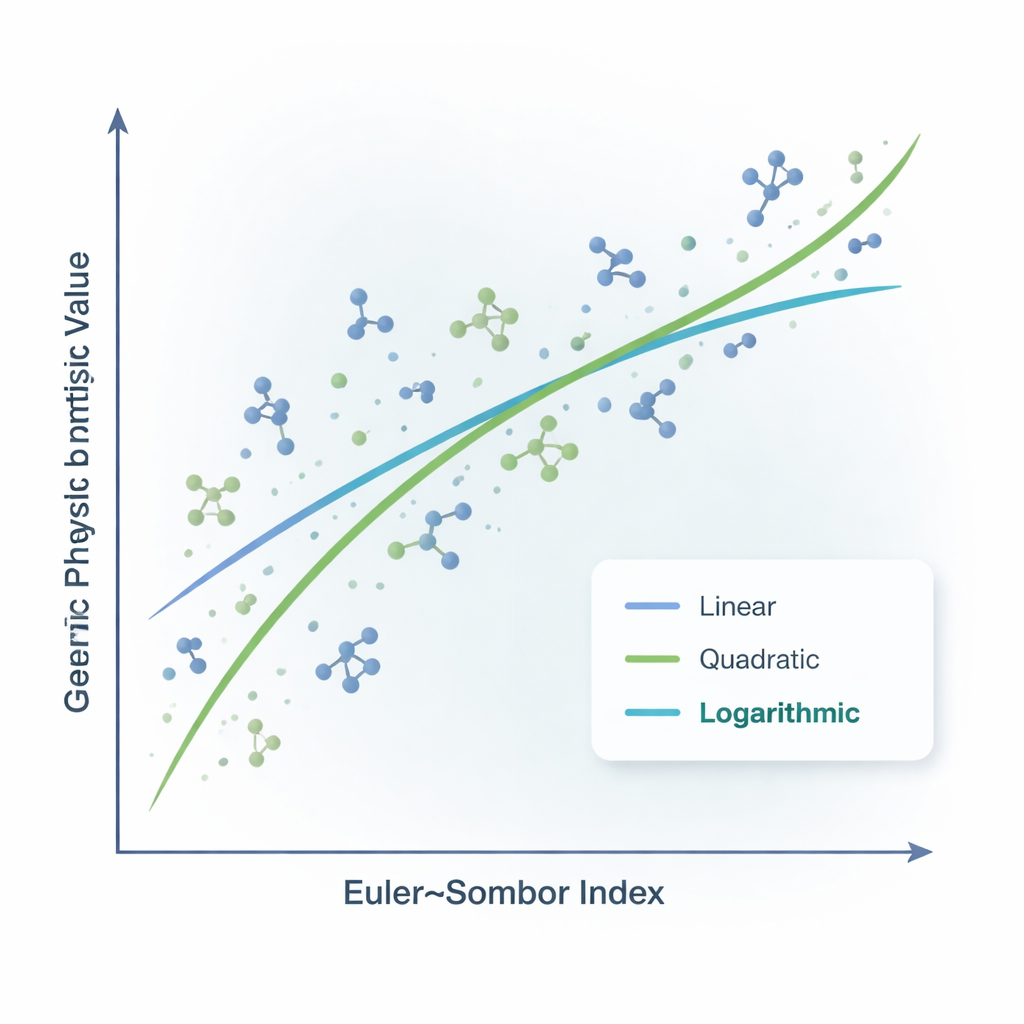
The team compared three types of regression: linear (a straight-line trend), quadratic (a gentle curve), and logarithmic (a curve that rises quickly at first and then levels off). For boiling point and enthalpy, all three approaches showed reasonably strong relationships between the Euler–Sombor index and the measured values, though predictions for boiling point were less precise, with a larger spread between predicted and actual temperatures. For melting point, the connections were somewhat weaker but still meaningful. Molar refraction stood out: here, the index tracked the data very closely, giving small prediction errors and high statistical reliability across all models.
Finding the Best Mathematical Fit
Looking more closely at the statistics, the authors found that the logarithmic model generally performed best for boiling point, melting point, and molar refraction, giving high correlation values and very low chances that the results were due to random noise. For enthalpy, a simple straight-line model worked slightly better than the curved ones. In practice, this means that once the Euler–Sombor index of a candidate molecule is known, a chemist can plug it into these fitted equations to obtain a reasonable estimate of several physical properties—before ever synthesizing the compound in the lab. The study also notes that the dataset is modest in size, and predictions for boiling point remain relatively noisy, so these models are promising guides rather than final answers.
What the Shapes of Simple Graphs Reveal
Beyond practical predictions, the paper dives into the mathematics of the Euler–Sombor index. The authors study “unicyclic” graphs—simple loop-like structures with exactly one ring—and determine which ones give the smallest and third-smallest possible index values for a fixed size. By carefully transforming and comparing different graph families, they identify specific patterns of how short branches attach to a single ring that minimize the index. These results help clarify how particular structural motifs push the Euler–Sombor value up or down, linking pure graph theory to potential molecular behavior.
What This Means for Future Drug Design
For a non-specialist, the key message is that a cleverly chosen number derived from the way atoms connect in a molecule can tell us a surprising amount about how that molecule behaves. The Euler–Sombor index shows strong promise as a compact, informative descriptor for anticancer drugs, especially for properties like molar refraction and enthalpy. At the same time, the mathematical analysis of simple looped graphs deepens our understanding of why certain structural patterns lead to lower or higher index values. Together, these insights suggest that tools from graph theory can help guide chemists toward more efficient, more targeted searches for future cancer therapies.
Citation: Shetty, S., Rakshith, B.R. & Udupa, N.V.S. QSPR analysis of anticancer drugs using the Euler–Sombor index and theoretical insights on its minimum value for unicyclic graphs. Sci Rep 16, 6924 (2026). https://doi.org/10.1038/s41598-026-36855-x
Keywords: anticancer drugs, Euler–Sombor index, QSPR modeling, molecular topology, graph theory in chemistry