Clear Sky Science · en
Warming trends and shortened growing seasons: integrating four decades of observations and model simulations to develop wheat adaptation strategies in semi-arid Pakistan
Why Wheat and Warming Matter to Everyone
For millions of people in Pakistan and beyond, wheat is not just a crop; it is the daily bread on the table. This study looks at how four decades of gradual warming and shifting rainfall have quietly but powerfully changed when wheat grows, how long it has to fill its grain, and how much food farmers can harvest in a semi-arid region that is already short on water. By blending real-world records from 1980 to 2020 with computer simulations, the researchers show how even small temperature increases can shrink growing seasons, cut yields, and threaten both food security and farm incomes—while also pointing to practical steps that can help.
Hotter Seasons and Thirstier Fields
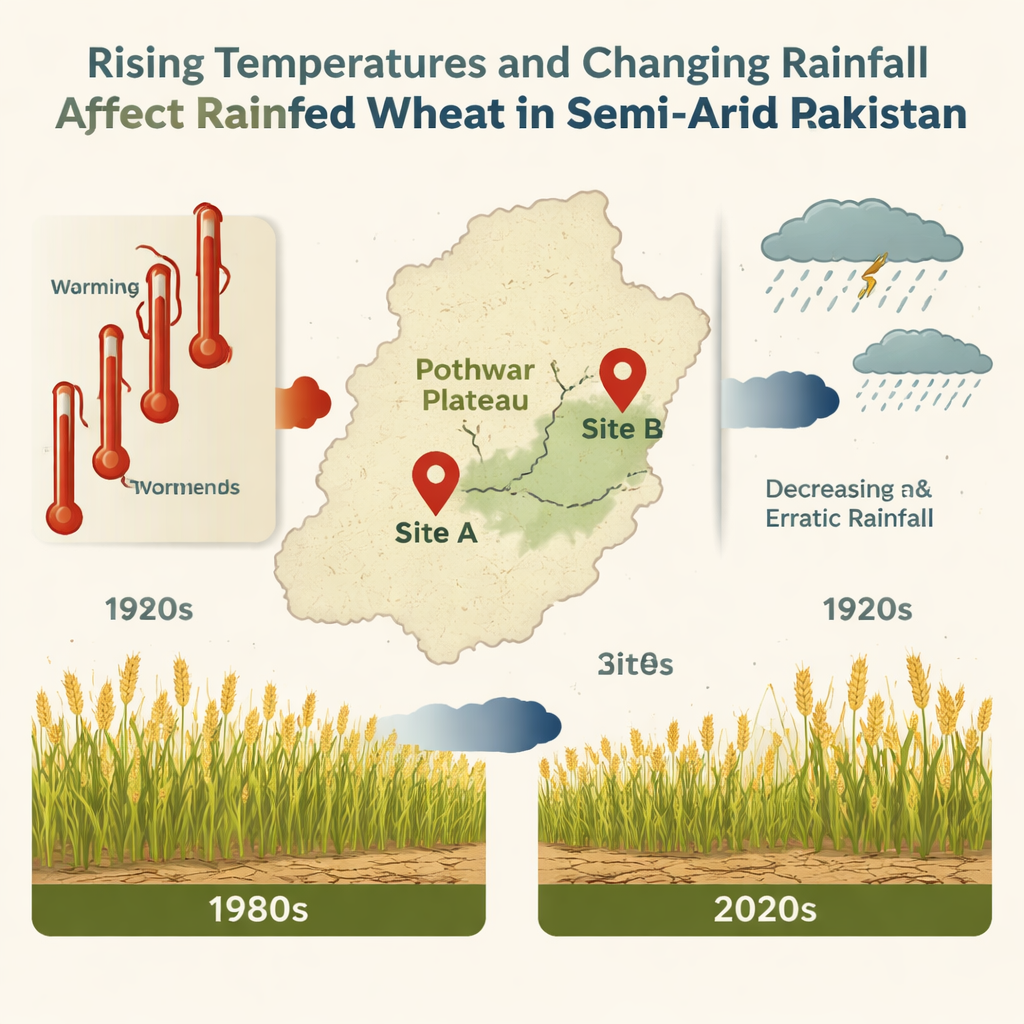
The researchers focused on two rainfed wheat districts in Pakistan’s Pothwar Plateau, labeled here as Islamabad and Chakwal. Using 41 years of weather, crop growth, and yield data, they tracked how the wheat season (from mid-October to late April) has changed. Average temperatures rose by about 1.5 °C at Islamabad and 1.0 °C at Chakwal over the study period, with the sharpest warming in spring—exactly when wheat flowers and fills its grains. Rainfall became more erratic and often lower than the long-term average. Together, these shifts mean crops now face more frequent heat waves and less reliable moisture during their most sensitive stages.
Shorter Growing Seasons, Rushed Plants
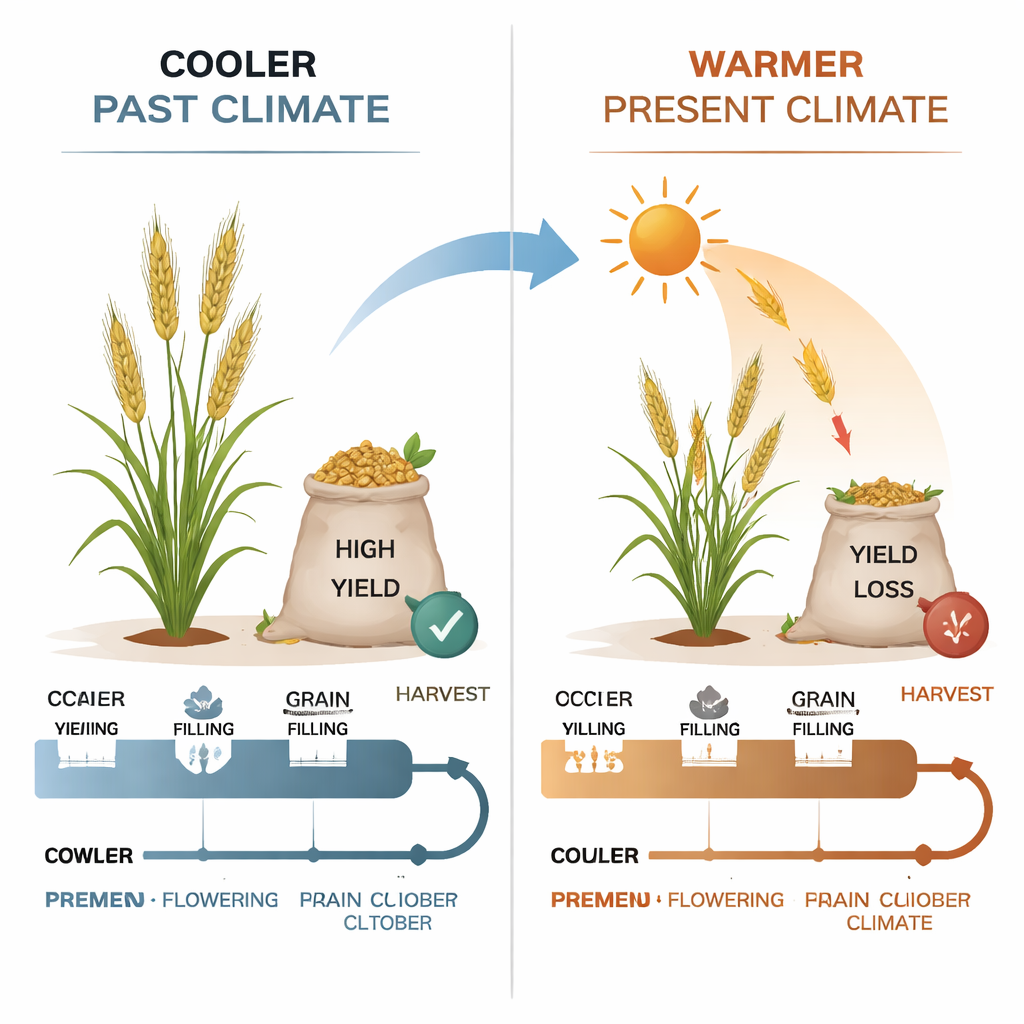
Wheat plants follow a predictable life cycle: they emerge, grow leaves, flower, and finally reach maturity when grains are ready to harvest. The team found that warming has sped up this clock. In the early 1980s, wheat in Islamabad took about 133 days to reach flowering and 163 days to maturity. By 2020–2021, those numbers had dropped to roughly 74 and 93 days. Chakwal showed a similar pattern, with flowering time shrinking from 127 to 70 days and maturity from 155 to 85 days. In essence, warmer air pushed the plants to race through their growth, leaving less time for building biomass and filling grain—a bit like forcing a student to finish a full course in half the time.
Heat, Yield Loss, and the Limits of ‘Good’ CO₂
To understand how this speeding up affects harvests, the scientists examined the total “heat load” the plants experienced and how it lined up with yields. They found that higher accumulated heat was consistently linked with lower grain output at both sites. Yields in Chakwal slipped from about 2.0 to 1.5 tons per hectare over the study period; in Islamabad they fell from about 2.3 to 1.4 tons per hectare. Computer experiments showed that for every 1 °C rise in temperature, yields dropped by about 4.5% at Islamabad and 6% at Chakwal. Higher carbon dioxide levels—which can sometimes help plants grow—did increase simulated wheat yield by 5–9%, but this “CO₂ bonus” was too small to cancel out the much larger damage from heat.
Timing the Planting to Dodge the Heat
Because farmers cannot control the weather, the study explored how changing sowing dates might help them work around the heat. Using a well-tested crop model, the researchers simulated five sowing dates from mid-October to late November. They found that planting earlier—between 1 and 15 October—allowed wheat to flower and fill grain under cooler conditions. In contrast, planting in late November pushed flowering into much hotter weeks, raising average flowering temperatures by more than 30% and cutting yields by up to 27% at Islamabad and 25% at Chakwal. In practical terms, simply shifting the calendar by a couple of weeks can mean the difference between a healthy harvest and a disappointing one.
What It All Means for Food and Farmers
Put together, the results paint a clear picture: in semi-arid Pakistan, gradual warming has shortened wheat’s growing season, exposed the crop to more heat during flowering and grain filling, and reduced yields over the last four decades. Looking ahead, higher temperatures are likely to do even more harm than any benefits from rising CO₂. Yet the study also offers hope. By sowing wheat earlier in October and adopting heat-tolerant varieties identified through process-based models, farmers can avoid the worst of the heat and recover a significant share of lost yield and income. For policy makers and the public, the message is straightforward: climate change is already reshaping a staple food, but informed, relatively low-cost adaptation—backed by long-term data and modeling—can help keep bread on the table in a warming world.
Citation: Ahmed, M., Sameen, A. & Kheir, A.M. Warming trends and shortened growing seasons: integrating four decades of observations and model simulations to develop wheat adaptation strategies in semi-arid Pakistan. Sci Rep 16, 4766 (2026). https://doi.org/10.1038/s41598-026-36853-z
Keywords: wheat, climate change, heat stress, sowing date, rainfed agriculture