Clear Sky Science · en
The (Ta + Ti) to Hf concentration ratio in MC carbides as a novel indicator for predicting γ’ phase fraction in hafnium-containing superalloys
Why Jet Engine Metals Matter
Modern jet engines rely on special metals known as superalloys to survive blazing temperatures and enormous stresses. Tiny changes in their inner structure can mean the difference between a safe, efficient flight and costly damage. This paper explores a new way to “read” that inner structure by looking at microscopic particles inside the metal, offering engineers a smarter tool to predict how strong and reliable these high‑temperature alloys will be over their lifetime.
The Hidden Building Blocks Inside Superalloys
Nickel‑based superalloys power aircraft turbines because their internal architecture is carefully tuned. Two features are especially important. First is the main metallic background, or matrix, which holds everything together. Second is a hard, ordered strengthening phase (called γ′ in technical language) that forms countless tiny particles throughout the metal. The more of this strengthening phase the alloy contains, the better it can resist slow, permanent stretching at high temperatures. Over decades of development, alloy designers have also added elements such as tantalum, titanium, and hafnium, which gather into carbide particles along grain boundaries and strongly influence both strength and crack resistance.
Why Hafnium Carbides Are Special
Among these elements, hafnium plays a double role. It helps stop cracks from spreading along grain boundaries, but it can also encourage unwanted brittle phases if used poorly. Crucially, hafnium loves to form very stable carbides—tiny, hard particles known as MC carbides. These carbides barely dissolve even at the high temperatures used in heat treatment, unlike carbides based mainly on other elements. Because of that stability, the authors treat hafnium‑rich carbides as a fixed reference point inside the alloy: hafnium stays put in these carbides, while tantalum and titanium can move in and out depending on how the alloy is heated and cooled.
A New Way to Read the Alloy’s Inner State
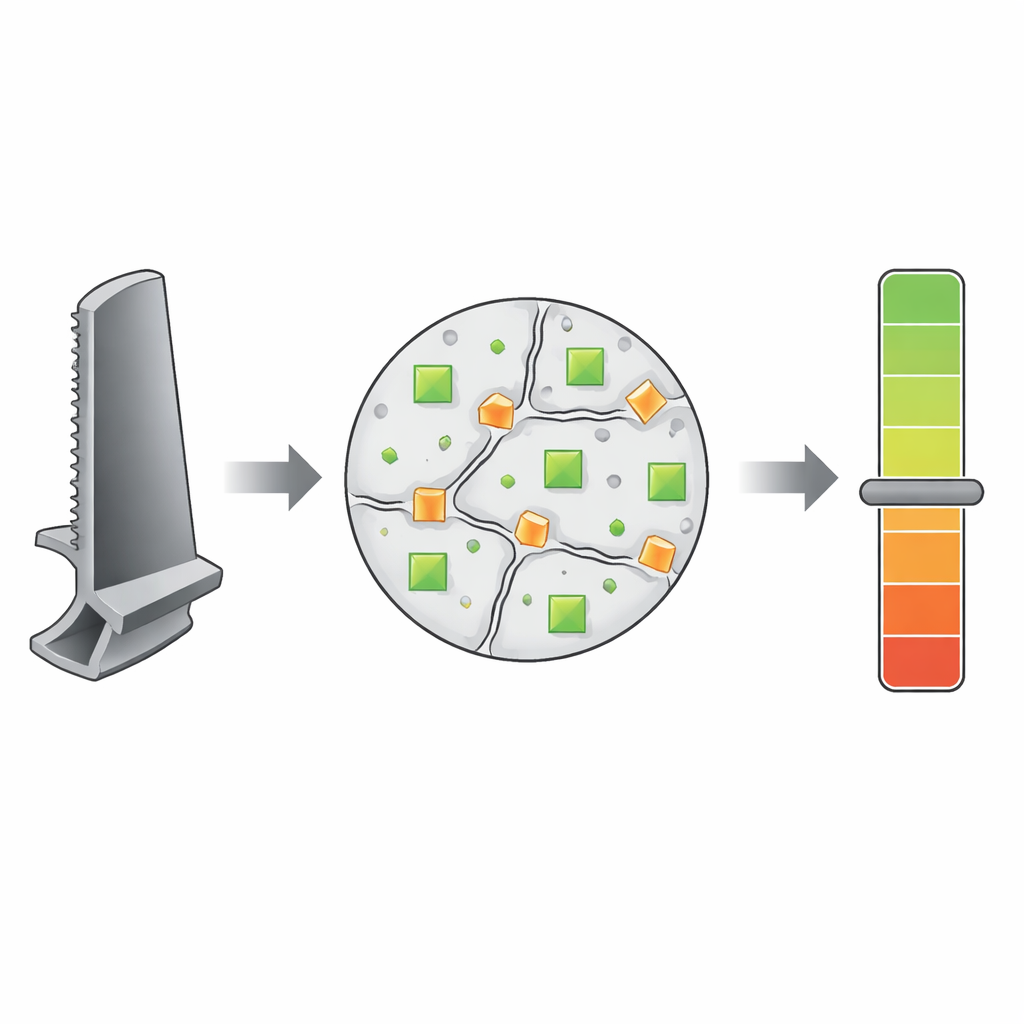
The study introduces a simple concentration index based on the ratio of tantalum plus titanium to hafnium inside these MC carbides. When heat treatment or service conditions allow atoms to diffuse, tantalum and titanium can leave the carbides and join the surrounding matrix, where they help form more of the strengthening phase. When they flow back into the carbides, the strengthening phase shrinks. By carefully measuring the chemistry of carbides in a turbine‑blade alloy called René 108DS after different heat treatments, the researchers showed that this ratio tracks these shifts. A lower (Ta+Ti)/Hf value in the carbides coincides with more strengthening phase in the matrix, while a higher value matches a reduced amount.

Testing the Idea in Real Heat Treatments
To test the index under realistic conditions, the team put René 108DS through several industrially relevant steps: high‑temperature solution treatment, aluminizing (which deposits a protective aluminum‑rich coating), a rapid post‑coating heat treatment, and a final ageing step. Throughout these cycles, they measured how much strengthening phase was present using image analysis, and how the tantalum, titanium, and hafnium were distributed using electron microscopy and crystallographic mapping. They found that slow cooling and aluminizing encouraged tantalum and titanium to leave the carbides and feed the strengthening phase, lowering the ratio inside carbides and increasing the hard phase content. Faster cooling had the opposite effect, pulling these elements back into carbides and reducing the strengthening phase.
What This Means for Future Turbine Blades
The key outcome is that a straightforward chemical ratio inside carbides—the balance of tantalum and titanium compared with hafnium—shows a nearly linear relationship with how much strengthening phase the alloy contains. Because hafnium carbides remain stable even as the alloy is repeatedly heated and cooled, this index can be used at many stages of processing or even after service to estimate how much of the crucial hard phase is present. For engineers, that means a practical, microscopy‑based “gauge” of alloy health in hafnium‑bearing superalloys, potentially improving the design, coating, and life prediction of future turbine blades.
Citation: Witala, B., Moskal, G., Tomaszewska, A. et al. The (Ta + Ti) to Hf concentration ratio in MC carbides as a novel indicator for predicting γ’ phase fraction in hafnium-containing superalloys. Sci Rep 16, 8404 (2026). https://doi.org/10.1038/s41598-026-36846-y
Keywords: nickel-based superalloys, hafnium carbides, turbine blades, heat treatment, high-temperature materials