Clear Sky Science · en
Balancing noise reduction and neural signature preservation in EEG biometrics
Why Your Brainwaves Could Be Your Next Password
Imagine unlocking your phone, a bank account, or even a secure lab not with a fingerprint or face scan, but with the unique rhythms of your brain. This study explores how electroencephalography (EEG)—the tiny electrical signals measured on the scalp—can serve as a powerful biometric for identifying people. The authors tackle a key real‑world problem: how to clean up these very noisy brain signals without scrubbing away the subtle patterns that make each person’s brain activity unique.
The Promise and Problem of Brainwave ID
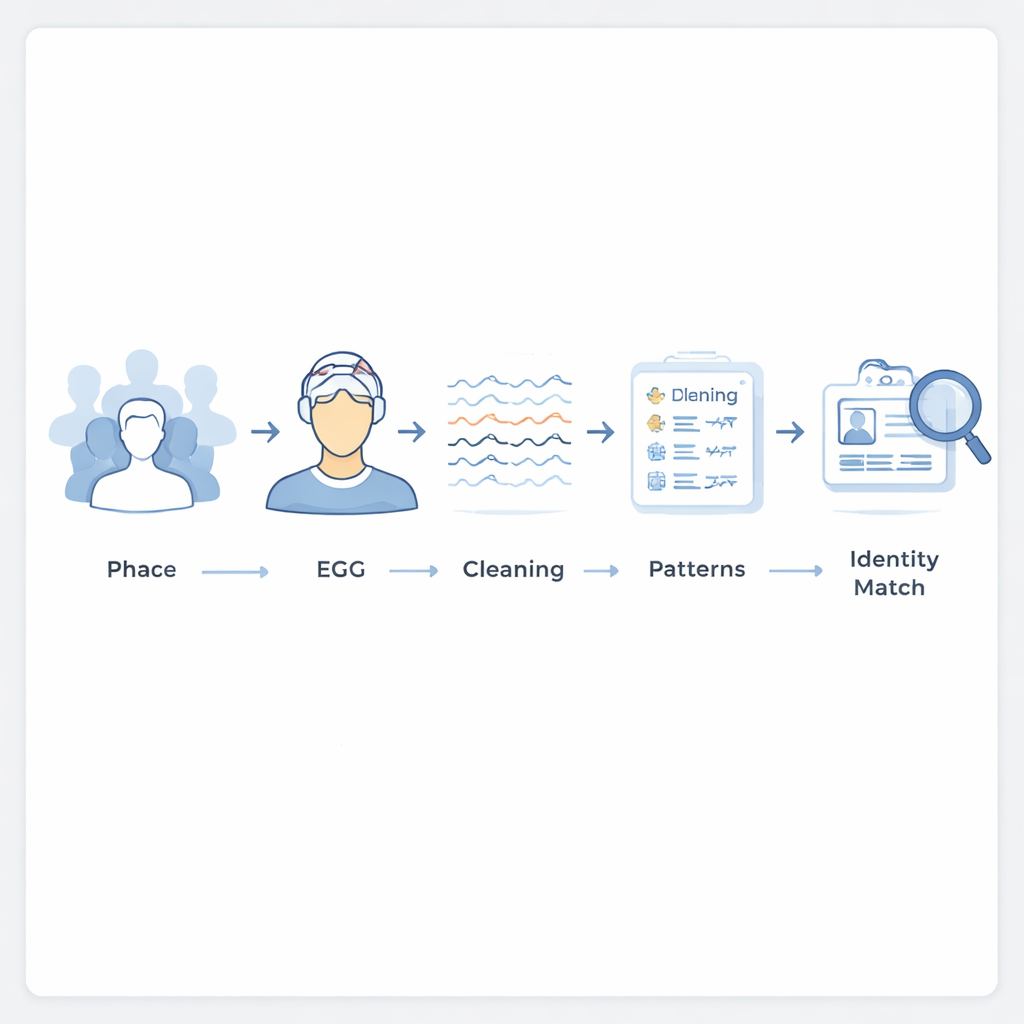
EEG has several advantages over familiar biometrics. Unlike a face or fingerprint, brain activity is hard to fake, cannot be captured at a distance without your cooperation, and changes if you are under duress, which makes it attractive for high‑security uses. But EEG is also messy. Blinks, jaw clenching, muscle tension, movement, and electrical interference from the environment all mix with the true brain signals. Traditional cleaning methods often assume calm laboratory conditions and can be very strict, discarding channels or entire recordings that look suspicious. In real deployments with consumer‑grade headsets, that strictness can backfire, replacing large chunks of real brain activity with mathematical guesses and potentially erasing the very “brainprint” needed to recognize a person.
A Gentler Way to Clean Brain Signals
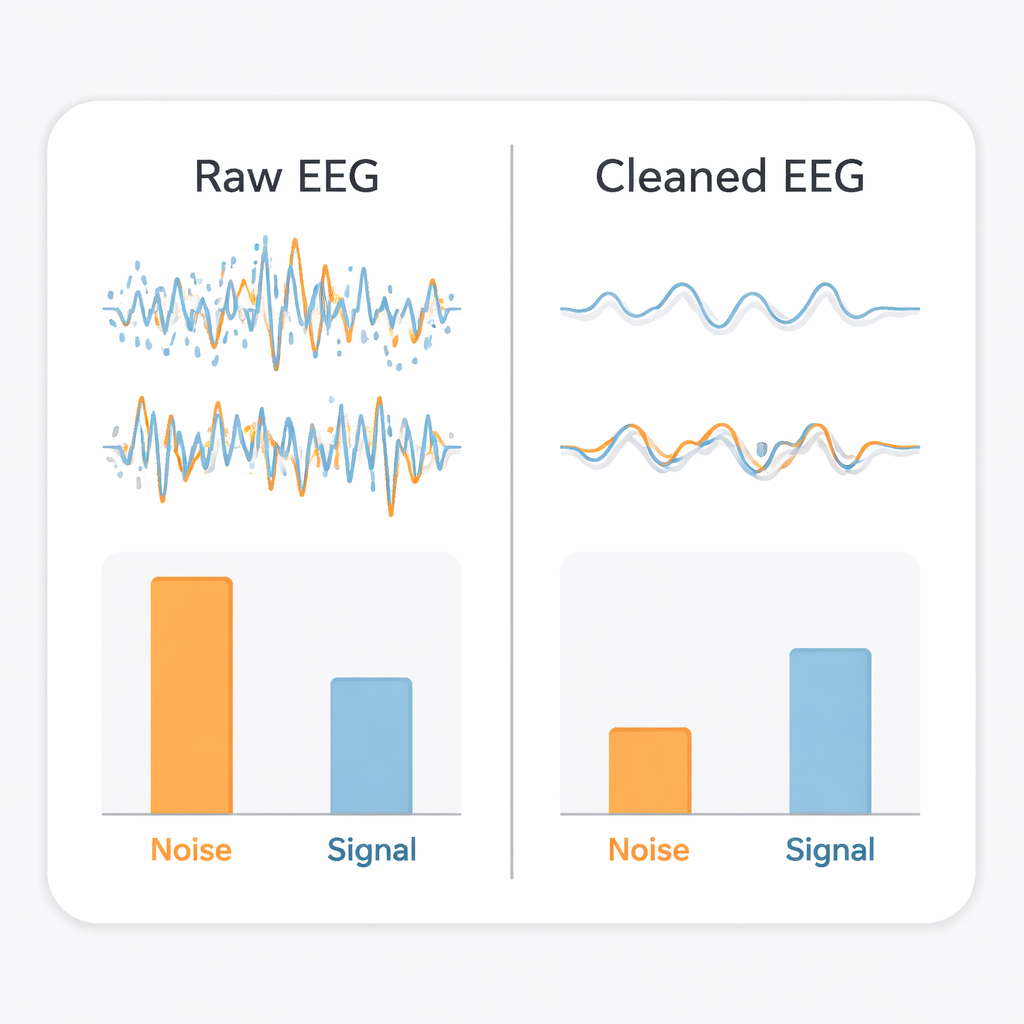
The researchers propose an end‑to‑end pipeline designed to balance noise reduction with preservation of individual neural signatures. Working with the Brain Encoding Dataset, which includes 21 volunteers across multiple sessions and several types of tasks, they compared three versions of the data: completely raw recordings, signals cleaned with a modified and more forgiving version of a standard preprocessing routine (called PREP), and a set of expert‑designed features that come packaged with the dataset. Their lenient cleaning strategy uses several steps—manual removal of obvious hardware failures, gentle filtering to remove slow drifts and electrical line noise, cautious detection and repair of bad channels, and re‑referencing signals against an overall average—while capping how much of any recording can be reconstructed rather than measured, so that enough authentic brain activity remains for identification.
Turning Brainwaves Into Recognizable Patterns
To compare these data versions fairly, the team extracted the same kind of features from each: compact descriptions of the signal’s frequency content known as mel‑frequency cepstral coefficients (MFCCs), widely used in speech recognition. These features summarize how power is distributed across brainwave bands—from slow, drowsy rhythms to faster, attention‑related activity—across all 14 EEG channels. The resulting pattern vectors were then fed into several standard machine‑learning models, including decision trees, random forests, support vector machines, and an algorithm called XGBoost, both individually and in an ensemble that combines their votes. The goal was straightforward: given a short segment of EEG, predict which of the 21 people it came from.
How Well Can We Recognize a Brain?
Within a single recording session, the results were striking. Using the leniently cleaned data, XGBoost identified individuals with up to 98 percent accuracy, especially during a specific visual stimulation condition where volunteers viewed rapidly flickering, color‑rich patterns at 10 hertz. On average, this careful cleaning improved accuracy by about 5 percent over raw signals and by more than 8 percent over the expert‑provided features, and these gains were statistically reliable. Resting with eyes closed emerged as another strong condition, providing high accuracy with simpler instructions. When the team tested robustness across different days or sessions—a much tougher challenge—performance dropped, reflecting natural day‑to‑day changes in brain state and sensor placement. Even so, the leniently cleaned data still outperformed both raw and conventionally processed data, with eyes‑closed rest showing the most stable identities over time.
What This Means for Future Brainwave Security
For a non‑specialist, the message is this: your brain’s electrical activity really can function like a password, but only if we treat the data carefully. The study shows that gently cleaning EEG signals—removing the worst noise without overcorrecting—gives machine‑learning systems a clearer, more reliable view of the patterns that distinguish one person’s brain from another’s. It also highlights which situations work best: rich, rhythmic visual flicker for maximum same‑session accuracy, and quiet, eyes‑closed rest for better stability across days. While cross‑day performance is not yet good enough for high‑stakes security on its own, this work lays out practical design rules for future EEG‑based authentication systems using affordable headsets, from how to clean the data to which tasks to ask users to perform.
Citation: Usman, M., Sultan, N., Nasim, A. et al. Balancing noise reduction and neural signature preservation in EEG biometrics. Sci Rep 16, 6674 (2026). https://doi.org/10.1038/s41598-026-36840-4
Keywords: EEG biometrics, brainwave authentication, signal preprocessing, machine learning, neural signatures