Clear Sky Science · en
Synthesis and characterization of activated carbon from acrylic acid-modified black liquor of sugarcane bagasse for enhanced cadmium removal
Turning Pulp Mill Waste into a Water Cleaner
Many everyday products, from paper to batteries, leave behind troublesome waste and toxic metals. This study shows how a dark, smelly byproduct from sugarcane paper mills—called black liquor—can be transformed into a powerful filter that removes the poisonous metal cadmium from water. By upgrading a waste stream into a high‑value cleaning material, the work links industrial recycling, safer drinking water, and cleaner rivers into one practical solution. 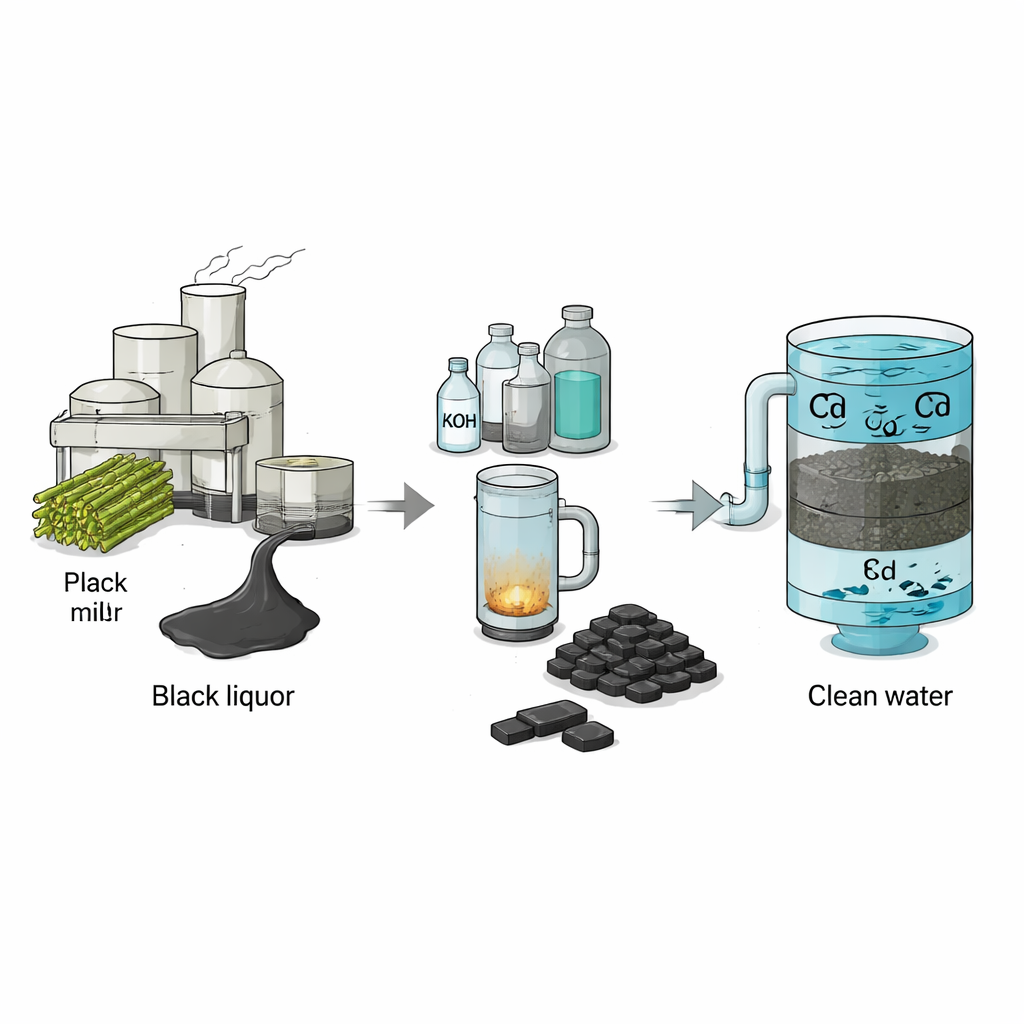
The Problem with Cadmium and Industrial Waste
Cadmium is widely used in batteries, metal coatings, pigments, and plastics, but it is highly toxic and builds up in the environment and in our bodies. It can damage lungs, liver, and kidneys, and it moves up the food chain through water and soil. At the same time, paper mills that process sugarcane bagasse generate huge volumes of black liquor, a dark liquid rich in organic matter and minerals that is costly to treat and can pollute waterways if mishandled. The idea behind this research is simple but powerful: can this troublesome liquid waste be converted into an efficient, low‑cost material to trap cadmium before it reaches the environment?
From Dark Liquid to Porous Carbon Sponge
The authors collected black liquor from a soda pulping mill that uses sugarcane bagasse. They first analyzed it and found that it contains about 40% lignin (a carbon‑rich plant polymer), 30% ash, and 25% holocellulose, along with abundant oxygen‑containing groups. This composition makes it a promising starting point for making activated carbon—a highly porous form of carbon widely used in filters. The team modified the black liquor by adding a small amount of acrylic acid under hydrothermal conditions, then dried and heated the resulting solid with potassium hydroxide at high temperature in the absence of air. This chemical activation carved out a dense network of tiny pores, turning the waste into a black, sponge‑like material known as acrylic‑acid‑modified activated carbon.
Building Better Pores for Trapping Metals
Careful testing showed how strongly this chemical tweak reshaped the material. Compared with unmodified carbon made from the same liquor, the new carbon had about three times higher surface area (1541 instead of 500 square meters per gram) and more than triple the total pore volume. Microscopy images revealed that the unmodified carbon had relatively smooth, compact surfaces with limited openings, whereas the modified version displayed a honeycomb‑like network of interconnected pores. X‑ray measurements indicated a slightly more ordered carbon structure, and infrared spectroscopy confirmed that acrylic acid had introduced many carboxyl groups—chemical “hooks” that can bond with positively charged metal ions like cadmium. Together, these changes created more places for cadmium to attach and easier pathways for water to flow through the material. 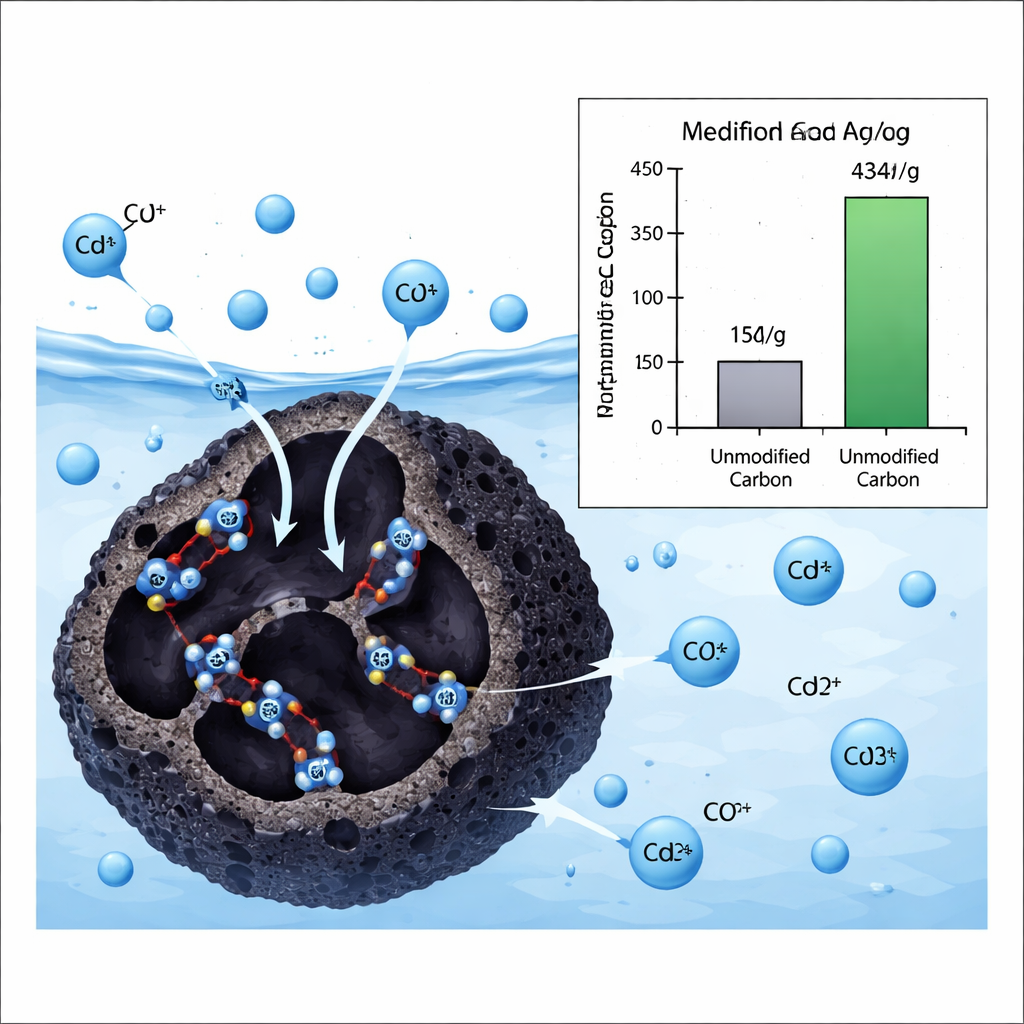
How Well It Cleans Cadmium from Water
To see how effective this upgraded carbon is, the researchers exposed it to water containing cadmium over a wide range of concentrations. The material removed nearly all cadmium at lower concentrations and continued to perform strongly even when the water was heavily contaminated. When the data were fitted to standard adsorption models, the maximum capacity reached about 434 milligrams of cadmium per gram of carbon—far higher than many commercial or previously reported carbons. The rate at which cadmium was taken up matched a model typically associated with chemical bonding, suggesting that cadmium does more than just cling weakly to the surface; it forms stronger, more specific interactions with the functional groups introduced by the acrylic acid. The process was also more favorable at higher temperatures and remained reasonably effective over several use‑and‑regeneration cycles, especially when nitric acid was used to release the captured metal.
What This Means for Cleaner Industry and Water
For non‑specialists, the key message is that an industrial waste liquid—black liquor from sugarcane pulp mills—can be turned into a high‑performance “metal sponge” that captures dangerous cadmium from water extremely well. By adding a common chemical (acrylic acid) before activating the carbon, the researchers created a material with many more internal surfaces and chemical hooks, leading to outstanding cadmium removal. This approach tackles two issues at once: it reduces the environmental burden and disposal cost of black liquor, and it offers a scalable, low‑cost tool for cleaning contaminated water. If developed further, such materials could help communities and industries limit heavy‑metal pollution while making smarter use of their own waste streams.
Citation: Pourbaba, R., Ashori, A., Abdulkhani, A. et al. Synthesis and characterization of activated carbon from acrylic acid-modified black liquor of sugarcane bagasse for enhanced cadmium removal. Sci Rep 16, 6765 (2026). https://doi.org/10.1038/s41598-026-36827-1
Keywords: activated carbon, black liquor, cadmium removal, wastewater treatment, sugarcane bagasse