Clear Sky Science · en
Distributed decision-making in a shared power network: a game-theoretic framework for integrated electricity and gas systems
Why power and gas need to talk to each other
As homes and businesses add more clean technologies, our energy grids are becoming tightly intertwined. Electricity can now be turned into gas fuels such as hydrogen or synthetic natural gas through power-to-gas units, and local energy markets let many small companies trade energy instead of relying on a single monopoly. This paper looks at what happens when several independent gas distributors share the same power network, and shows how careful coordination can keep the lights on, the gas flowing, and the market fair for everyone.
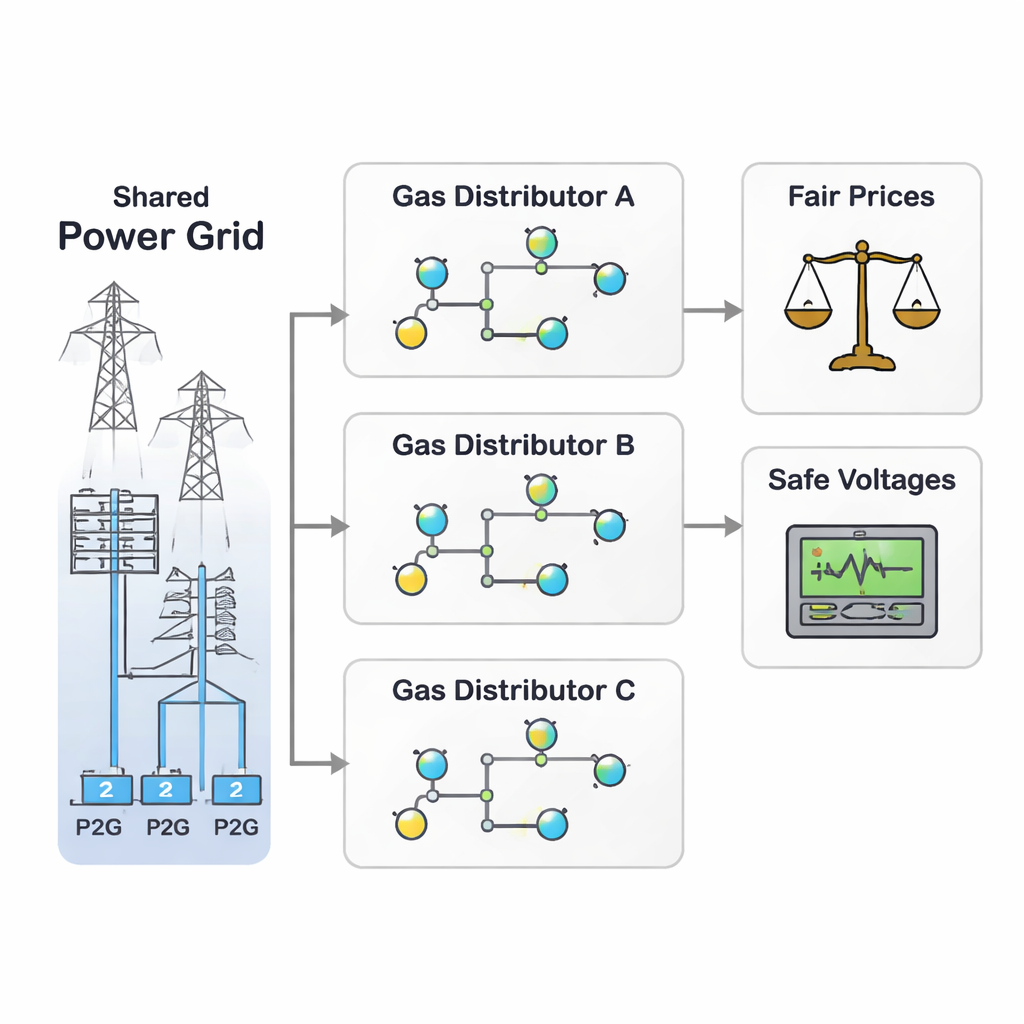
A shared grid with separate players
The study is inspired by real regions, such as parts of Long Island in New York, where one company runs the electric grid while multiple firms manage local gas networks. These gas distributors all plug their power-to-gas equipment into the same electricity system, but sell gas in separate territories. Because they share wires but not business plans, one company’s decision to ramp up gas production can unintentionally push the shared grid beyond safe voltage limits. Traditional planning tools often gloss over these real-time interactions or simplify the physics of the grid, which can make a strategy look safe on paper while being risky in practice.
A new way to model energy decisions
To tackle this problem, the authors build a game-like model that treats each gas distributor as a self-interested player. Each one tries to minimize its own costs while respecting both gas pipeline limits and power grid limits. On the gas side, companies must make yes-or-no choices, such as which direction gas should flow in a pipe or whether a compressor is on or off. On the power side, they must obey the full, curved relationship between electricity, voltage, and current, rather than simplified straight-line approximations. The framework links these two layers so that gas prices influence how much electricity each player draws, while the state of the power grid pushes back by limiting what their power-to-gas units can do.
How the coordination loop works
The authors propose a step-by-step computing process that lets these interacting decisions settle into a stable outcome. First, a gas market calculation figures out how much gas each distributor buys and at what price, given everyone else’s choices. Next, a power system calculation updates how electricity flows and how the shared grid responds. Prices and power-to-gas schedules are then exchanged between the two layers, and the process repeats. This back-and-forth continues until further changes become tiny, meaning the system has reached a balanced state where no player has a strong reason to change its strategy.
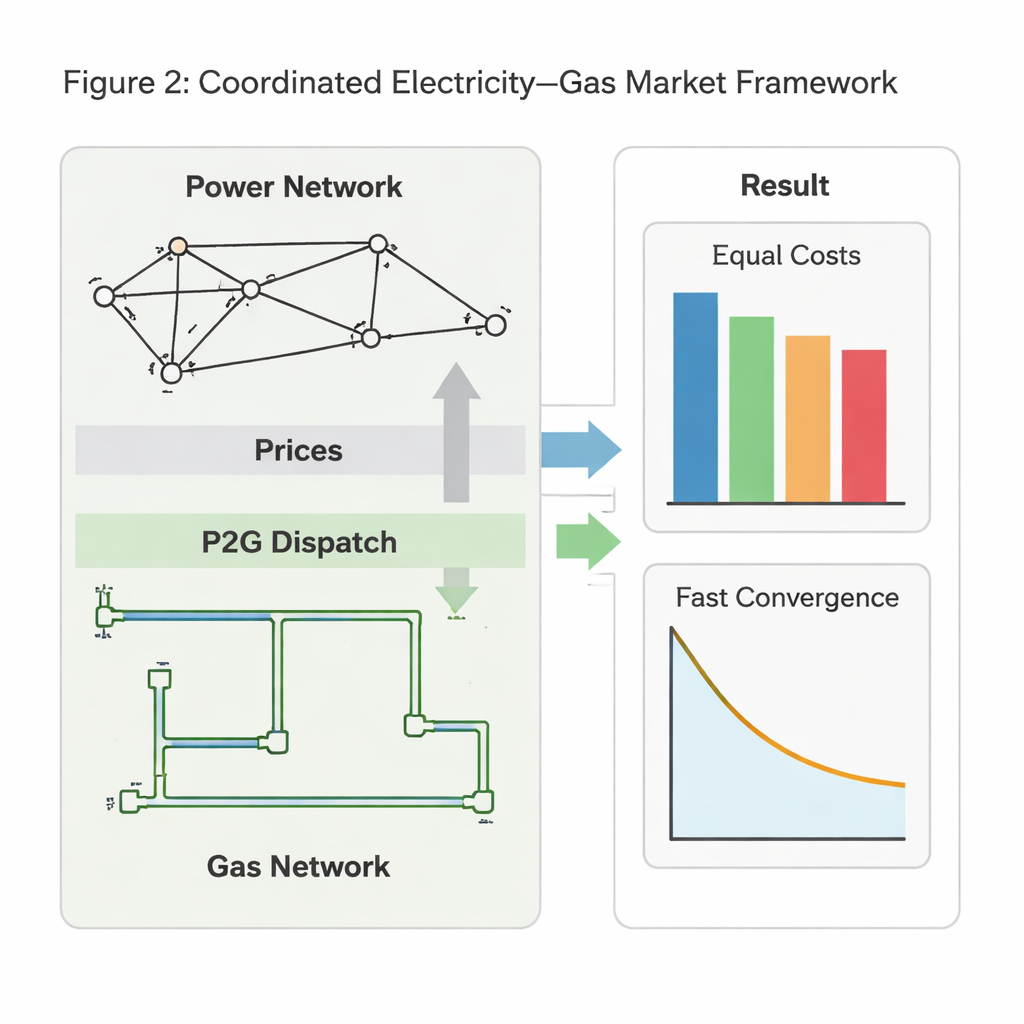
Fair prices and safe operation
Using test cases that combine a 10-node power distribution system with several gas networks, the study shows that the method converges quickly—within about ten rounds of calculation—to a very precise solution. Importantly, gas distributors that operate in structurally identical networks end up paying the same effective cost for gas over time, indicating that the market is not favoring one over another for arbitrary reasons. At the same time, the full physical behavior of the power grid is respected, so strategies that would cause unsafe voltages are automatically ruled out. The method also proves robust: it reaches the same outcome even when starting from rough guesses or when some of the neat mathematical conditions behind the theory are intentionally relaxed.
What this means for future energy markets
For a lay reader, the key message is that as our energy systems become more complex and more open to competition, we need tools that can juggle fairness, profit, and physics all at once. This paper provides such a tool for situations where multiple gas distributors share the same power wires. By combining detailed engineering models with a game-like view of market behavior, the framework helps ensure that companies can compete on a level playing field without putting the grid at risk. In essence, it offers a blueprint for running future electricity–gas systems that are both fair to market participants and safe for society.
Citation: Huang, J., Yu, T., Pan, Z. et al. Distributed decision-making in a shared power network: a game-theoretic framework for integrated electricity and gas systems. Sci Rep 16, 5758 (2026). https://doi.org/10.1038/s41598-026-36826-2
Keywords: integrated energy systems, power-to-gas, local energy markets, game theory, electricity and gas networks