Clear Sky Science · en
A novel hybrid medical image encryption scheme based on memristive chaos and DNA-ARX-3DES with Real-Time implementation
Why locking medical images really matters
Hospitals now send X‑rays, mammograms, eye scans, and dental images across networks every minute. These pictures can reveal a patient’s identity and most intimate health details. Yet many of today’s protection methods were never designed for the huge, detailed image files modern medicine relies on. This paper presents a new way to scramble medical images so thoroughly that they look like random noise to outsiders, while still being fast enough to run on small, low‑power devices used in clinics and at the bedside.
A new digital lock inspired by physics and biology
The authors combine ideas from three worlds: electronics, biology, and classical cryptography. At the heart of their method is a special electronic component called a memristor, which naturally produces wildly changing electrical signals that are extremely hard to predict. These signals are turned into long strings of random bits that act as secret keys. Borrowing from DNA, the method then treats chunks of the image data as if they were short genetic codes, allowing them to be mixed and swapped in ways that further disguise the original picture. Finally, a well‑known banking‑grade cipher (3DES) is used as an extra “whitening” layer to wipe out any remaining patterns. 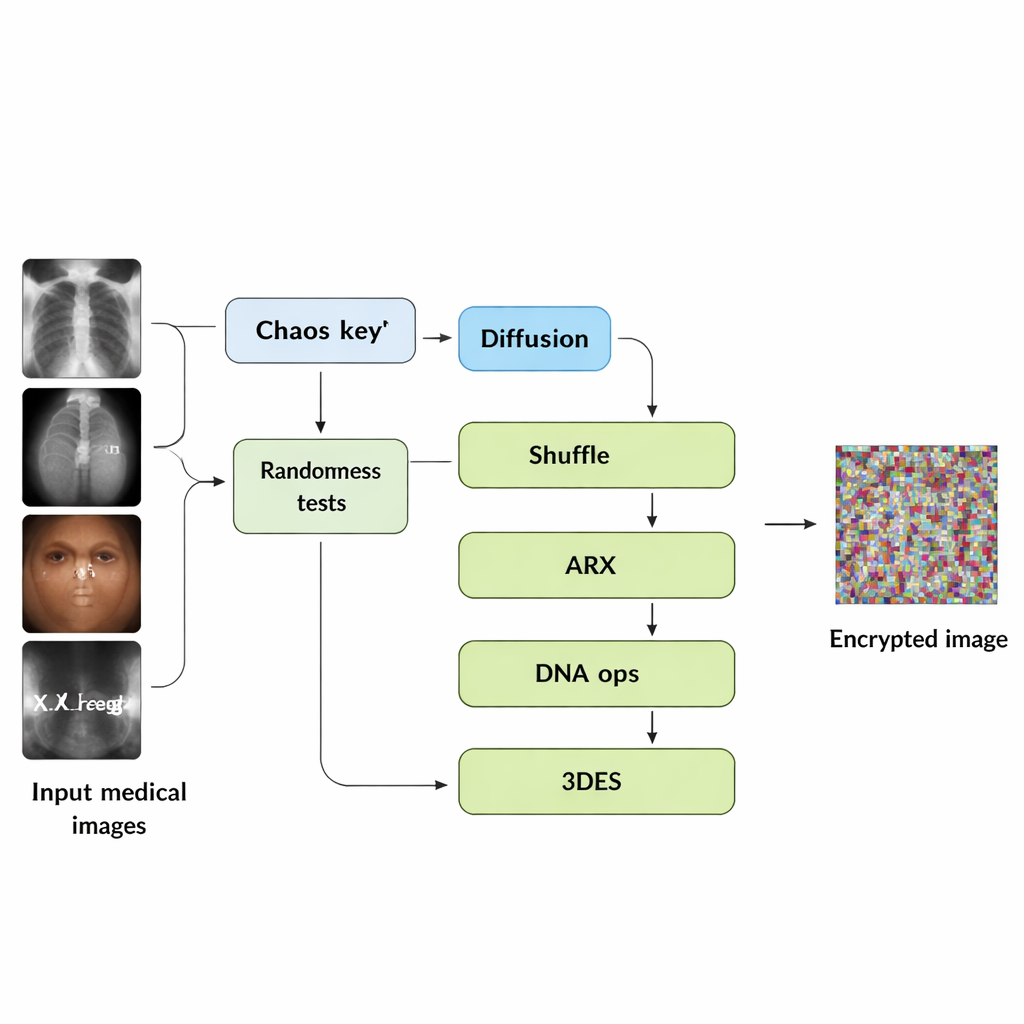
How a medical image is scrambled step by step
Each colour medical image is first split into its red, green, and blue layers, which are processed independently. For every layer, the memristor circuit generates a chaotic number stream that is carefully cleaned and tested for randomness using official U.S. standards (NIST and FIPS). This stream controls several stages: bits in the image are first flipped and rearranged, then passed through a simple but powerful arithmetic mix (called Add‑Rotate‑Xor, or ARX) that rapidly spreads small changes across many pixels. Next, the bits are recoded into a 16‑symbol “DNA alphabet” and combined with a key sequence in a crossover step, echoing how biological DNA strands exchange information. Only after all this scrambling is the result fed into the 3DES cipher with a fresh random starting value for each image.
Putting the system to the test
To see if this chain of tricks truly hides information, the team encrypted four types of medical images: bone fractures, breast mammograms, retina blood vessels, and teeth X‑rays. They checked how the brightness values of the encrypted pictures are distributed, how strongly neighbouring pixels are related, and how much the result changes if you tweak just one pixel or one bit of the secret key. In every case, the encrypted images looked statistically indistinguishable from random noise, with almost no correlation between adjacent pixels and nearly perfect measures of randomness. Changing a single pixel or a single key bit caused changes across more than 99.5% of the encrypted image, meaning attackers cannot learn anything useful from carefully chosen test images. 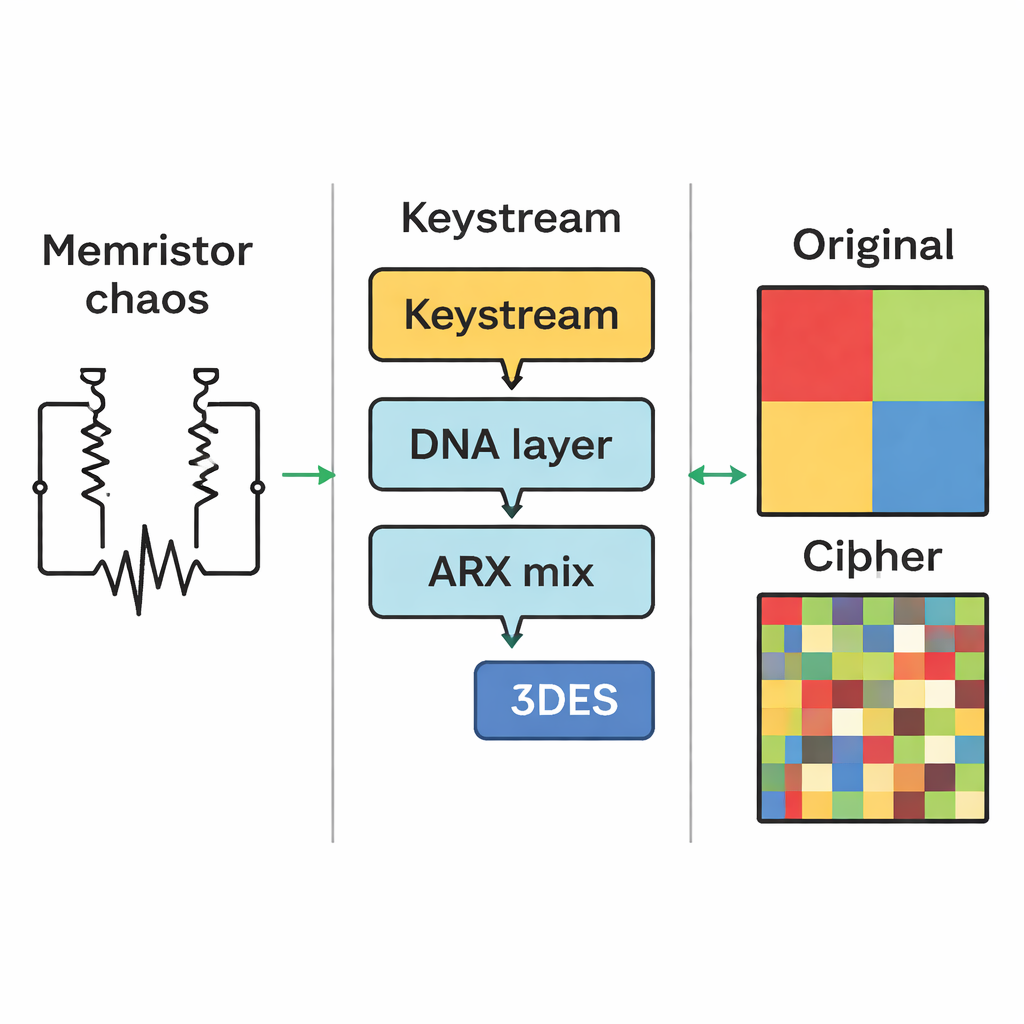
Ready for real‑time use at the edge
Strong security is only helpful if it can run where it is needed. The researchers therefore implemented their scheme on two low‑cost embedded platforms: NVIDIA’s Jetson Nano and the PYNQ‑Z1 board. Despite the multiple layers of protection, they were able to encrypt and decrypt standard 256×256‑pixel medical images in roughly half a second on the Jetson Nano and just over a second on the PYNQ‑Z1. These speeds are fast enough for many Internet‑of‑Medical‑Things applications, such as encrypting images in portable scanners or sending them securely to cloud‑based diagnostic services without noticeable delay.
What this means for patient privacy
Overall, the study shows that it is possible to build a practical “defence in depth” system for medical images, where physics‑based chaos, DNA‑style data mixing, and established ciphers all reinforce one another. For a non‑expert, the takeaway is simple: this method makes a medical image so random‑looking that even powerful computers cannot easily reverse it without the exact secret key, yet doctors and devices can still unlock it quickly when needed. As healthcare continues to move online and onto small connected devices, such hybrid approaches could become an important tool for keeping sensitive scans and X‑rays safe from prying eyes.
Citation: Suzgen, E.E., Sahin, M.E. & Ulutas, H. A novel hybrid medical image encryption scheme based on memristive chaos and DNA-ARX-3DES with Real-Time implementation. Sci Rep 16, 6230 (2026). https://doi.org/10.1038/s41598-026-36824-4
Keywords: medical image encryption, memristor chaos, DNA-based cryptography, embedded security, health data privacy