Clear Sky Science · en
Analysis of hydraulic mechanism of dynamics flow visualization in an axial pump with impeller blades based on novel transient characteristics conditions and vibration techniques
Keeping Water and Lights On
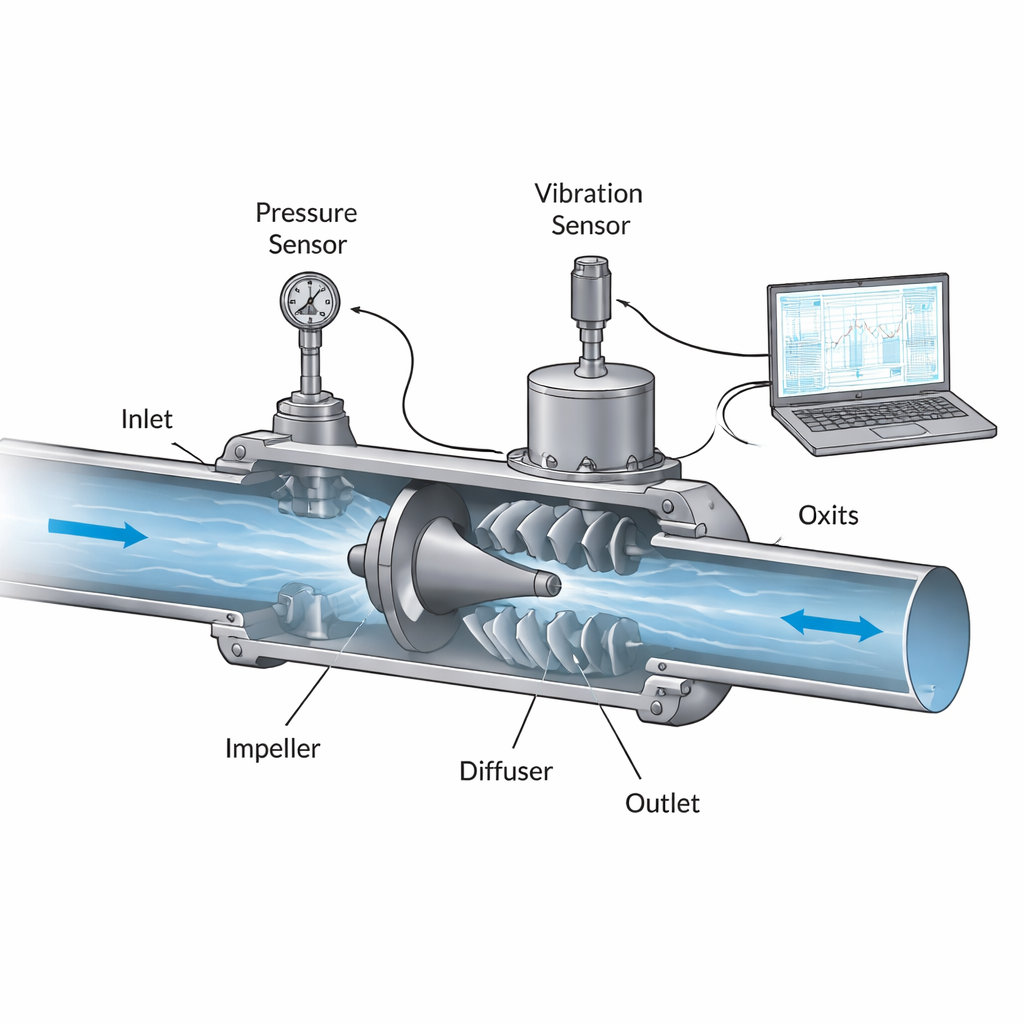
Hidden inside dams, irrigation canals, and city water systems, pumps work around the clock to move water and often to generate electricity. Axial-flow pumps—machines that look like ship propellers inside pipes—are especially attractive because they are compact and relatively cheap. Yet they can shake, vibrate, and lose efficiency when the water flow is not exactly what they were designed for. This study peeks inside one such pump, combining lab measurements and computer simulations to reveal how swirling water and blade geometry control its stability, noise, and lifespan.
Why These Pumps Matter
Many remote communities and small hydropower stations rely on pumps that can also run as turbines, turning water flow into electricity. Axial pumps are promising candidates because they cost less than traditional turbines and can be installed directly in pipelines. The catch is that they behave well only near a specific “sweet spot” flow rate. When demand for water or power changes, the pump is forced to run at part-load (too little water) or overload (too much), where it can become noisy and unstable. Understanding exactly how water moves through the pump at these conditions is crucial for building machines that are both efficient and reliable.
Peering Inside the Machine
The researchers studied a high-speed axial pump with four blades spinning at 3000 revolutions per minute. In the laboratory, they measured water flow, pressure, and vibration at several operating points, from very low flow (5 liters per minute) to above the design flow (12.5 liters per minute and higher). At the same time, they built a detailed three-dimensional computer model of the pump and surrounding pipes, using computational fluid dynamics to simulate how water accelerates, slows, and swirls between the blades and through the stationary diffuser vanes. The simulations were carefully checked against experiments and found to match key performance measures, such as head (the height the pump can lift water) and efficiency, within about five percent.
When Flow Becomes Unruly
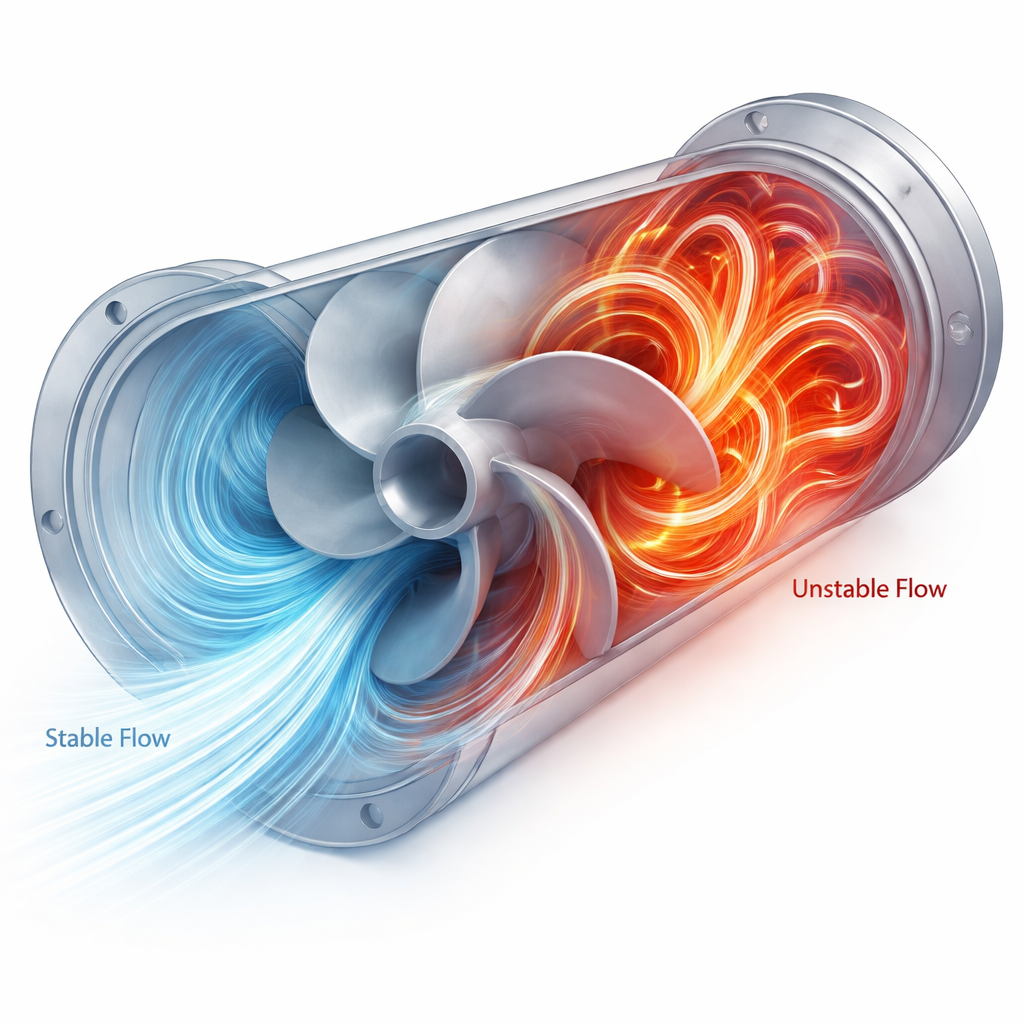
By tracking both the pressure inside the water and the vibration of the pump casing, the team showed that the pump’s behavior changes dramatically with flow rate. At part-load, much of the passage between blades—up to about 70 percent of the area—fills with slow, recirculating water, while narrow high-speed jets hug the suction side of the blades and the outer wall. These uneven patterns spawn vortices and backflows that buffet the blades and diffuser vanes. In the pressure signals, this appears as strong rhythmic pulsations tied to the blade-passing frequency—the rate at which each rotating blade sweeps past the stationary vanes—along with extra low-frequency components linked to large-scale swirling structures. As the flow is increased toward overload, these chaotic regions shrink and pressure oscillations drop by roughly 14 percent, indicating a calmer, more stable hydraulic state.
How Blade Angle Changes the Story
The study also explored how small tweaks to the impeller blade angle—tilting the blades by −3°, 0°, or +3°—alter the internal flow. Even such modest changes had a big impact. Increasing the angle generally intensified the swirling motion of the water and strengthened regions of backflow near the hub (the inner part of the blades). These changes raised pressure pulsations, particularly in the space between the rotating blades and the stationary diffuser, where the interaction is strongest. Under some off-design conditions, certain blade angles produced especially high fluctuations, showing that geometry must be chosen with care to avoid harmful vibration and noise.
From Lab Insight to Real-World Reliability
For non-specialists, the key message is that the way water threads its way through a pump determines not only how efficiently it runs, but also how quietly and how long it will last. This work maps out where dangerous flow structures and pressure spikes arise inside an axial pump, and how operating point and blade angle can either worsen or calm them. Designers can use these insights to select blade settings that balance efficiency with stability, and operators can better understand why running far from the design flow invites trouble. Ultimately, such knowledge helps make low-cost pump-as-turbine systems more dependable tools for supplying water and renewable energy.
Citation: Al-Obaidi, A.R., Alwatban, A. Analysis of hydraulic mechanism of dynamics flow visualization in an axial pump with impeller blades based on novel transient characteristics conditions and vibration techniques. Sci Rep 16, 6416 (2026). https://doi.org/10.1038/s41598-026-36822-6
Keywords: axial-flow pump, pressure pulsation, flow instability, pump vibration, impeller blade angle