Clear Sky Science · en
A preclinical study of device dependent therapeutic effects of cold atmospheric plasmas on atopic dermatitis induced by DNCB
New Light on an Old Itch
Atopic dermatitis, often called eczema, affects millions of children and adults with dry, red, intensely itchy skin. While creams and immune-suppressing drugs can help, they may bring side effects or lose effectiveness over time. This study explores an unusual, needle-free approach: treating eczema-like skin in mice with gentle "cold" plasma—an energized gas that can be generated in air— to see whether it can calm inflammation and help restore the skin’s natural barrier.
A Gentle Glow Instead of a Pill
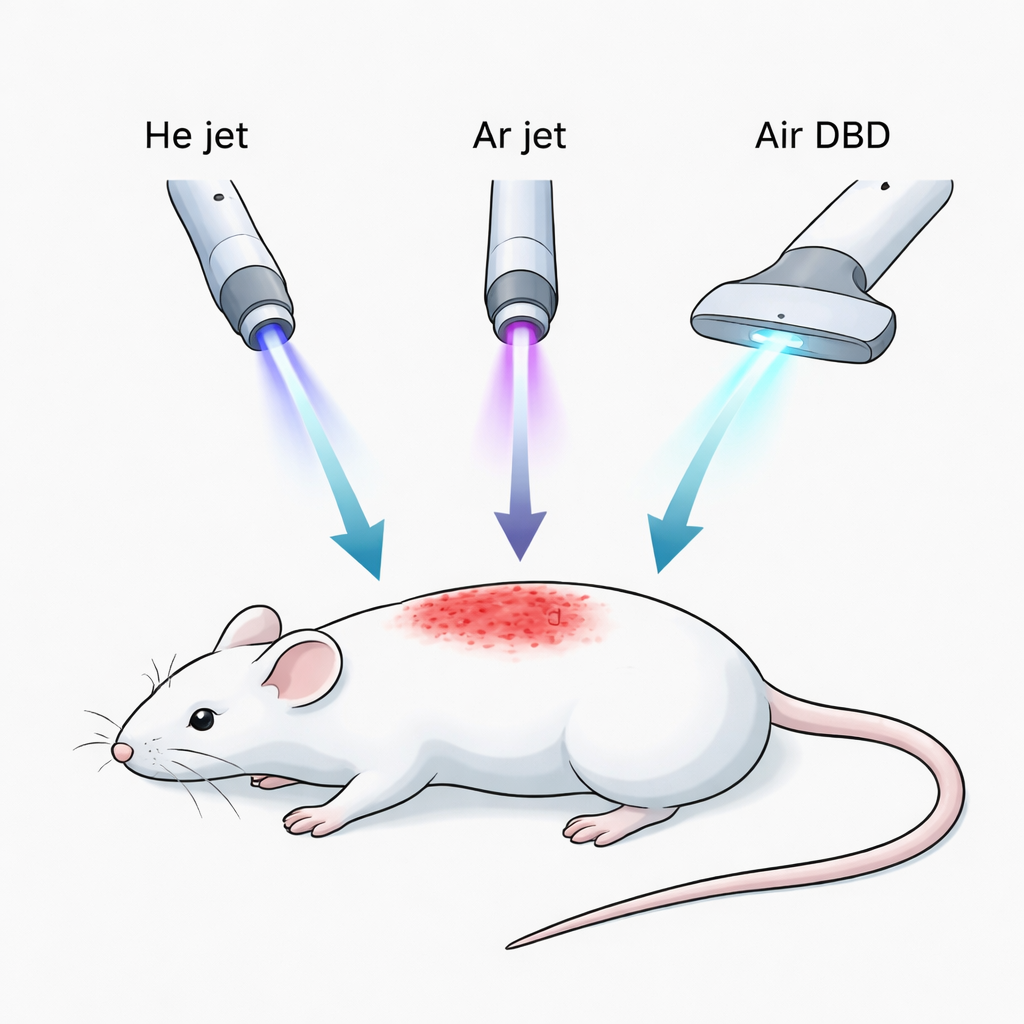
Plasma is sometimes called the fourth state of matter, made when gas is energized so that charged particles, reactive molecules, and faint light are produced. The team tested three small devices that create cold atmospheric plasma at room temperature: a helium gas jet, an argon gas jet, and a flat air-based device known as a floating electrode dielectric barrier discharge (FE-DBD). None of these tools cut or burn the skin; they simply bathe it for a short time in reactive molecules. The researchers wanted to know whether these different devices, which produce slightly different mixes of reactive particles, would show different healing power on eczema-like skin.
Building an Eczema-Like Model in Mice
To mimic atopic dermatitis, the scientists used a well-established method in female mice: repeated applications of a chemical called DNCB on shaved back skin. This triggered dry, scaly, red, and damaged patches similar to human eczema, along with hallmark internal changes such as thickened skin layers, overgrowth of blood vessels, and a surge of immune cells and itch- and allergy-related signals. Once the disease was established, the mice were divided into groups that received daily treatment for one week with helium plasma, argon plasma, air plasma, a standard prescription ointment (tacrolimus), or no active treatment. Throughout the study, the investigators carefully scored visible skin damage and examined tissue samples under the microscope and with molecular tests.
How the Skin Responded to Plasma
The results showed that not all plasmas are created equal. Mice treated with helium and argon plasma jets had the greatest visible improvement: less redness, scaling, and open sores, and lower overall dermatitis severity scores than untreated animals. Under the microscope, these groups showed reduced damage in both the outer (epidermis) and deeper (dermis) layers of skin, in many cases matching or even surpassing what was seen with tacrolimus ointment. Air plasma, by contrast, produced only modest improvement in these structural measures. All three plasma types thinned the abnormally thick outer layer, but air plasma was especially effective at shrinking this thickness, hinting that different gas types may target different aspects of the disease.
Calming Blood Vessels and Immune Signals
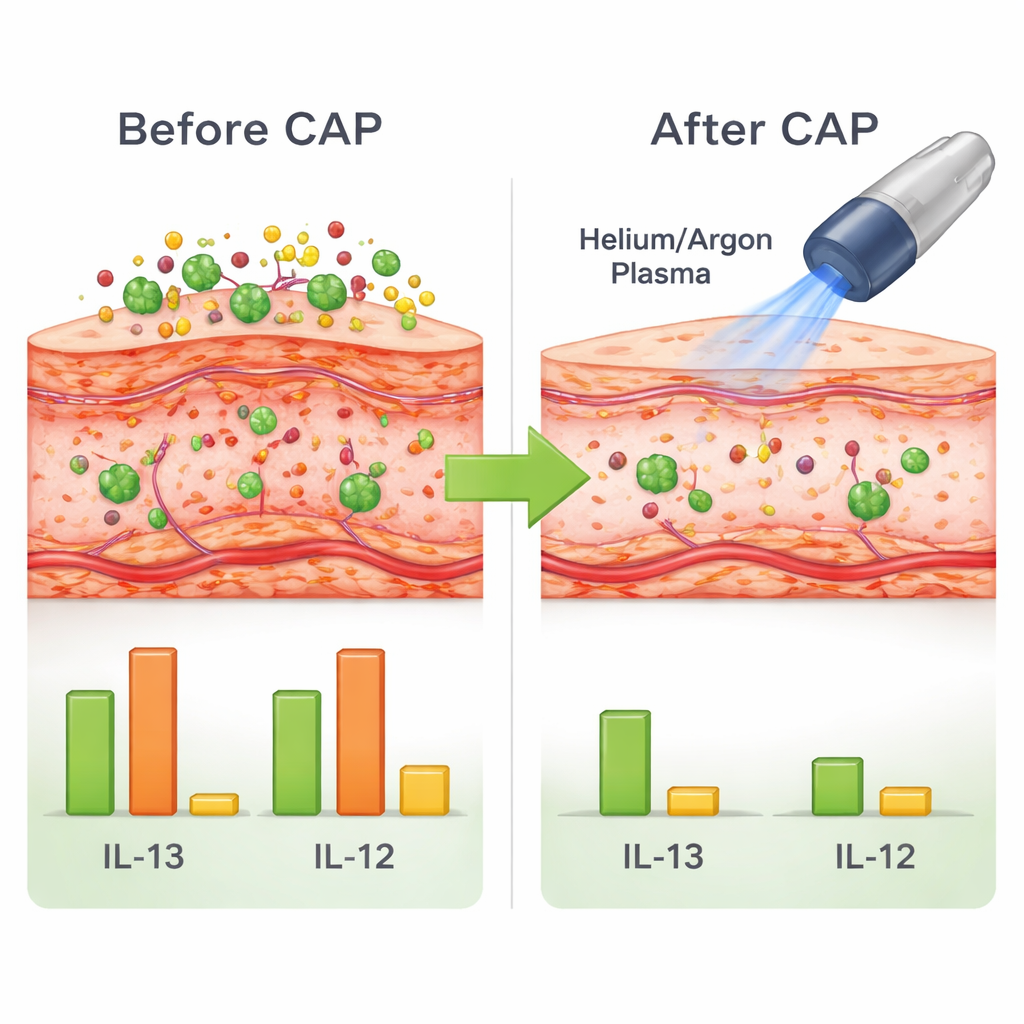
Beyond appearance, the team probed how plasma affected the biology of the skin. Eczema is fueled by overactive immune signals and changes in tiny blood vessels. In the DNCB-treated mice, a protein called CD31—used to mark blood vessel growth—was elevated, reflecting increased and leaky vessels linked to redness and swelling. Plasma treatment brought CD31 levels back down, particularly with helium plasma, to a degree similar to the drug ointment. Plasma also boosted E-cadherin, a key adhesion protein that helps neighboring skin cells lock together to maintain a strong barrier against irritants and germs. At the same time, gene tests showed that all plasma treatments, especially helium and argon jets, sharply reduced levels of inflammatory messenger molecules IL-13, IL-31, and IL-12 that are tied to itch, allergy, and chronic inflammation. Argon and air plasma also cut down the number of mast cells—immune cells that drive itching and flare-ups—while helium had less impact on this particular cell type.
What This Could Mean for Future Care
Put together, these findings suggest that controlled doses of cold atmospheric plasma can do more than just clean the skin surface: they can ease inflammation, normalize blood vessel growth, reinforce the skin’s structural “mortar,” and dial down key itch- and allergy-driving signals in an eczema-like condition. In this mouse study, helium and argon plasma jets performed as well as, or better than, a standard prescription ointment for several measures of skin health, while the air-based device lagged behind. The work does not yet prove that such plasma treatments are safe and effective for people with eczema, but it builds a compelling case for further research and future clinical trials to see whether a cool, glowing gas could become a new tool in the fight against chronic itchy skin.
Citation: Shakeri, F., Mehdian, H., Bakhtiyari-Ramezani, M. et al. A preclinical study of device dependent therapeutic effects of cold atmospheric plasmas on atopic dermatitis induced by DNCB. Sci Rep 16, 6697 (2026). https://doi.org/10.1038/s41598-026-36821-7
Keywords: atopic dermatitis, cold atmospheric plasma, eczema treatment, skin inflammation, plasma medicine