Clear Sky Science · en
Swimming is superior to running in inducing physiological cardiac hypertrophy and enhancing myocardial performance
Why how you move shapes your heart
Most of us have heard that “cardio” is good for the heart, but not all aerobic workouts stress the body in the same way. This study in rats asks a deceptively simple question with big implications for training and heart health: does swimming or running lead to a stronger, healthier heart, and why might one be better than the other?
Two workouts, one goal
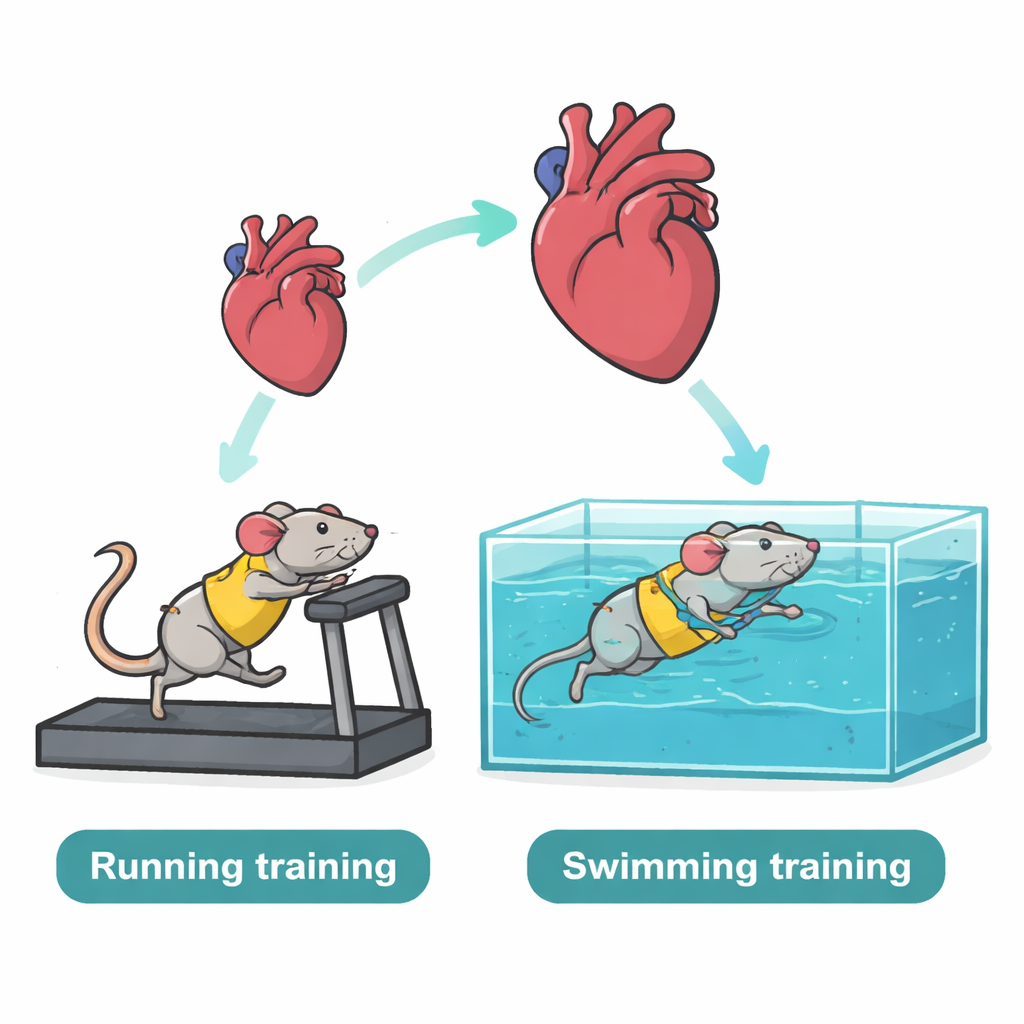
Researchers divided young male rats into three groups: untrained, treadmill runners, and swimmers. The running and swimming programs were carefully matched: both lasted nine weeks in total, with eight weeks of training at about the same moderate intensity, five days a week for an hour each day. Before and after training, the team measured the animals’ fitness (how much oxygen they could use and how long they could swim before exhaustion), used ultrasound-style scans to look at heart size and pumping, and tested heart muscle strips in the lab to see how forcefully and quickly they could contract.
Swimming builds a bigger, stronger pump
Both running and swimming made the rats fitter: their maximum oxygen uptake rose, and they could swim longer before tiring. But when the scientists examined the hearts, an important difference emerged. Only the swimming group showed clear heart growth. Their left ventricles—the main pumping chambers—were larger inside and heavier relative to body weight, and individual heart muscle cells were thicker with bigger nuclei, signs of healthy enlargement. This pattern, known as “eccentric hypertrophy,” reflects a heart that has adapted to pumping larger volumes of blood, similar to what is often seen in endurance athletes. In contrast, the running group’s hearts looked much like those of untrained rats in terms of size and structure.
More power without signs of strain
To understand performance, the team isolated tiny pieces of heart muscle called papillary muscles and measured how they behaved under controlled conditions. Muscles from the swimming rats generated more force and changed tension more rapidly—both in squeezing and relaxing—than those from untrained or running animals. Running produced only a modest improvement in how quickly the muscle could develop force. Notably, standard measures of heart pumping at rest inside the body, such as ejection performance and filling patterns, were similar across all groups. This suggests that the swimming-trained hearts had extra “reserve” power that would matter most under stress or during exercise, rather than at rest.
Inside the cell: growth switches and tiny RNA controllers
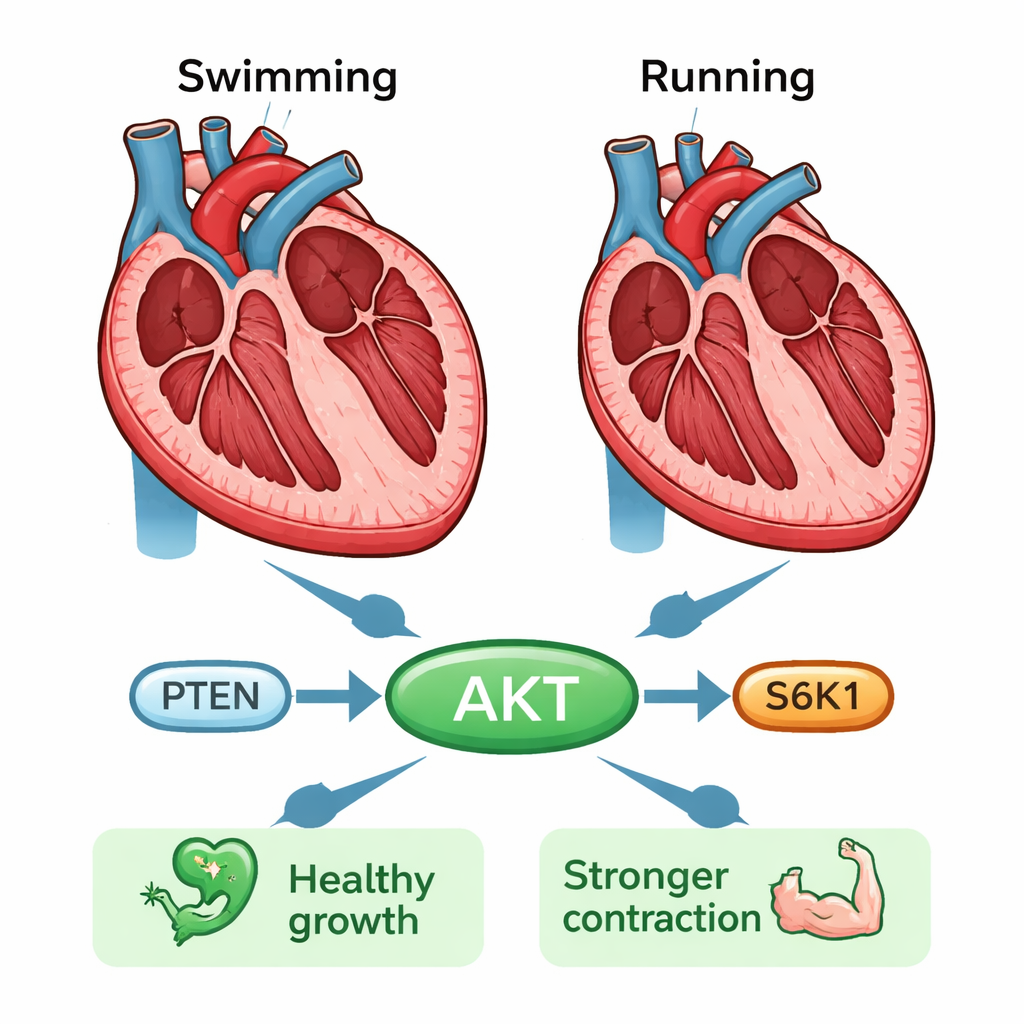
The scientists then probed the molecular switches that govern whether the heart grows in a healthy, training-induced way or in a harmful, disease-related way. They focused on a pathway centered on a protein called AKT, which promotes beneficial growth, and on its upstream brake PTEN and downstream target S6K1. Both types of training boosted the genetic activity of PI3K and AKT, core activators of this pathway. However, only swimming clearly lowered PTEN protein levels and increased AKT activation, tipping the balance toward stronger growth signals. In the swimming group, this ultimately led to higher activity of S6K1, a key driver of new protein production in heart cells. At the same time, swimming more strongly increased several small regulatory molecules called microRNAs (miR‑1, miR‑21, miR‑27a, miR‑124, and miR‑144) that are known to fine-tune heart cell growth, blood vessel formation, and protection against stress. Running also changed these microRNAs, but to a lesser extent.
What this means for your heart
Put simply, in this controlled animal study, swimming did more than running to make the heart bigger and more powerful in a way that appears healthy, not harmful. The hearts of swimming-trained rats pumped with greater muscle strength and showed molecular signatures of protective, exercise-induced remodeling rather than disease. While rats are not humans and the exact pathways may differ, the work supports the idea that different aerobic sports can shape the heart in distinct ways. Activities that combine whole-body effort with sustained volume loading of the heart—like swimming—may be especially effective at building a robust cardiac pump, provided they are done safely and progressively.
Citation: Yoshizaki, A., Antonio, E.L., Santos, L.D. et al. Swimming is superior to running in inducing physiological cardiac hypertrophy and enhancing myocardial performance. Sci Rep 16, 6592 (2026). https://doi.org/10.1038/s41598-026-36818-2
Keywords: swimming training, running training, cardiac hypertrophy, aerobic exercise, myocardial performance