Clear Sky Science · en
Relationship between pelvic incidence and hip, pelvic, and lumbar motion during squatting in healthy individuals with high and low pelvic incidence
Why your squat and spine shape might be connected
Deep squats are part of everyday movements, from lifting a box to getting out of a chair, and they are central to many sports and exercise programs. Yet people differ in how their backs and hips move during a squat, and those differences may influence their long-term risk of hip and back problems. This study asked a simple but important question: does a built-in anatomical feature called pelvic incidence—essentially the way your pelvis and lower spine are shaped—change how your spine and pelvis move when you squat?
The built-in angle in your pelvis
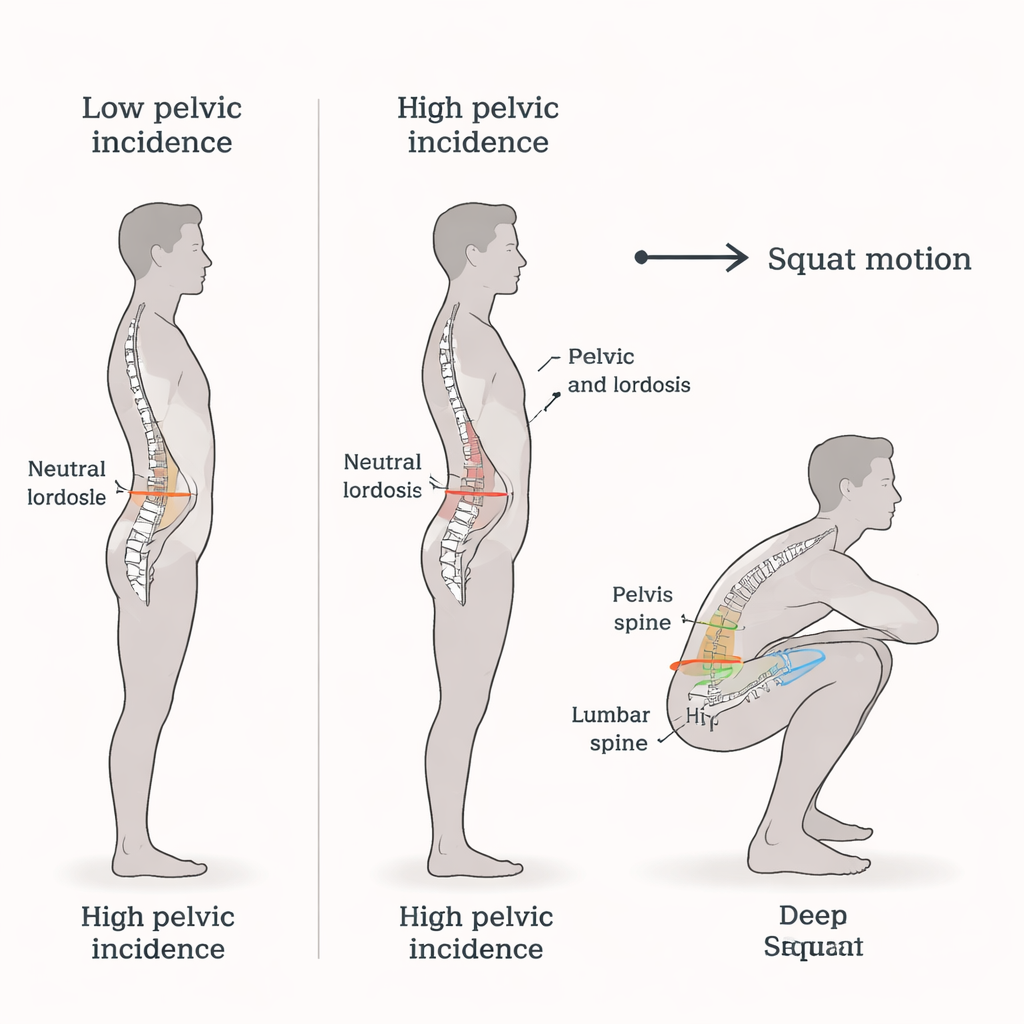
Pelvic incidence is a fixed bony angle that describes how the top of the sacrum (the base of the spine) is oriented relative to the pelvis. Unlike posture, it does not change when you sit or stand, so it is often thought of as a structural “setting” for the spine and pelvis. People with a high pelvic incidence tend to have a more forward-tilted sacrum and a more pronounced inward curve in the lower back (lumbar lordosis) when standing. Because both back curvature and pelvic tilt affect how well the hip socket covers the femoral head, pelvic incidence has been suspected to play a role in hip osteoarthritis and in how people adapt their movements to protect their joints.
How the researchers measured squats
The researchers recruited healthy young men with no known hip or spine disorders. Using hip and pelvic MRI scans, they measured each participant’s pelvic incidence and then divided them into two groups: those with clearly low values and those with clearly high values. They excluded anyone whose hip bone shape suggested existing joint problems or who could not perform a deep bodyweight squat. During the experiment, reflective markers were placed on the trunk, pelvis, and legs, and a three-dimensional motion capture system tracked how each body segment moved as the men performed standardized deep squats synchronized to a metronome. The team then focused on how the pelvis, hips, and especially the curve of the lower back changed over the full descent of the squat.
What differed: the lower back, not the hips
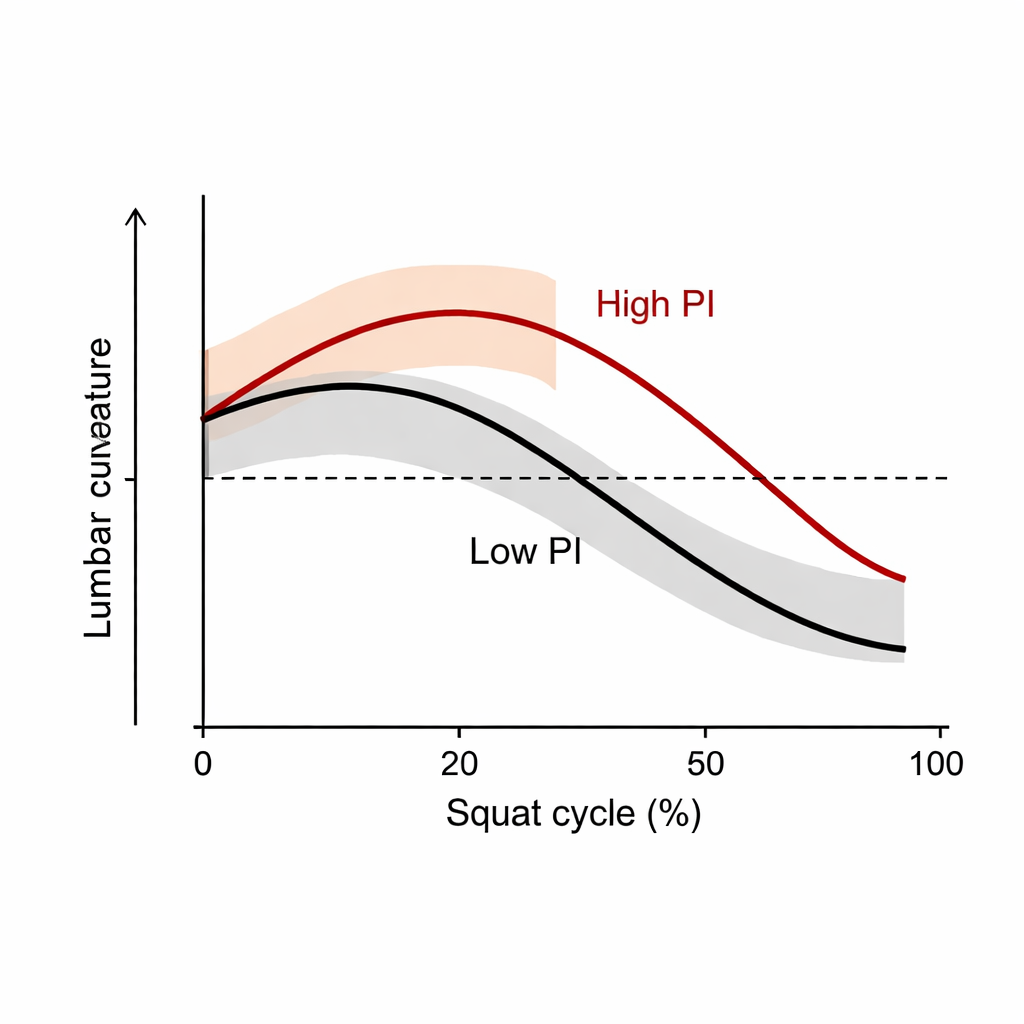
The analysis showed that pelvic incidence mainly affected how the lumbar spine behaved, rather than how the pelvis or hips moved. Both high and low pelvic incidence groups reached similar squat depths and used comparable hip and pelvic angles overall. However, the high pelvic incidence group kept their lower backs in an inward curve (lordosis) for a larger portion of the squat and shifted into a rounded-back posture (kyphosis) later in the movement. They also showed a smaller change in how far their upper body leaned forward, indicating a more upright trunk strategy. In other words, people with a higher built-in pelvic angle seemed to rely more on their lumbar spine curvature to manage the squat, while still ending up with similar hip and pelvic positions as those with lower pelvic incidence.
A built-in compensating strategy
From these findings, the authors proposed a simple mechanical explanation. Because a high pelvic incidence places the sacrum more forward relative to the pelvis, maintaining the same pelvic tilt as someone with low pelvic incidence would tend to pull the trunk farther forward. To avoid tipping too far, people with high pelvic incidence appear to preserve more inward curve in the lower back, using their spine to “compensate” and keep the torso from leaning excessively. This strategy may increase their capacity to tilt the pelvis backward when needed, potentially protecting the hip joint by adjusting how the socket covers the femoral head. At the same time, if something—such as low back pain or muscle weakness—prevents them from maintaining that lumbar curve, they could be more prone to a strong backward pelvic tilt and reduced hip coverage.
What this means for everyday backs and hips
For the general public and for clinicians, this study suggests that a person’s built-in pelvic shape steers how their lower back contributes to squatting, even when hip and pelvic motions look similar on the surface. High pelvic incidence by itself did not cause harmful pelvic motion or reduced hip coverage in these healthy men; instead, it seemed to support a normal adaptation that keeps the trunk more upright. The authors stress that more research is needed in women, older adults, and people with hip or back pain. Still, understanding pelvic incidence may help guide personalized exercise, rehabilitation, and even assistive devices—such as supportive footwear or exoskeletons—aimed at preserving healthy squatting mechanics and reducing stress on the hips and spine.
Citation: Fukushima, K., Tsutsumi, M., Nakata, A. et al. Relationship between pelvic incidence and hip, pelvic, and lumbar motion during squatting in healthy individuals with high and low pelvic incidence. Sci Rep 16, 5831 (2026). https://doi.org/10.1038/s41598-026-36815-5
Keywords: pelvic incidence, squat biomechanics, lumbar spine, hip osteoarthritis, pelvic tilt