Clear Sky Science · en
Plasma fatty acids reflect pain, disability, and psychological well-being in knee osteoarthritis in a longitudinal study with joint replacement surgery
Fats in the Blood and Aching Knees
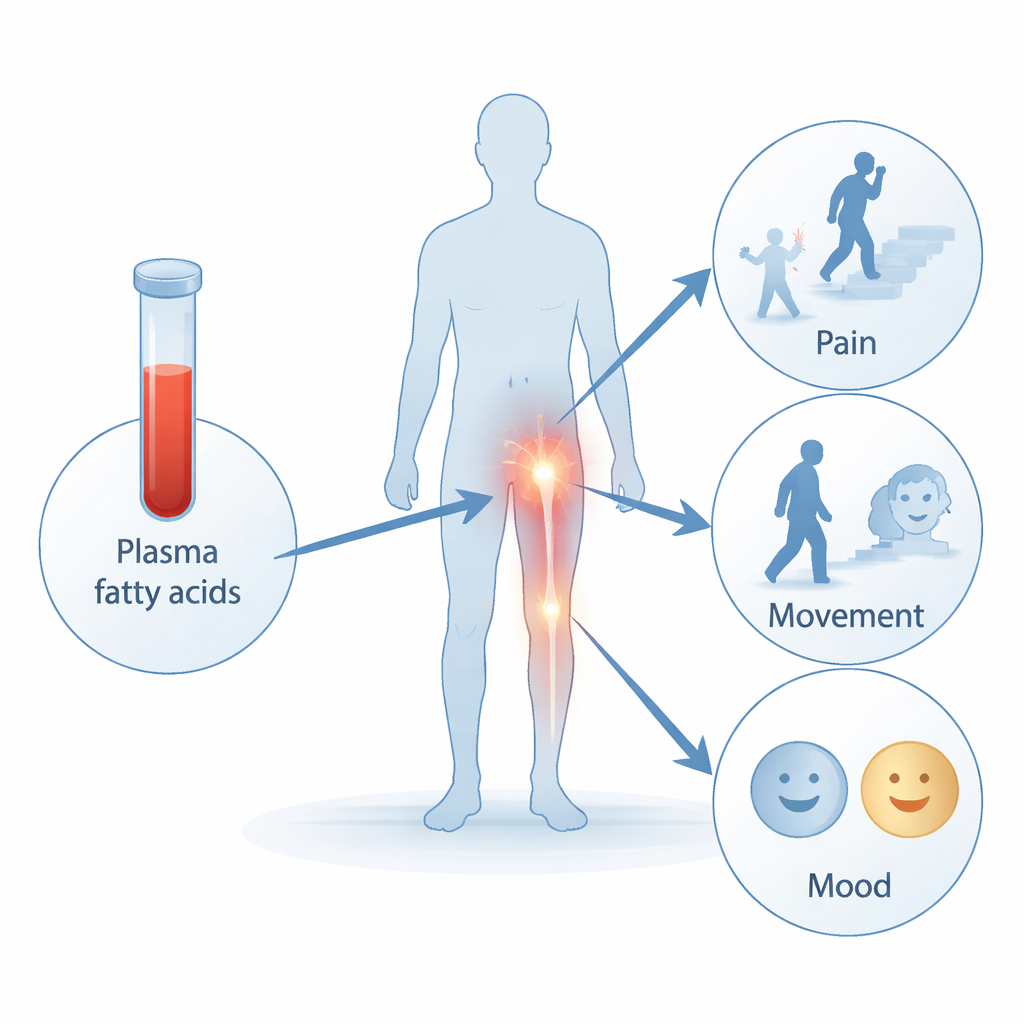
Knee osteoarthritis is a leading cause of pain and disability, especially in older adults. Many people wonder why some knees hurt far more than others with similar X‑ray findings, or why standard painkillers bring only partial relief. This study explores a surprising suspect in the bloodstream—certain fatty acids—to see whether the mix of fats circulating in our blood can help explain differences in knee pain, stiffness, everyday functioning, and even mood in people undergoing knee replacement surgery.
Why Knee Pain Is So Hard to Explain
Osteoarthritis is often described as “wear and tear” of the joint, but the story is more complex. People with badly damaged cartilage can have little pain, while others with milder changes suffer greatly. Pain arises not only from the joint itself, but also from inflamed tissues, irritated nerves, and how the brain processes painful signals. Psychological factors such as anxiety and depression can amplify discomfort. Doctors have searched for blood markers that mirror what patients actually feel, but many known markers of inflammation are not specific enough to knee pain. Fatty acids, which make up cell membranes and are raw material for hormone‑like signaling molecules, are promising candidates because some drive inflammation while others help to calm it.
Taking a Closer Look at Blood Fats
Researchers in Finland followed 13 patients with severe knee osteoarthritis as they went through total knee replacement, comparing them with 12 healthy volunteers of similar sex but younger age and lower body weight. Blood samples were taken after an overnight fast before surgery and again 3 and 12 months afterward. Using detailed chemical analysis, the team measured 57 different fatty acids in blood plasma and, when possible, in the lubricating fluid from the arthritic knee. The participants also completed pain and quality‑of‑life questionnaires, performed walking, stair‑climbing, and chair‑stand tests, and underwent sensory and brain‑stimulation measurements that probed how sensitive they were to pressure and heat and how strongly their leg muscles were controlled by the nervous system.
How Specific Fats Lined Up with Pain and Movement
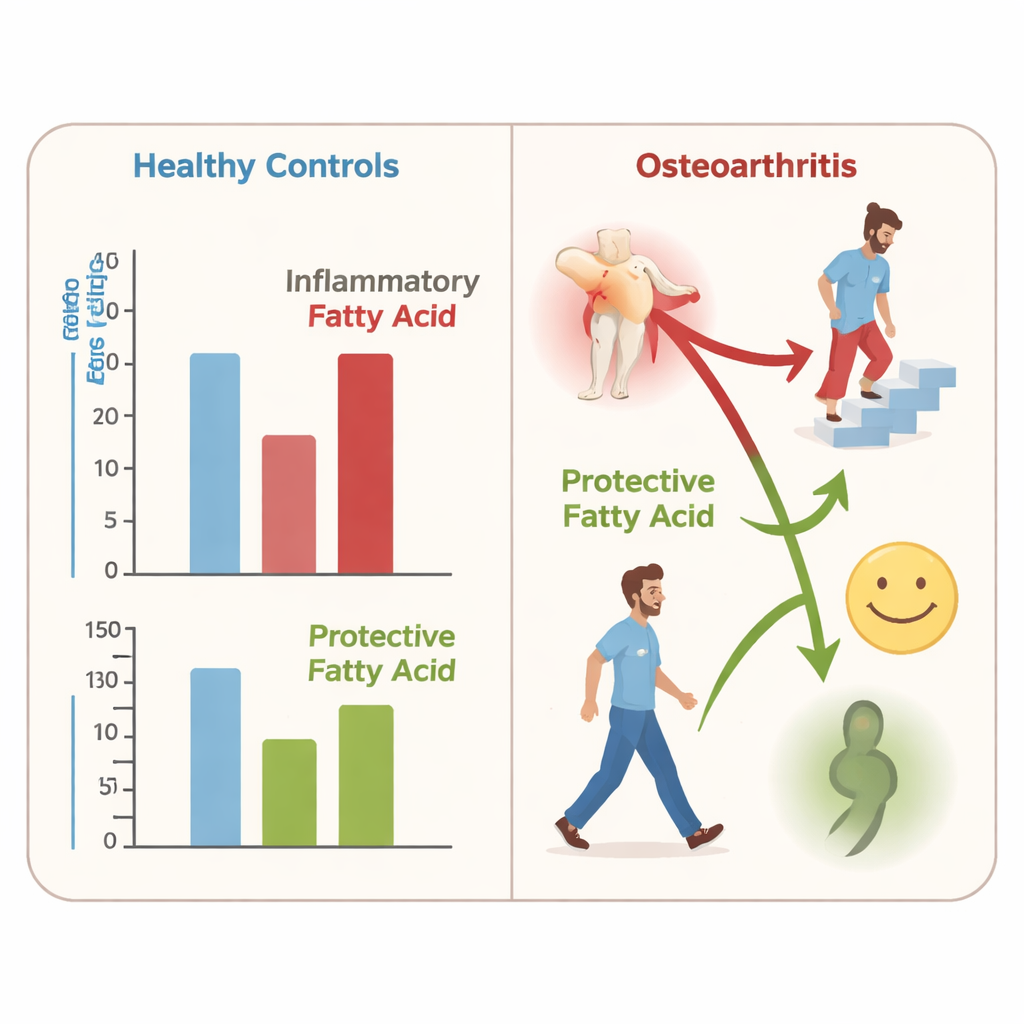
The overall pattern of common fats did not change dramatically between healthy people and patients, but several less familiar fatty acids showed telling links to symptoms. A group of so‑called n‑6 fatty acids, especially one named arachidonic acid, tended to go hand in hand with more intense knee pain and greater sensitivity to pressure. Very long chains of saturated fat and a fatty acid called 24:1n‑9, which are abundant in nerve tissue, were tied to worse stiffness, more trouble walking on flat ground or stairs, and poorer scores on functional tests. Some fatty acids also tracked with how easily the brain could activate leg muscles, hinting that the fat mix in the blood may influence the nervous system that controls movement. In contrast, certain n‑3, or “omega‑3,” fatty acids were linked to better confidence in managing pain, although their relationships with pain itself were more complex.
Links Between Fats, Feelings, and Well‑Being
Beyond joints and nerves, the study connected specific fats to mental health. Higher levels of one n‑6 fatty acid called 20:3n‑6 were strongly associated with greater anxiety, even after accounting for age, body weight, and pain scores. There were hints that this fat might also relate to depression, while some patterns in other fatty acids in the joint fluid pointed in the opposite, more protective direction. Since anxiety and low mood are known to worsen pain and slow recovery from knee surgery, these findings suggest that the body’s fat chemistry could sit at a crossroads between physical discomfort and psychological distress.
What This Means for People with Sore Knees
In plain terms, this research suggests that the types of fats circulating in our blood may help predict how much pain, stiffness, and emotional burden someone with knee osteoarthritis experiences, independently of age and body size. The results do not yet justify new diet rules or specific supplements for patients, because the study was small and did not measure what people actually ate. But it highlights particular fatty acids as potential targets for future treatments designed to quiet painful signals or support the body’s own inflammation‑resolving systems. Larger studies could eventually show whether adjusting dietary fats—or developing medicines that mimic the helpful ones and block the harmful ones—might ease knee pain and improve quality of life for the millions living with osteoarthritis.
Citation: Mustonen, AM., Säisänen, L., Karttunen, L. et al. Plasma fatty acids reflect pain, disability, and psychological well-being in knee osteoarthritis in a longitudinal study with joint replacement surgery. Sci Rep 16, 6022 (2026). https://doi.org/10.1038/s41598-026-36812-8
Keywords: knee osteoarthritis, fatty acids, joint pain, omega-3, inflammation