Clear Sky Science · en
The changed endemic pattern of human adenovirus from species C to B among children in 2022–2024 in Shenzhen, China
Why this matters for families
Since the COVID-19 pandemic, many parents have noticed that coughs, fevers, and chest infections seem to be coming back in new waves. This study from Shenzhen, a large city in southern China, shows that one familiar childhood virus—human adenovirus—has quietly changed its pattern, with a new type becoming more common in children. Understanding this shift helps doctors and health officials prepare hospitals, guide testing, and ultimately protect kids from severe lung infections.
A common virus with uncommon impact
Human adenovirus is a group of viruses that often cause colds, sore throats, and bronchitis in children. Most infections are mild, but some can progress to serious pneumonia that requires hospital care, especially in younger kids. Adenoviruses come in many “types,” grouped into species labeled with letters such as B and C. Before and during the COVID-19 pandemic, types from species C, particularly one called C1, were frequently found in children with respiratory infections in many parts of China. At the same time, strict public health measures against COVID-19—like mask-wearing, school closures, and distancing—changed how many respiratory viruses spread.
Tracking sick children in hospitals and neighborhoods
To see what was happening locally, researchers followed children younger than 14 years in Shenzhen between late 2022 and mid‑2024. They enrolled more than 800 children with suspected respiratory infections from eight hospitals and over 1,500 children from city communities. From these children, they collected nose and throat samples and tested them for a wide panel of viruses and bacteria, including adenovirus. The team then used genetic tests to determine which adenovirus types were present and how closely related the strains were to those circulating in other parts of China and around the world.
A sharp rise and a type switch
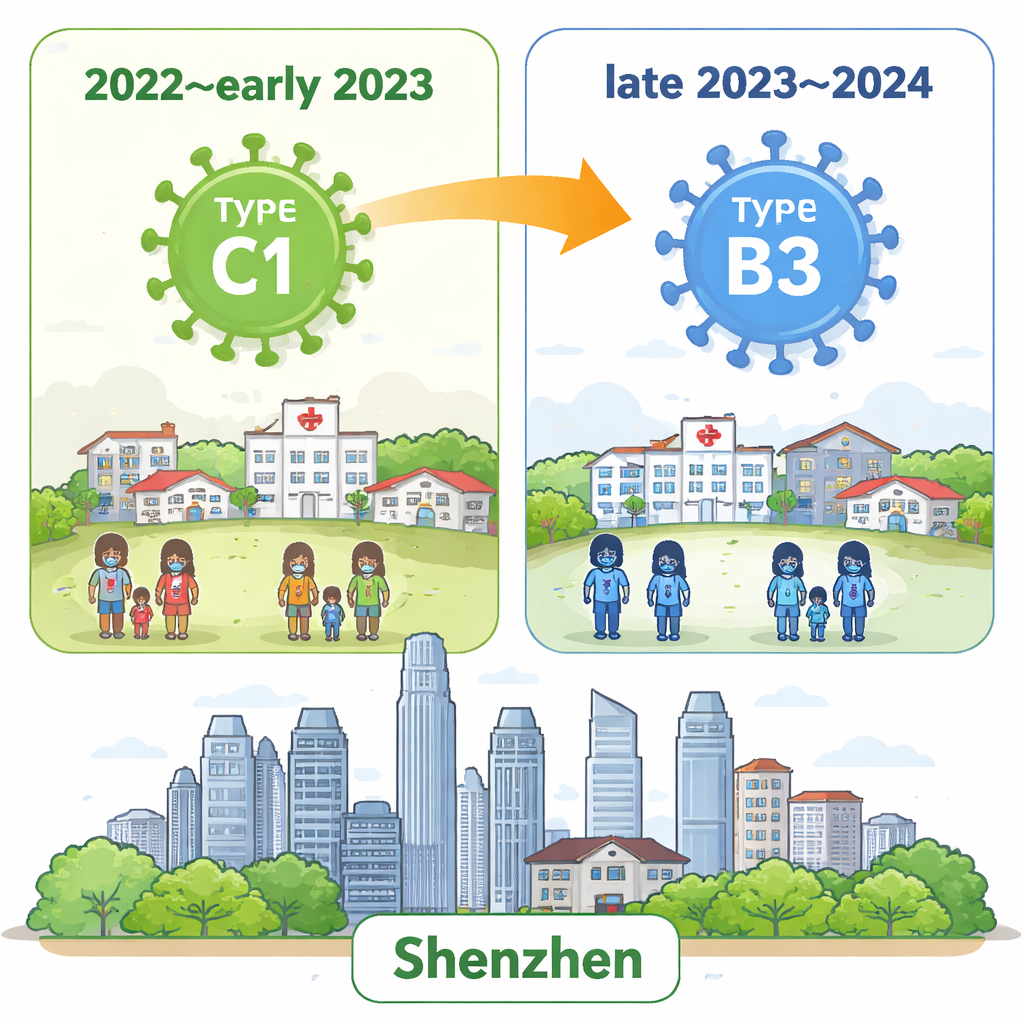
The results showed two big changes. First, adenovirus became much more common in hospitalized children: the share of tested hospital patients who carried adenovirus jumped from about 3% in late 2022–mid‑2023 to nearly 17% in late 2023–mid‑2024. Second, the dominant virus type shifted. At first, most infections were caused by a species C virus, type C1. By the following year, this had flipped, and a species B virus, type B3, was responsible for the vast majority of cases in both hospitals and the community. Children in hospital were more likely to test positive than those seen in clinics, and in the community, girls were somewhat more likely than boys to carry adenovirus. However, infections with the “old” C group and the “new” B3 type occurred at similar ages, suggesting the switch was not just an age effect.

What the virus’s genes reveal
By reading key genes from the virus, the researchers could see how these strains fit into the global family tree. The B3 viruses found in Shenzhen were remarkably stable: their genetic material closely matched B3 strains seen in China and several other countries over decades, with only tiny differences. This stability suggests that B3 has been successful at spreading without needing major genetic changes, and it strengthens the case that B3 could be a good target for future vaccines. In contrast, one Shenzhen C1 strain carried a small deletion in a gene that helps the virus enter cells, and both C1 and B3 showed a few amino acid changes at specific positions in their outer coat. These small tweaks lined up with distinct evolutionary branches, hinting at long-term adaptation to human immunity rather than a sudden, dangerous mutation.
What this means for parents and public health
For families, the key takeaway is that adenovirus infections in children did not just increase after COVID‑19 restrictions eased—the main virus type also changed, with B3 now leading in Shenzhen and in several other countries. The study does not suggest that a brand‑new, more deadly variant has emerged. Instead, an already known type, B3, has taken center stage as children return to school and normal social life, filling an “immunity gap” left by years of reduced exposure to common bugs. By mapping how and where these strains spread, and by pinpointing the small genetic changes that mark different branches of the virus family tree, this work gives health authorities a clearer picture of which adenovirus types to watch, how to strengthen infection control in hospitals and schools, and which viral strains might be the best candidates for future vaccines to keep children safer from severe chest infections.
Citation: Niu, Dd., Zhang, Z., Chen, Zg. et al. The changed endemic pattern of human adenovirus from species C to B among children in 2022–2024 in Shenzhen, China. Sci Rep 16, 5902 (2026). https://doi.org/10.1038/s41598-026-36811-9
Keywords: adenovirus, child respiratory infection, post-COVID epidemics, Shenzhen China, virus evolution