Clear Sky Science · en
Lack of concordance among infant social attention measures
How Babies’ Gazes Offer Clues to Social Growth
Parents and scientists alike often look to babies’ eyes for hints about how they are learning to connect with others. Do they focus on a person’s eyes, watch where someone is looking, or choose a face over a toy? Many researchers have assumed that these different habits are all part of one broad ability called “social attention.” This study put that assumption to the test in 10‑month‑old infants and found a more complicated picture than expected.
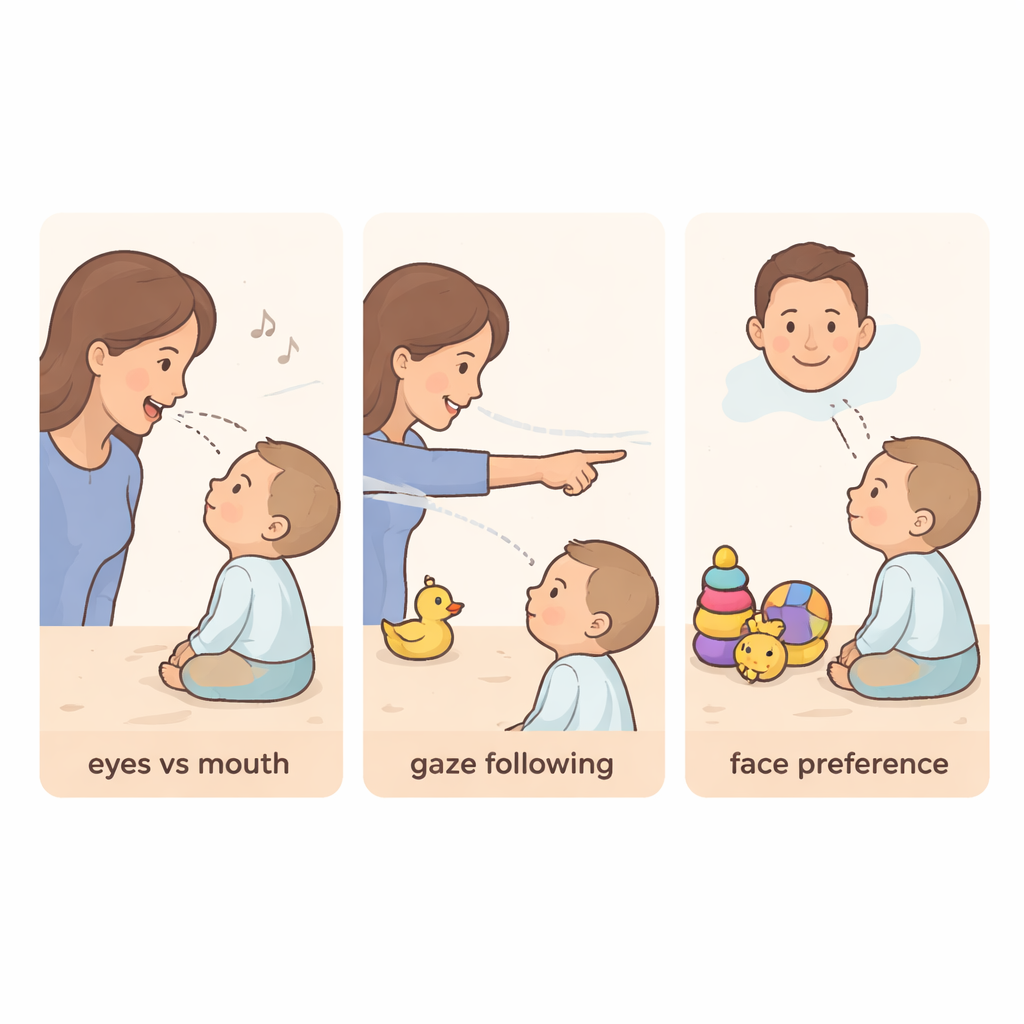
Three Ways to Watch a Baby Look
The researchers invited 50 ten‑month‑old infants to a university lab and used eye‑tracking cameras to see exactly where the babies were looking on a screen. They measured three common kinds of social looking. First, they asked whether babies preferred the eyes or the mouth when watching a woman sing nursery rhymes. This was captured in an “eye–mouth index,” with higher scores meaning more eye‑looking. Second, they looked at “gaze following”: did babies shift their eyes to a toy after a woman on the screen looked toward it? Third, they measured “face preference” by showing arrays that mixed one face with three everyday objects such as a ball or a clock, and calculated how much time babies spent looking at the face compared with the objects.
Checking Links to Early Communication
To see whether these looking patterns tied in with real‑world behavior, parents filled out a standard questionnaire about their child’s communication and social skills. This checklist asked about everyday behaviors, such as whether the baby tries to get a caregiver’s attention, shows when they need help, or uses early gestures and sounds. The researchers then compared each baby’s scores on the three eye‑tracking tasks with the parent reports, asking whether stronger social‑looking habits went along with more advanced social and communication abilities.
Surprising Disconnect Between Social Looking Measures
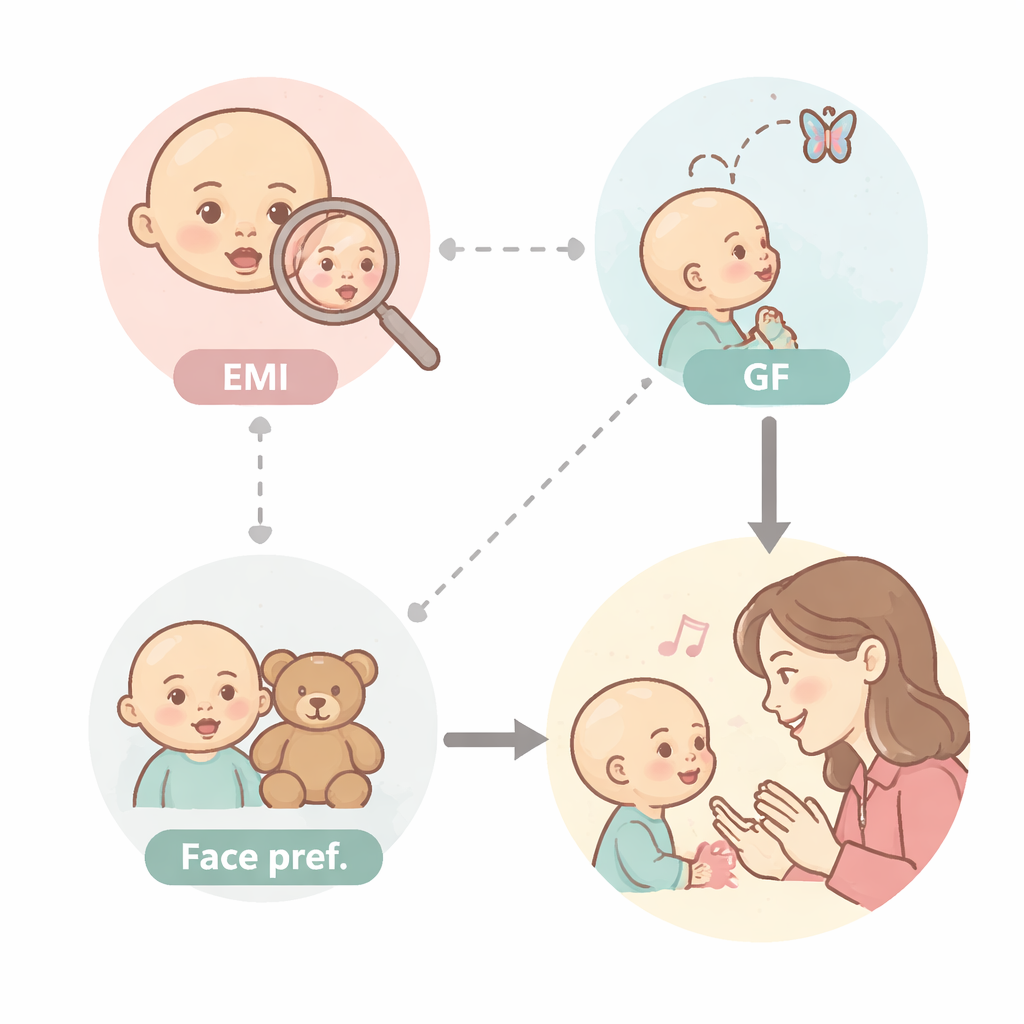
On average, the babies behaved as earlier work would predict. As a group, they spent more time looking at eyes than at mouths, usually followed the woman’s gaze toward a toy, and preferred faces over non‑social objects. But when the scientists looked for links between these three measures across individual babies, they found none. A baby who strongly preferred eyes was not necessarily better at gaze following or more drawn to faces over objects, and the same lack of connection held for all pairwise comparisons. Statistical checks, including Bayesian analyses, even suggested moderate support for the idea that there truly is no meaningful relationship among these measures at this age.
Only One Measure Ties to Social Skills
The story changed somewhat when the researchers examined parent‑rated communication. When considered one at a time, none of the three gaze measures showed a clear, stand‑alone link to overall social‑communication scores. However, when all three were entered into the same analysis, a more specific pattern emerged. Only babies who tended to look more at eyes than at mouths had higher scores on the communication part of the parent questionnaire. Gaze following and face preference did not uniquely predict how socially communicative the infants were, suggesting that not all forms of social looking carry the same weight for early everyday interactions.
Rethinking What “Social Attention” Really Means
These findings challenge the idea that social attention in infancy is a single, unified trait that can be captured by any one gaze task. Instead, the results suggest that different ways of looking at people—choosing eyes over mouth, tracking another’s gaze, or preferring faces over objects—may reflect separate systems that develop along their own timelines and are shaped by different influences. Only one of these, eye‑versus‑mouth preference, was clearly tied to infants’ current communication skills at 10 months. For parents and clinicians, this means that no single eye‑tracking measure can stand in for “social attention” as a whole, and for researchers it underscores the need to treat each type of social looking as its own piece of the puzzle in understanding how babies learn to connect with other people.
Citation: Viktorsson, C., Astor, K. Lack of concordance among infant social attention measures. Sci Rep 16, 2591 (2026). https://doi.org/10.1038/s41598-026-36807-5
Keywords: infant social attention, eye tracking, gaze following, face preference, early communication