Clear Sky Science · en
Improving free-space continuous variable quantum key distribution with adaptive optics
Securing data through thin air
Most of our secure online communication today relies on fragile mathematical puzzles that powerful future computers could crack. Quantum key distribution offers a different path: it uses the laws of physics to share secret encryption keys. This study explores how to send such quantum keys through open air—between buildings or to satellites—where flickering, turbulent air usually scrambles delicate light signals. The researchers show that a technology borrowed from astronomy, called adaptive optics, can tame this turbulence and make these quantum links far more reliable.
Why turbulence is a problem for quantum light
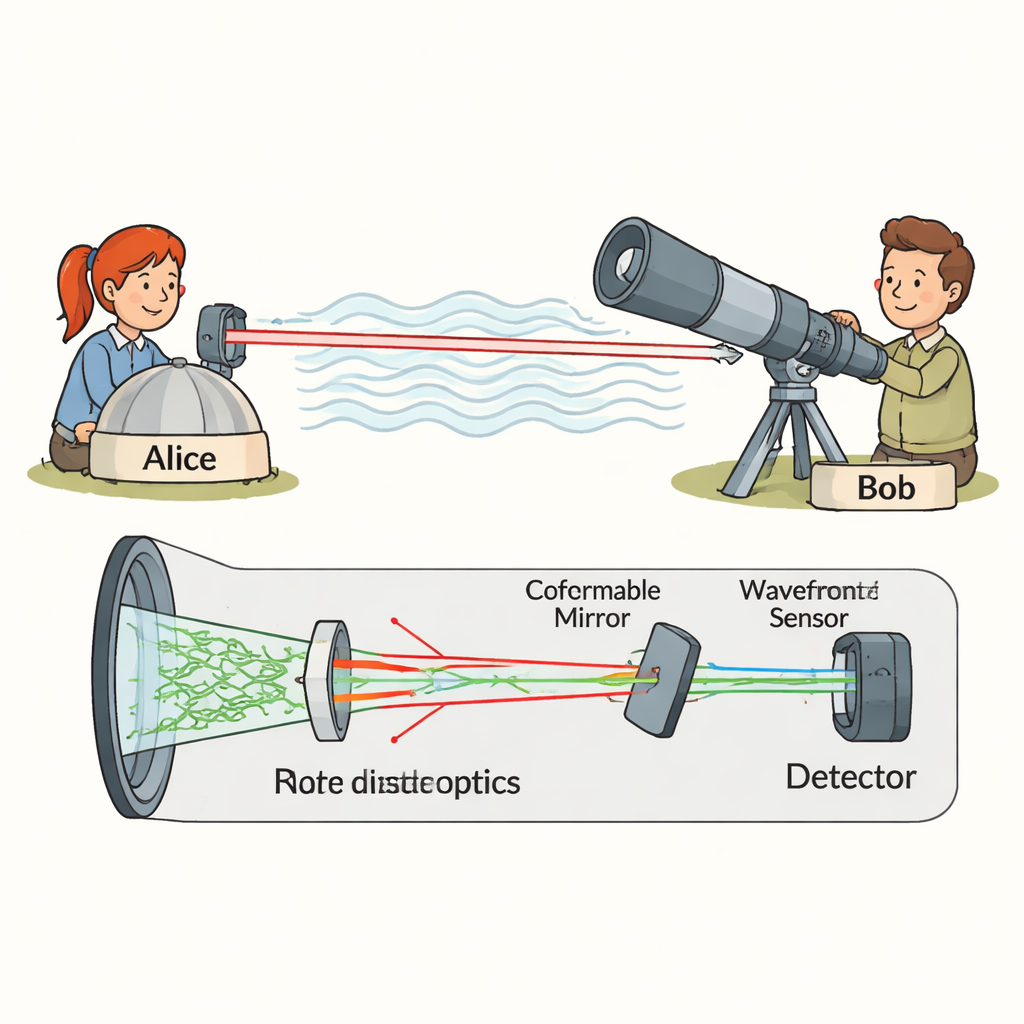
Sending quantum information through optical fibres in the ground is already well developed, but taking it into free space—through the atmosphere—is much harder. As a laser beam travels through warm and cool pockets of air, its wavefront gets distorted. The beam can wander, its brightness can flicker, and its shape can become patchy. For continuous-variable quantum key distribution, which encodes information in tiny changes of a light wave, these distortions reduce how well the incoming quantum signal matches a reference beam at the receiver. This match, called interferometric visibility, is crucial: when visibility drops, the system behaves as if extra loss and noise have crept in, and the rate at which secure keys can be generated falls or even becomes zero.
Borrowing a trick from big telescopes
To fight this, the team turned to adaptive optics, a technique used on large telescopes to sharpen images blurred by the atmosphere. In their experiment, a continuous-wave laser at a telecom wavelength was split into a signal beam and a strong reference beam known as the local oscillator. The signal left the fibre, crossed either a 60-centimetre or a 30-metre stretch of air, and was deliberately disturbed by a heat gun that created controlled turbulence. At the receiver, part of the incoming light illuminated a wavefront sensor, which measured how the beam’s shape was being distorted across many small patches. Those measurements drove a deformable mirror whose surface could bend in real time, reshaping the beam so that, after correction, it more closely matched the calm, undisturbed reference beam.
Measuring how much correction helps
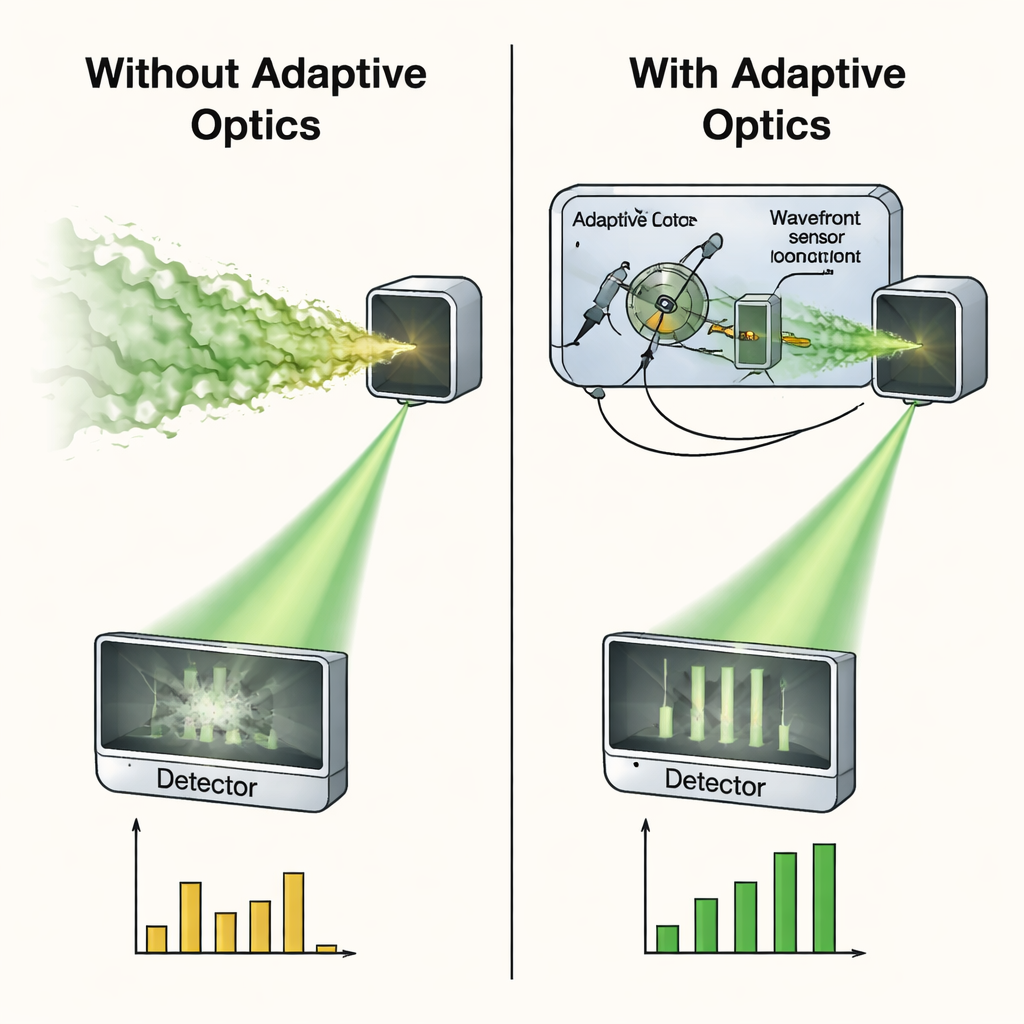
The researchers quantified turbulence by tracking how much the spots on the wavefront sensor wandered over time, and they measured visibility using interference between the signal and the local oscillator. They also recorded the statistical spread of many measurements to see how stable the system was. In both the short (60 cm) and longer (30 m) air paths, turning on the heat gun caused visibility to fall sharply when no adaptive optics were used. When the adaptive optics loop was closed, much of the lost visibility was recovered, and the fluctuations in visibility became noticeably smaller. In some of the harsher conditions in the 30 m link, it was only possible to keep the system phase-locked—and therefore usable—when adaptive optics were active, highlighting its stabilising role.
Impact on secure key rates and noise
Using their visibility data and standard formulas for continuous-variable quantum key distribution, the authors calculated how the achievable secret key rate would change. They found that better visibility directly translated into higher, more consistently positive key rates for both common detection schemes (homodyne and heterodyne). In effect, adaptive optics made the turbulent channel behave more like a clean, low-loss connection. However, there was a trade-off: the constant corrections by the deformable mirror introduced a small amount of extra noise, especially when it had to work harder under stronger turbulence. In realistic full systems this extra noise must be carefully accounted for, but the analysis shows that, in the regimes studied, the gains in visibility and stability outweigh the added noise.
What this means for future quantum networks
For a non-specialist, the takeaway is that the authors have shown a practical way to make quantum-encrypted links through the air more robust. By actively reshaping incoming light in real time, adaptive optics can counteract the twinkling effects of turbulence, allowing quantum devices to share secret keys more reliably and with fewer outages. While further engineering is needed to integrate this approach into complete field-ready systems and to manage all sources of noise, the work demonstrates that tools developed for clearer views of the stars may also be key to building secure global quantum communication networks.
Citation: Sayat, M.T., Birch, M., Copeland, M. et al. Improving free-space continuous variable quantum key distribution with adaptive optics. Sci Rep 16, 6160 (2026). https://doi.org/10.1038/s41598-026-36805-7
Keywords: quantum key distribution, free-space optics, adaptive optics, atmospheric turbulence, quantum communication