Clear Sky Science · en
A study on the coupling mechanism between the urban environment and depression perception based on deep learning and street view image
Why the look of your street matters
Most of us have felt that some streets simply drag our mood down, while others feel calm or uplifting. This study asks a deceptively simple question: what exactly in the urban scene makes a place look more or less depressing, and can we measure that across an entire city? Using artificial intelligence and millions of pixels from street‑view photos of Wuhan, China, the researchers built a new way to read the emotional tone of streets and to link it to concrete features like trees, sky, buildings and traffic. Their findings suggest that careful street design could become a practical tool for protecting mental health in fast‑growing cities.
Seeing cities through a human eye
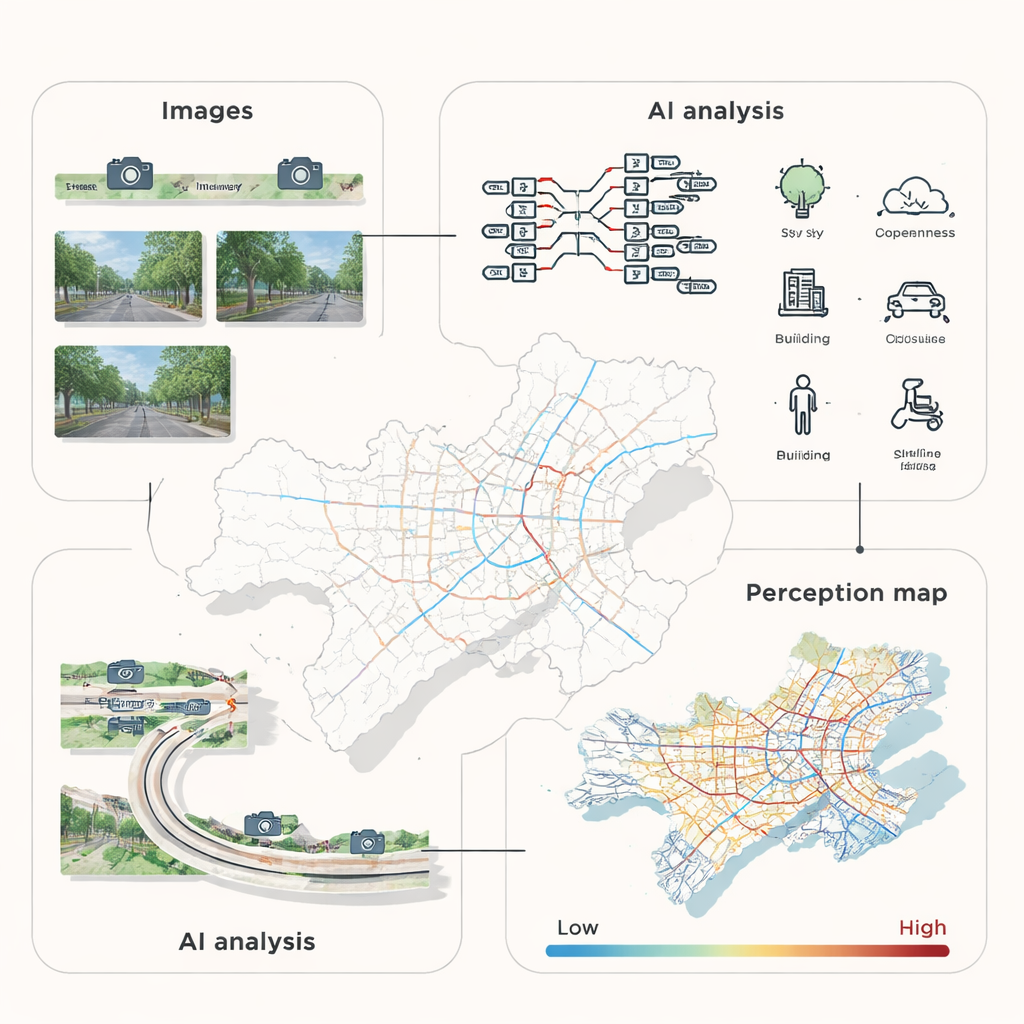
Rather than focusing on medical diagnoses, the authors examine “depression perception”—how depressing a streetscape looks to an average observer. This is an environment-level measure, not a judgment about any individual’s mental health. To capture it, they began with a massive trove of crowd-sourced opinions from the MIT Place Pulse project, where people repeatedly compared pairs of street images and picked which looked more depressing. A deep learning model learned from these judgments, then applied what it had learned to 133,114 street-view images covering the dense inner districts of Wuhan. The result is a fine-grained emotional map of the city’s streets, scored by how gloomy or uplifting they appear.
What the city’s emotional map reveals
When the model’s scores were plotted on a map, clear patterns emerged. High “depressing” values clustered along transport–industrial corridors: around major railway stations, heavy-traffic arterials and former industrial zones. These places tend to be visually cramped, dominated by vehicles and hard surfaces, with little greenery or open sky. In contrast, streets along lakes, rivers and major parks, and those near university districts, showed much lower scores. These areas offer more trees, broader views of the sky and slower, more human-scale activity. Intriguingly, some historic districts with narrow, enclosed lanes bucked the trend: despite high physical enclosure, they still looked relatively undepressing, suggesting that cultural character and a sense of place can soften the visual burden of dense form.
Unpacking the ingredients of a depressing street
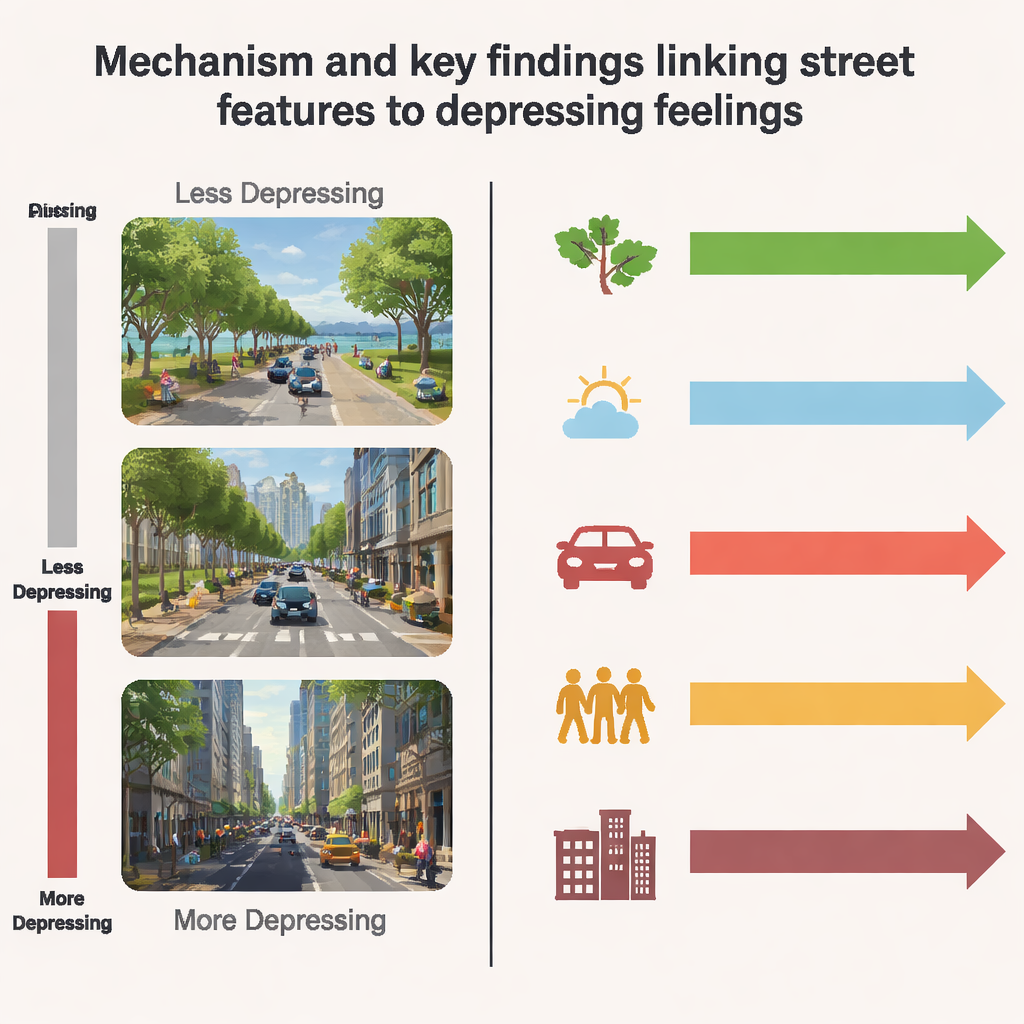
To move from patterns to mechanisms, the team used a computer vision system to dissect each image into six simple elements: visible greenery, visible sky, degree of enclosure by buildings and walls, share of motor vehicles, presence of people and cyclists, and share of sidewalk. They then ran a large statistical model to see which features best predicted depression perception. Five stood out. More greenery, more visible sky and more pedestrians or cyclists were each strongly linked to lower depressing scores. In contrast, a tighter sense of enclosure and a higher share of cars were linked to higher scores. Sidewalk coverage, once the others were accounted for, did not add much explanatory power. Overall, these five variables together explained about a quarter of the variation in how depressing different scenes looked—a substantial share given how many other social and cultural factors also shape our feelings about place.
Designing streets that lift, not lower, our mood
The study translates these numbers into design guidance. If a street already feels stressful or gloomy, the model suggests several levers: add vertical and roadside greenery, open up more sky by avoiding canyon-like building walls, calm or reroute heavy motor traffic, and make it easier and safer for people to walk and cycle so that human presence is more visible. Along lakes and rivers, improving access and sightlines could amplify their natural calming effect. At the same time, the historic district example hints that culture, identity and legible layouts can help dense areas feel less oppressive. In plain terms, the work shows that how a street looks—its trees and traffic, openness and activity—is not just an aesthetic issue; it is closely tied to the emotional climate people experience every day, and thus to the broader project of building mentally healthier cities.
Citation: Sun, H., Zhang, N., Jiang, Y. et al. A study on the coupling mechanism between the urban environment and depression perception based on deep learning and street view image. Sci Rep 16, 5856 (2026). https://doi.org/10.1038/s41598-026-36804-8
Keywords: urban mental health, street view imagery, deep learning, green spaces, urban design