Clear Sky Science · en
An intelligent single valued neutrosophic MCDM framework for Business English language analysis curriculum planning and pedagogical support under uncertainty
Why choosing the right business English course is so hard
For companies working across borders, business English is no longer a luxury skill — it is the language of deals, emails, and virtual meetings. Yet picking the most effective training program for employees is surprisingly tricky. Managers must weigh teaching quality, costs, cultural fit, and real-world usefulness, often based on fuzzy impressions like “very good” or “fair” rather than hard numbers. This study introduces a new decision framework that turns such vague, sometimes hesitant opinions into a systematic way to compare and rank business English training options under uncertainty.
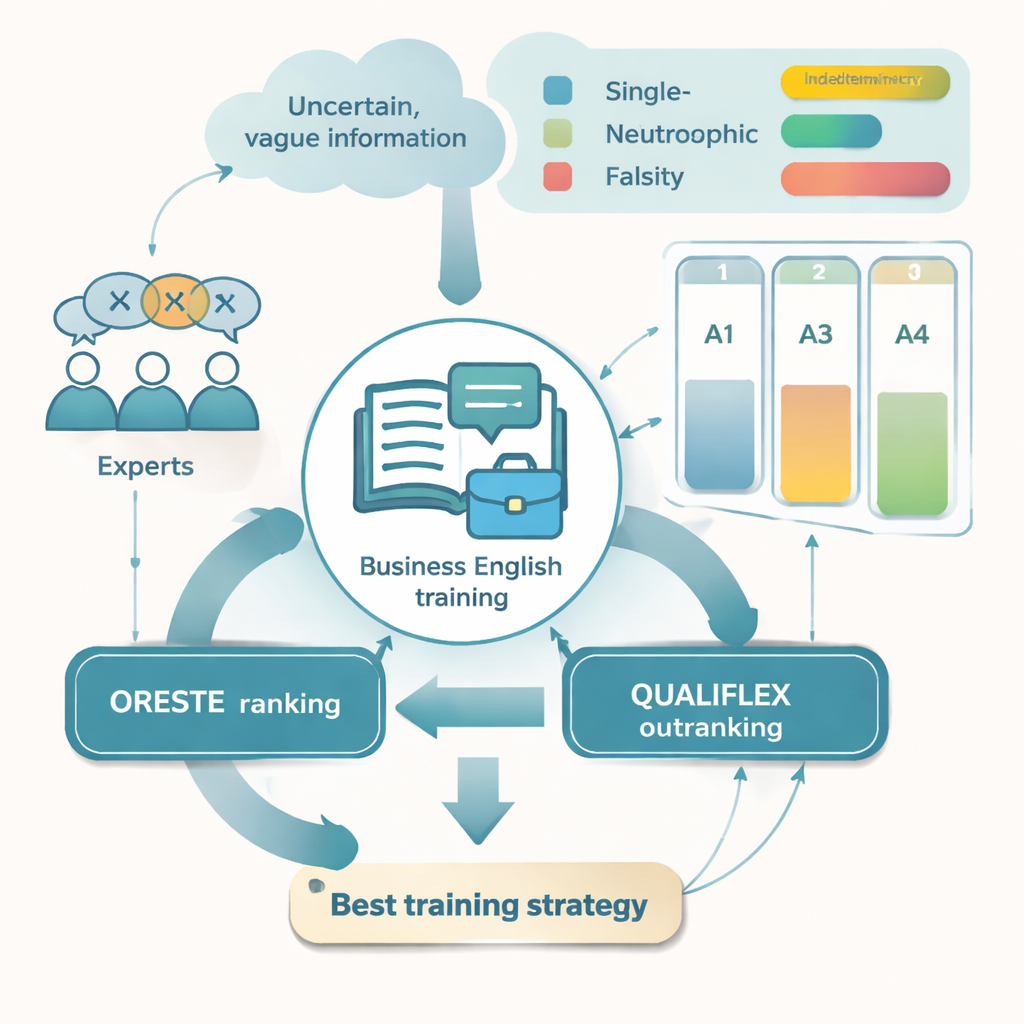
Turning fuzzy opinions into usable information
Traditional decision tools prefer clean numbers: test scores, prices, hours. But language learning decisions are usually expressed in words — “excellent teachers,” “somewhat engaging,” “not sure about cultural value.” The authors use a mathematical idea called a single-valued neutrosophic set to capture three aspects of every judgment at once: how true it seems, how uncertain it is, and how false it might be. Instead of forcing experts to choose a single score, this approach records their confidence and hesitation explicitly. That makes the input data closer to how people actually think about teaching quality, motivation, and communication skills.
Blending human judgment with data-driven checks
The framework is designed for situations with several candidate training strategies and many qualitative criteria. In their example, the authors consider four types of business English programs — from in-house intensive courses to an overseas immersion camp — and ten benefit-focused criteria such as teaching quality, learner engagement, cultural adaptability, flexibility, and practical application. Three experts, including curriculum specialists and a corporate trainer, rate each option in simple linguistic terms from “very very bad” to “very very good.” These terms are converted into neutrosophic values and combined using a careful averaging process, so no single expert dominates the discussion.
Two complementary ranking methods working together
Once the expert opinions are translated into this richer numeric form, the framework applies two ranking techniques that serve different purposes. First, an approach called ORESTE produces an overall order of the training options based on how they perform across all criteria, while also reflecting the relative importance of each criterion. Importance is not fixed by opinion alone: subjective weights from experts are blended with objective weights derived from how much the criteria actually distinguish between alternatives. Second, a method known as QUALIFLEX checks the ranking through detailed pairwise comparisons, asking in effect, “Does option A really make more sense than option B, given all the evidence?” By combining an easy-to-understand global ranking with a rigorous pairwise consistency test, the framework aims to be both intuitive and trustworthy.
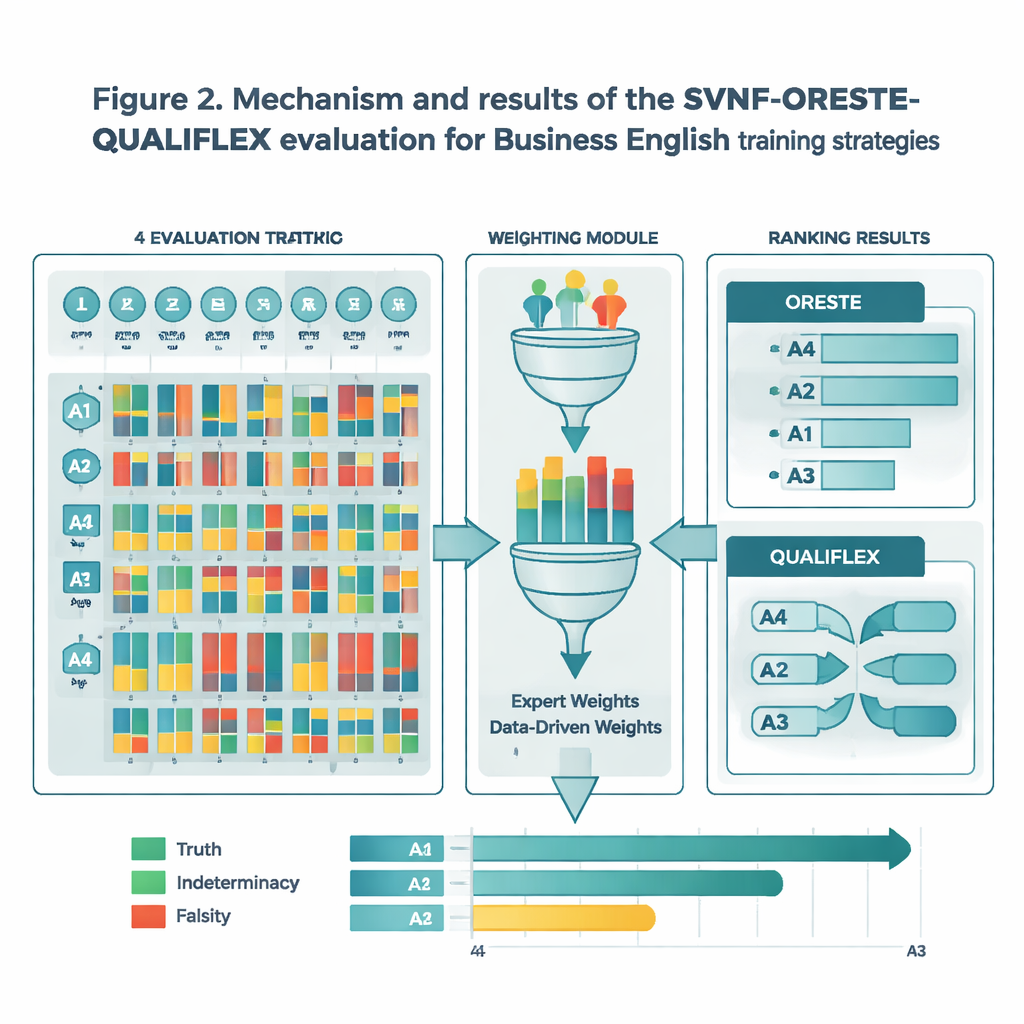
What the case study reveals about training choices
To demonstrate the method, the authors build a realistic hypothetical case of a multinational firm choosing among four business English strategies: an in-house intensive program, an online interactive course, a university–industry partnership, and an international business training camp abroad. Using their framework, they find that the overseas training camp comes out as the best option, followed by the online course, then the in-house program, with the university partnership ranked last. Importantly, this order remains stable even when they vary how much weight is given to expert opinion versus data patterns, or how tolerant the system is of uncertainty. Comparative tests against more familiar fuzzy decision tools show that all methods agree on the top choice, but the new framework produces clearer gaps between options and is less sensitive to small changes in the linguistic inputs.
Why this matters for real-world educators and managers
For non-specialists, the key message is that it is possible to make clearer, fairer choices among complex language training options without pretending that all judgments are precise. By explicitly modeling doubt and partial knowledge, this neutrosophic decision framework helps curriculum designers, training managers, and policy makers weigh multiple qualitative factors and arrive at a stable ranking of programs. Although the study focuses on business English, the same logic could guide decisions about other language courses, educational technologies, or any setting where experts speak in shades of gray rather than black-and-white numbers.
Citation: Ding, C., Tang, R. & Ji, W. An intelligent single valued neutrosophic MCDM framework for Business English language analysis curriculum planning and pedagogical support under uncertainty. Sci Rep 16, 6641 (2026). https://doi.org/10.1038/s41598-026-36803-9
Keywords: business English training, language curriculum planning, decision-making under uncertainty, fuzzy and neutrosophic methods, training strategy evaluation