Clear Sky Science · en
Somatotopy-independent reduction of audio-tactile intersensory facilitation for looming sounds within the peripersonal space during arm movements execution
Why moving bodies change how we feel sound
Imagine you are walking down a busy street and hear a bicycle rushing up behind you. Long before it reaches you, your body is already primed to react. This study asks a deceptively simple question about that kind of everyday experience: how does moving our body—in this case, moving an arm—change the way our sense of touch is sharpened by nearby sounds that seem to rush toward us? The answer turns out to reveal something fundamental about how the brain links movement, sound, and touch to protect us in the space immediately around our body.
The space where the world feels close
Our brain treats the space just around us as special. This “near space” around the body is where objects can be reached for or might collide with us, and several senses are merged there to guide action and defense. Sounds that grow louder, as if something is approaching, are known to speed up our reactions to a touch on the skin when we are still. Earlier research showed this for whole-body movements like walking or cycling, and suggested that near space can expand toward the places we are moving to. What was not known is whether more modest actions, such as moving just an arm and hand, change these audio–touch interactions in a way that depends on the body part that is moving or whether the effect reflects a more general change in the brain’s state.
Probing touch during approaching sounds
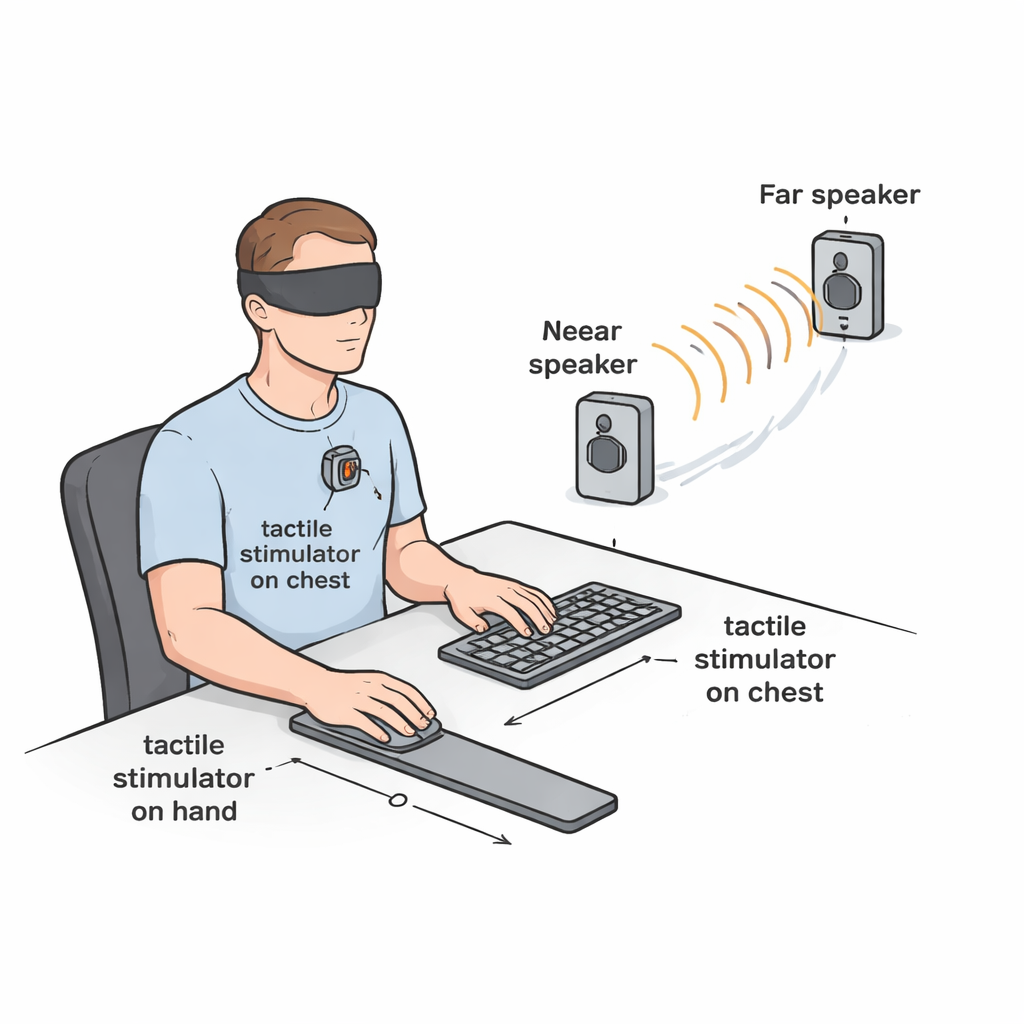
To explore this, the researchers ran two carefully controlled experiments. Volunteers sat blindfolded at a table while faint electrical taps were delivered either to the right index finger or to the center of the chest. At the same time, “pink noise” sounds were played through two speakers placed along a line in front of them. By gradually increasing sound volume at the near speaker and decreasing it at the far one, the team created the illusion of a sound source moving toward the body; reversing this produced a sound moving away. Participants had a simple task: press a key with the left hand as soon as they felt a tap. In some blocks they kept the right hand still. In others, they moved a computer mouse smoothly forward and back along the table while the sounds played, mimicking an everyday reaching motion.
When being still sharpens touch
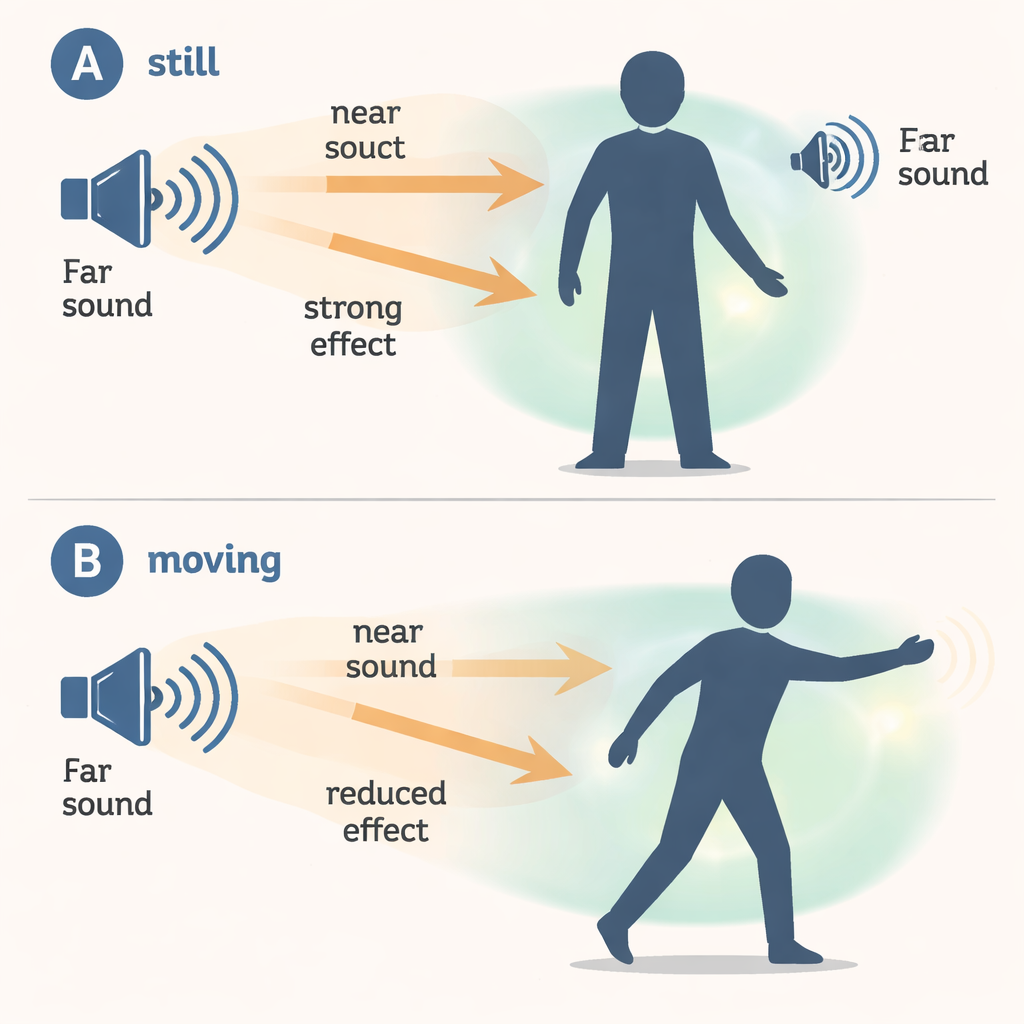
Across both experiments, the pattern was clear when people were not moving. When an approaching sound was perceived as close to the body, participants responded faster to a tap than when the same sound seemed farther away. This speeding up appeared both when the tap was on the hand and when it was on the trunk, showing that nearby looming sounds generally heighten touch in near space. The researchers also took care to rule out a simple timing explanation: people naturally expect events more as time passes. By comparing conditions that were matched in timing but differed in sound distance and direction, they showed that the improvement really depended on the sound being near and approaching, not just on when it occurred.
Movement blurs the advantage of near sounds
The picture changed once participants moved their arm. During movement, overall touch responses became slower, and—crucially—the special boost for taps paired with nearby approaching sounds largely disappeared. Reaction times no longer differed reliably between near and far sounds, whether the tap was given on the moving hand or the still chest. Analyses of how reaction times changed with sound distance showed that, while looming sounds produced a clear near–far difference when people were still, this near–far slope flattened during movement. Because the reduction appeared for both the moving and non-moving body sites and at modest arm speeds, the authors argue it cannot be explained just by local “gating” at the moving limb’s nerves. Instead, it points to a more global adjustment in the brain’s handling of sensory information whenever we are actively moving.
What this means for everyday life and technology
These findings suggest that the brain does not simply add up information from sound and touch in a fixed way. Instead, when we move, it seems to dampen how strongly nearby approaching sounds sharpen touch across the body, perhaps to avoid overload from the flood of signals that our own actions create. In everyday terms, our protective near space becomes less sharply tuned by sound while we are in motion. Understanding this dynamic coordination between movement and multisensory processing could help design better rehabilitation exercises, safer human–machine interfaces, and assistive systems for people—such as blind individuals—who rely heavily on sound and touch to navigate the world.
Citation: Piero, L., Nafiseh, S. & Matteo, C. Somatotopy-independent reduction of audio-tactile intersensory facilitation for looming sounds within the peripersonal space during arm movements execution. Sci Rep 16, 7133 (2026). https://doi.org/10.1038/s41598-026-36796-5
Keywords: peripersonal space, multisensory integration, looming sounds, tactile perception, movement and sensation